
Katherine Johnson: mathematician who helped navigate early U.S. spaceflight
Profile of Katherine Johnson (1918–2020), African American mathematician whose trajectory calculations at NACA/NASA helped enable early human spaceflight and who received the Presidential Medal of Freedom.
Katherine Coleman Goble Johnson (August 26, 1918 – February 24, 2020) was an American mathematician whose calculations were instrumental to early U.S. human spaceflight. Trained in advanced mathematics, she worked for the National Advisory Committee for Aeronautics (NACA) and later the National Aeronautics and Space Administration (NASA). Her precise hand computations and later work with electronic computers supported orbital mechanics, reentry paths and navigation that helped convert theoretical plans into successful missions.
Image gallery
8 Images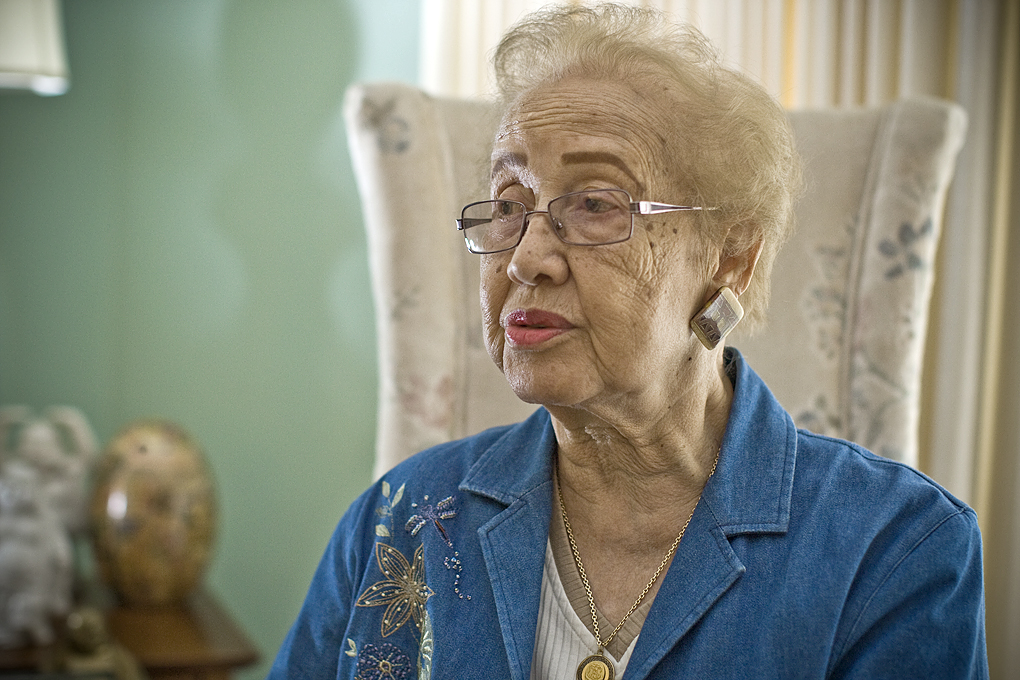


Education and early career
Johnson showed academic ability at a young age and completed secondary and college studies earlier than most of her peers. She graduated from West Virginia State College (a historically Black college) with strong marks in mathematics and went on to teach before entering government service. Her grounding in analytical methods and numerical techniques prepared her for work on applied problems in aeronautics and astronautics.
Work at NACA/NASA and technical contributions
At the Langley Research Center, Johnson joined a group informally known as "computers"—mathematicians who performed the calculations needed for aircraft and spacecraft design. She became especially known for her expertise in orbital mechanics and celestial navigation, converting physical constraints into solvable numerical procedures. Her computations supported early crewed missions, including those involving Alan Shepard and John Glenn. In a well-known episode of the Mercury program, Glenn asked that Johnson personally verify the electronic computer's numbers before he orbited the Earth, reflecting trust in her work.
Scope and documented work
Over her career Johnson contributed to a range of programs. She helped derive trajectories and windows for launch and reentry, participated in analyses used during the Apollo lunar program and assisted development work for later systems such as the Space Shuttle. She also worked on planning concepts for missions farther afield, including studies related to a proposed mission to Mars. Her name appears on technical reports produced by the laboratory—she is credited with authoring or coauthoring more than two dozen research publications and was the first woman invited to sit in an editorial meeting at the center, a notable step in professional inclusion.
Recognition and legacy
Johnson's career received renewed public attention late in her life. In 2015 she was awarded the Presidential Medal of Freedom by the U.S. president (Presidential Medal of Freedom). Media and cultural profiles highlighted her role in the space program, and she was named in the BBC listing of 100 Women. Her story has been cited in discussions of civil rights, women in STEM, and the evolution of computing from hand calculation to electronic methods.
- Notable facts: Johnson authored roughly 26 technical reports and papers, and she is credited with pioneering work that bridged manual and electronic computation methods.
- She worked at the Langley facility on programs that paved the way for lunar missions such as Apollo 11 and for understanding return trajectories from the Moon.
- Her later years were spent in Newport News, where she died at age 101; local references note Newport News and her long connection to Virginia.
Katherine Johnson's work is an example of how detailed mathematical practice underpins high‑risk engineering projects. Her combination of formal mathematical training, meticulous computation and willingness to engage with emerging electronic tools made her contributions enduring in the history of space exploration. She remains a reference point in conversations about access, recognition and the roles of women and minorities in science and engineering.
Related articles
Author
AlegsaOnline.com Katherine Johnson: mathematician who helped navigate early U.S. spaceflight Leandro Alegsa
URL: https://en.alegsaonline.com/art/123396
Sources
- nasa.gov : "Katherine Johnson Biography"
- nasa.gov : "Katherine Johnson: The Girl Who Loved to Count"
- biography.com : "Katherine G. Johnson Biography"
- docs.google.com : "Google Docs - create and edit documents online, for free"
- wtkr.com : Local hero, NASA mathematician Katherine Johnson dies at 101
- wikidata.orgQ11740.html : wikidata.orgq11740.html
- authority.bibsys.no : 1488830536072
- cantic.bnc.cat : a19957361
- d-nb.info : 1128107163
- id.loc.gov : n79016663
- aleph.nkp.cz : xx0212139
- uli.nli.org.il : 004898503
- snaccooperative.org : w6mh8cc3
- idref.fr : 200203649
- viaf.org : 928148997583759870001