
K. Alex Müller (Karl Alexander Müller)
Swiss physicist Karl Alexander Müller, Nobel laureate (1987) noted for discovering high-temperature superconductivity in ceramic materials with Georg Bednorz and for advancing condensed-matter research.
Overview
K. Alex Müller (Karl Alexander Müller, born April 20, 1927) is a Swiss physicist best known for the 1986 discovery of superconductivity in certain ceramic materials, work that earned him and Georg Bednorz the Nobel Prize in Physics in 1987. Their finding marked a major turning point in condensed-matter physics by demonstrating superconductivity at higher temperatures in copper-oxide ceramics.
Image gallery
4 Images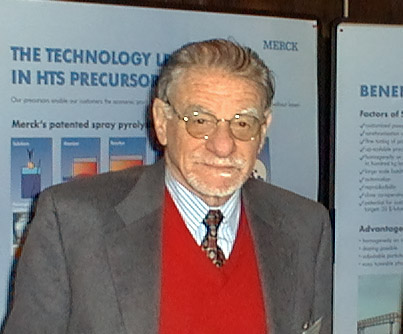


Research and discovery
Müller collaborated with Georg Bednorz on experiments with oxide ceramics, exploring electrical and magnetic properties of complex materials. They reported their results in the June 1986 issue of Zeitschrift für Physik B, showing that particular ceramic compounds could enter a superconducting state. This class of materials, commonly referred to as cuprates, sparked intense global research into high-temperature superconductivity and prompted new theoretical and experimental efforts to understand pairing mechanisms beyond conventional metals.
Career and positions
Following his studies, Müller joined the Battelle Memorial Institute in Geneva, where he became manager of a magnetic resonance group. During his time there he also served as a lecturer at the University of Zürich. His professional path combined laboratory leadership, teaching, and collaborative research that bridged basic physics and materials science. For more on his career milestones see relevant biography.
Impact and applications
The discovery of superconductivity in ceramic materials broadened the search for practical superconductors and influenced the development of magnetic devices, sensors, and studies of quantum materials. Although many practical engineering challenges remain for widespread use of high-temperature superconductors, Müller and Bednorz’s work accelerated efforts in thin films, wires, and electronic applications and reshaped research priorities in solid-state physics. Additional resources are available at further readings.
Recognition and notable facts
- Shared the 1987 Nobel Prize in Physics with Georg Bednorz for the discovery of superconductivity in ceramic materials.
- Their 1986 publication in Zeitschrift für Physik B triggered a wave of rapid discoveries and subsequent Nobel-level attention to high-temperature superconductivity.
- Müller combined experimental spectroscopy and materials synthesis approaches during his career.
For archival materials and institutional records related to Müller's work see institutional sources. His contributions remain a foundational chapter in modern condensed-matter physics.
Related articles
Author
AlegsaOnline.com K. Alex Müller (Karl Alexander Müller) Leandro Alegsa
URL: https://en.alegsaonline.com/art/123315
Sources
- ui.adsabs.harvard.edu : 1986ZPhyB..64..189B
- doi.org : 10.1007/BF01303701