
Karl Ernst von Baer
Karl Ernst von Baer (1792–1876) was a Baltic German naturalist and pioneer of embryology whose research shaped developmental biology and who helped found scientific institutions in the Russian Empire.
Karl Ernst von Baer (1792–1876) was a Baltic German scientist active in the Russian Empire, widely regarded as one of the founders of comparative embryology. His work combined careful observation with comparative anatomy, and he helped build scientific institutions in St. Petersburg and beyond. His Russian name and transliterations are discussed in historical sources: Russian form of his name.
Image gallery
8 Images

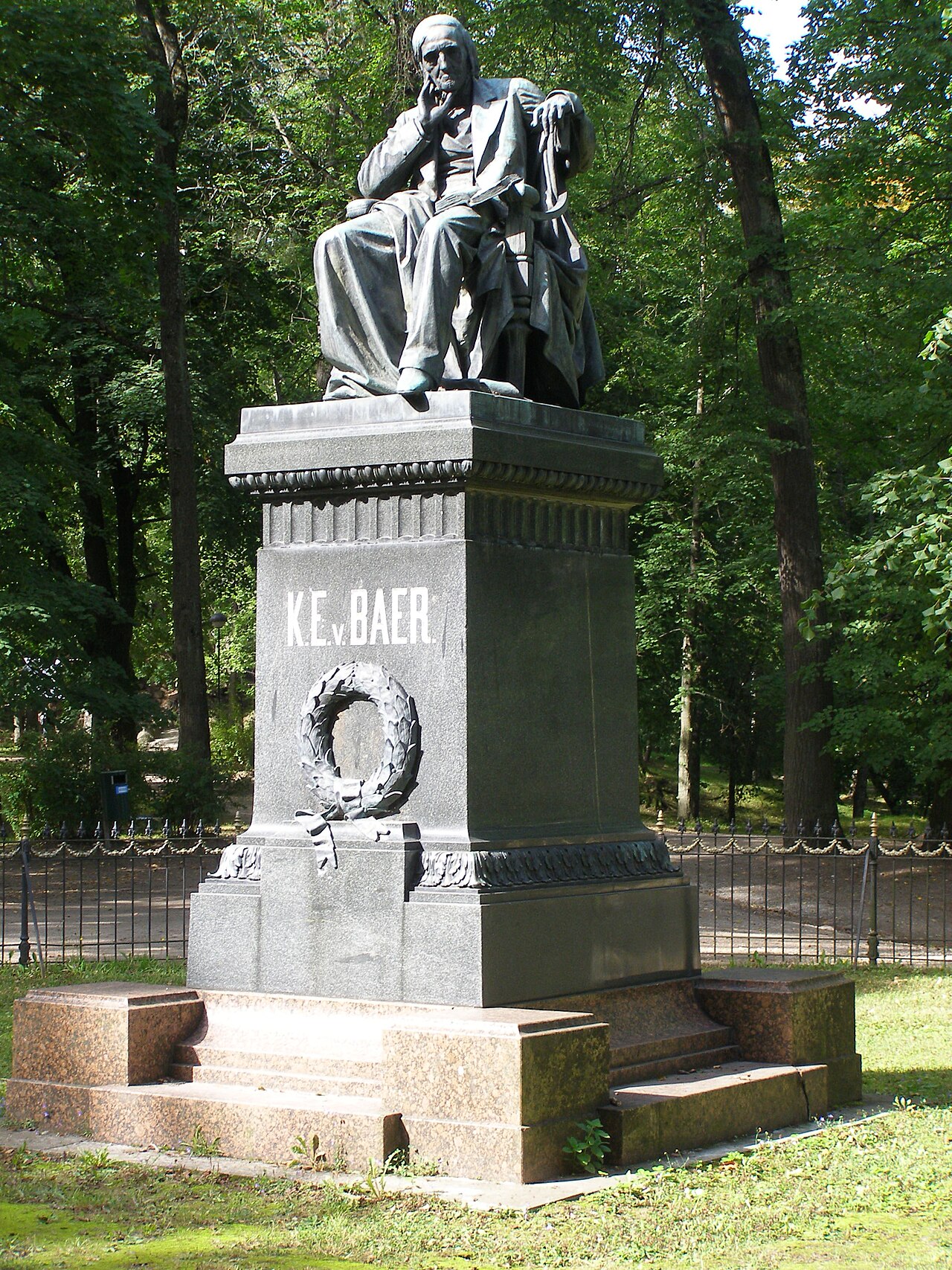


Life and career
Baer was born in the late 18th century in what is now Estonia and carried out much of his career within the structures of the Russian Empire; records of his life are sometimes given with old-style dates. He trained in natural history and medicine, and later held curatorial and academic posts that put him at the center of zoological and anatomical research. Over a long career he combined fieldwork, museum curation and laboratory study, and he was an active member of learned societies.
Scientific contributions and methods
Baer is best known for establishing principles of animal development through comparative study of embryos. Working across groups of animals, he emphasized systematic description of stages and the idea that embryonic development proceeds from general structures to those that are specific to each group. He discovered and described key features of mammalian reproduction and brought attention to the germ-layer organization that underlies later organ formation. His methods stressed direct observation, detailed illustration and cross-species comparison.
Fields of work
- Biology — comparative anatomy, reproductive biology and embryology.
- Geography and exploration — mapping and natural-history collecting in northern regions.
- Embryology — foundational descriptions and conceptual laws about development.
- Meteorology, geology and natural history more broadly, reflecting the polymathic careers of 19th-century naturalists.
Exploration, institutions and influence
Baer took part in expeditions and surveys across European Russia and parts of Scandinavia, collecting specimens and making geological and geographical observations. He helped found or lead scientific organizations: he was a prominent member of the Russian Academy of Sciences, a co‑founder of the Russian Geographical Society and served as the first president of the Russian Entomological Society. These roles made him an important institutional figure who promoted research, collections and scientific communication in the region.
Legacy and significance
Von Baer’s influence is felt most strongly in developmental and comparative biology. His generalization that embryos develop from the general to the particular shaped later thinking about patterns of development and evolution and provided a corrective to simplistic recapitulation ideas. Several concepts and historical discussions in embryology reference his laws and observations. Beyond theory, his work on museums, societies and field exploration helped professionalize natural science in the Russian Empire and connected local research to wider European debates.
Notable facts about Baer include his broad range of interests across natural sciences, his role as a bridge between Baltic German and Russian scientific communities, and his enduring reputation as a careful observer whose comparative approach remains central to developmental biology and the history of science.
Questions and answers
Q: Who was Karl Ernst Ritter von Baer?
A: Karl Ernst Ritter von Baer was an Estonian scientist and explorer who was a founding father of embryology.
Q: What was Karl Ernst Ritter von Baer's full name?
A: Karl Ernst Ritter von Baer's full name was Karl Ernst von Baer, Edler von Huthorn.
Q: What was Karl Ernst Ritter von Baer known as in Russia?
A: In Russia, Karl Ernst Ritter von Baer was known as Karl Maksimovich Baer.
Q: What were Karl Ernst Ritter von Baer's areas of expertise?
A: Karl Ernst Ritter von Baer was an expert in natural science, including biology, geology, meteorology, and geography.
Q: What was Karl Ernst Ritter von Baer's role in Russian academia?
A: Karl Ernst Ritter von Baer was a member of the Russian Academy of Sciences, a co-founder of the Russian Geographical Society, and the first president of the Russian Entomological Society.
Q: Where did Karl Ernst Ritter von Baer explore?
A: Karl Ernst Ritter von Baer explored European Russia and Scandinavia.
Q: When did Karl Ernst Ritter von Baer live?
A: Karl Ernst Ritter von Baer lived from February 28, 1792, to November 28, 1876.
Related articles
Author
AlegsaOnline.com Karl Ernst von Baer Leandro Alegsa
URL: https://en.alegsaonline.com/art/123321
Sources
- reproduction-online.org : "An historical look at embryo transfer"
- doi.org : 10.1530/jrf.0.0620001
- hektoeninternational.org : "Evolution from recapitulation theory to Neural Darwinism"
- wikidata.orgQ57190.html : wikidata.orgq57190.html
- authority.bibsys.no : 90329132
- catalogo.bne.es : XX1168777
- catalogue.bnf.fr : cb12349129z
- data.bnf.fr : (data)
- ipni.org : Baer
- biografischportaal.nl : 42356889
- cantic.bnc.cat : a11211775
- uni-stuttgart.de : 223
- d-nb.info : 118505831
- isni.org : 0000 0001 1470 7654
- id.loc.gov : n50026054