
John Carmack: Game Programmer and Graphics Pioneer
John Carmack (born 1970) is a pioneering video game programmer, co‑founder of id Software, lead developer of early 3D shooters and influential contributor to graphics engines, VR and hobbyist rocketry.
Overview
John D. Carmack II is an American programmer and engineer widely regarded for his foundational work in real‑time 3D graphics and game engine development. Born on August 20 of 1970, he rose to prominence through a combination of low‑level optimization, careful algorithm design and a practical, performance‑first engineering ethos. His contributions helped transform interactive entertainment into a technically demanding medium and influenced how graphics software is built and taught.
Image gallery
5 Images



Early life and formation of id Software
Carmack showed early interest in programming and graphics. In the late 1980s and early 1990s he and several collaborators began building technology and games that would culminate in the formation of id Software. The company, founded in 1991, became a crucible for experimentation with real‑time rendering, level editing and networking. These efforts occurred amid the broader growth of the video games industry and the emergence of new hardware capable of supporting immersive 3D experiences.
Major games and engines
Carmack was the principal programmer on a series of influential titles that defined the modern shooter. He worked on early work exemplifying the first-person shooter format and is credited with writing or directing the low‑level engine code for several landmark releases, notably Wolfenstein 3D, Doom and Quake. These projects introduced innovations such as fast software rasterizers, well‑designed networking stacks for multiplayer, modifiable game data and modular engine architectures that could be reused across titles.
- Wolfenstein 3D — helped popularize the immersive corridor shooter and demonstrated aggressive performance optimization for the hardware of the time.
- Doom — expanded level design, modding and networked multiplayer, and became a cultural touchstone for 1990s PC gaming.
- Quake — moved to fully three‑dimensional worlds and engines, influencing later real‑time lighting and shader development.
Technical approach and engineering philosophy
Carmack emphasized simplicity, measurable gains and pragmatic algorithm choices. His techniques included careful use of fixed‑point arithmetic early on, bespoke visibility and collision routines, strong attention to cache and memory behavior, and extensive profiling. He favored releasing engine code and technical notes to the community, fostering learning and reuse: many developers cited his published engines and talks as primary learning resources for graphics and systems programming.
Later career and other projects
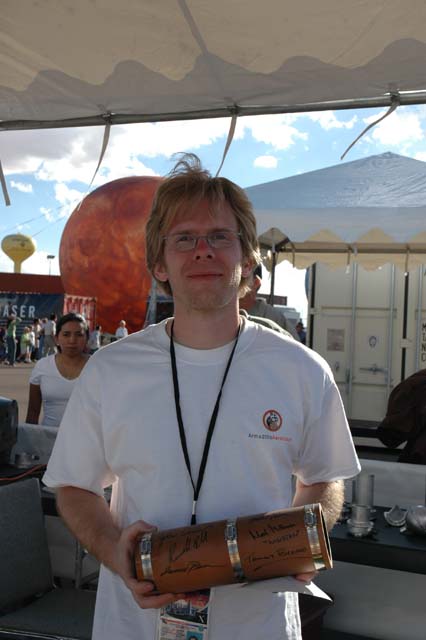
Beyond id Software’s game work, Carmack pursued a variety of engineering interests. He founded a small aerospace effort for hobbyist rocketry, applying iterative engineering practices and rapid prototyping. In the 2010s he shifted much of his attention to virtual reality, accepting a role at a VR company where he worked on low‑latency rendering and system optimization. Over time his public activities mixed research, product engineering and advisory roles, while he continued to speak at conferences and publish technical writing.
Recognition and influence
Carmack’s technical achievements earned him recognition both inside and outside the games community. In 1999 he was listed by TIME among a group of influential technology figures, appearing on that magazine’s technology list. In 2006 he was honored on a commemorative Walk celebrating important contributors to interactive entertainment. His influence is visible in the continued use of engine‑style modularity, the openness of some engine codebases and the broad interest in high‑performance, low‑level programming techniques.
Personal life
Carmack’s personal life has also been noted in profiles: he married Katherine Anna Kang in January 2000, and the couple has a son born on August 13, 2004. While private about family matters, Carmack has publicly discussed how personal projects and family life influence his priorities and time for technical pursuits.
Legacy and further reading
John Carmack remains a significant figure for students of computer graphics, systems programming and game development. His published engines, recorded talks and technical essays continue to serve as practical learning resources. For readers seeking primary material, many of his public presentations and code releases are preserved in community archives and technical repositories; these sources illuminate both historical milestones and enduring engineering practices in the field of interactive graphics.
Related articles
Author
AlegsaOnline.com John Carmack: Game Programmer and Graphics Pioneer Leandro Alegsa
URL: https://en.alegsaonline.com/art/122384
Sources
- time.com : time.com