
Jalal Talabani: Kurdish leader and President of Iraq (1933–2017)
Jalal Talabani was a Kurdish politician who founded the Patriotic Union of Kurdistan, served as Iraq’s president (2005–2014), and played a central role in Kurdish and Iraqi politics after Saddam Hussein’s fall.
Overview
Jalal Talabani (12 November 1933 – 3 October 2017) was a prominent Kurdish politician and statesman who helped shape modern Iraqi politics. He founded the Patriotic Union of Kurdistan (PUK) and later served as President of Iraq from 2005 to 2014, becoming the first holder of the presidency from a non-Arab background in the post-2003 political order. His career spanned decades of Kurdish activism, armed struggle, and negotiated politics during periods of intense change across Iraq and the region. More on his origins.
Image gallery
5 Images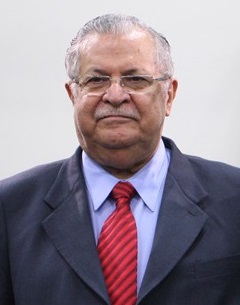


Early life and education
Talabani was born in 1933 in Kelkan in what is today northern Iraq. He studied in Baghdad, where he attended university and entered political life amid the turbulent mid-20th century Iraqi scene. These formative years exposed him to pan-Arab and Kurdish political movements as Iraq moved through coups, monarchy abolition, and shifting governments that affected minority politics and regional autonomy.
Political career and the PUK
In the 1970s Talabani coalesced Kurdish political forces into the Patriotic Union of Kurdistan, a party that combined armed resistance, political organizing, and negotiation. The PUK positioned itself as a social-democratic and pragmatic force within Kurdish politics and frequently negotiated with rival Kurdish factions over leadership and territorial administration. Talabani also served on interim and transitional bodies after the fall of Saddam Hussein, taking part in the process of rebuilding Iraqi institutions following the 2003 invasion. Some of these events are connected to the wider removal of the Saddam Hussein regime. Saddam Hussein era and 2003 invasion.
Presidency and national role
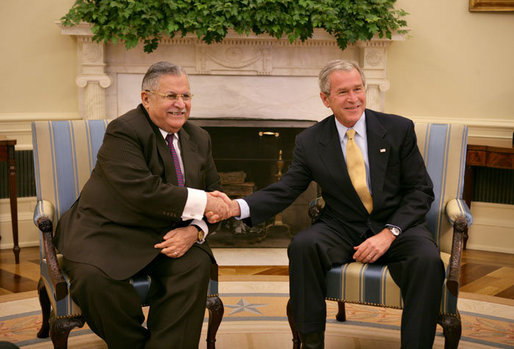
After the 2003 transition, Talabani emerged as a consensus figure acceptable to multiple communities and was elected president by the Iraqi National Assembly in 2005. During his presidency he worked to mediate between Baghdad and the Kurdistan Region, to promote federal arrangements, and to help stabilize post-war institutions. His tenure coincided with debates over oil revenue sharing, territorial disputes, and the balance between central and regional authority in Iraq.
Languages, affiliations and personal life
Talabani was widely reported to speak Kurdish as his mother tongue and to be fluent in several other languages, which helped his role as a regional interlocutor: Kurdish, Arabic, Persian, and English.
- Native language: Kurdish
- Arabic proficiency: Arabic
- Persian proficiency: Persian
- English proficiency: English
Health, death and legacy
In December 2012 Talabani suffered a major stroke and was treated in Baghdad before traveling to Germany for further care. His health remained a subject of public attention in the years that followed. He died in Berlin on 3 October 2017 from complications related to a cerebrovascular event. Medical reports and coverage of his death noted his long struggle with the consequences of the stroke and treatment in Germany. Berlin hospital reports.
Significance
Talabani is remembered as a key Kurdish leader who moved between armed resistance and institutional politics, and as an Iraqi president who embodied the fragility and possibilities of multiethnic governance after authoritarian rule. His political life illustrates the interplay between regional autonomy, national reconciliation, and international diplomacy in Iraq’s modern history.
Related articles
Author
AlegsaOnline.com Jalal Talabani: Kurdish leader and President of Iraq (1933–2017) Leandro Alegsa
URL: https://en.alegsaonline.com/art/121233
Sources
- chinadaily.com.cn : "Iraq's president appoints Shiite as prime minister"
- socialistinternational.org : XXIII Congress of the Socialist International, Athens. SPEECH OF H.E. JALAL TALABANI, PRESIDENT OF THE REPUBLIC OF IRAQ, 2008.
- huffingtonpost.com : "Jalal Talabani, Iraq President, Suffers Stroke"
- bbc.co.uk : "Iraqi President Jalal Talabani 'in coma after stroke'"
- aljazeera.com : "Iraq President Talabani stable after stroke"
- guardian.co.uk : "Iraqi president Jalal Talabani flies to Germany for stroke treatment"
- bbc.co.uk : "Iraq's Jalal Talabani arrives in Germany for treatment"
- worldnews.nbcnews.com : "Iraq's President Talabani leaves for treatment in Germany after stroke"
- hurriyetdailynews.com : "Iraq Presidential Office publishes pictures showing ailing Jalal Talabani recovering from stroke"
- worldbulletin.net : Former Iraqi President Talabani dies at 83