
Blackburn Buccaneer B-103 — British carrier-capable strike aircraft
Cold War-era British low-level strike aircraft designed for naval operations. Introduced in 1962, later flown by the RAF, notable for an internal rotating weapons bay, split rudder airbrake and carrier safety features.
Overview
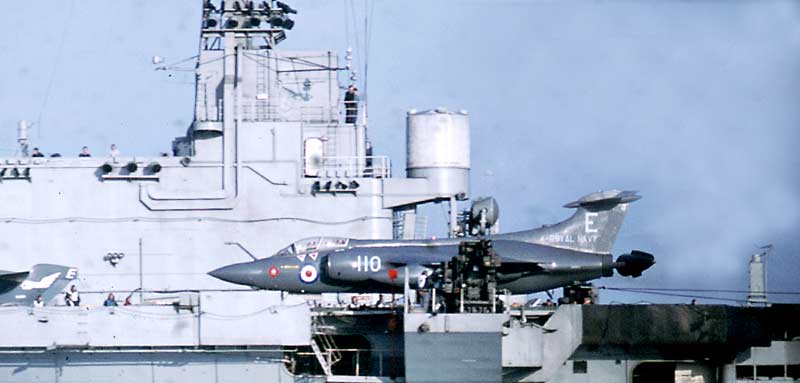
The Blackburn Buccaneer B-103 was a British low-level, carrier-capable strike aircraft developed in the 1950s and introduced into service in the early 1960s. Designed primarily to operate from Royal Navy carriers, it combined sturdy construction and aerodynamic refinements to deliver weapons at low altitude against maritime and land targets. In 1968 the type also entered service with the Royal Air Force, extending its role beyond pure naval strike duties.
Image gallery
10 Images



Design and notable features
The Buccaneer emphasized survivability and weapon delivery in demanding environments. Its design featured a large internal weapons bay that reduced drag and improved low-level performance, an arrangement sometimes described as a rotating or stowage magazine for either conventional or nuclear ordnance. The airframe incorporated measures to improve ditching and buoyancy when operating from carriers, and a distinctive split rudder that could be used as an airbrake to increase drag during steep descents or landing approaches.
Characteristics
- Carrier-capable layout with robust structure and folding surfaces for hangar stowage.
- Internal weapons bay to carry a mix of stores while preserving aerodynamic cleanliness.
- Twin-jet propulsion arranged for good low-level speed and stability.
- Control features such as the split rudder airbrake and systems to enhance buoyancy for maritime operations.
History and service
After development and flight trials the type was ordered for the Royal Navy and first entered operational service in 1962. The type later joined the Royal Air Force for continued strike and maritime roles following reductions in carrier strength. Throughout its career the Buccaneer underwent upgrades to avionics and weapons integration, maintaining frontline status into the 1980s and early 1990s until retirement in 1994.
Operational use and conflicts
The Buccaneer performed maritime strike, reconnaissance and interdiction missions. It was capable of delivering both conventional and nuclear ordnance, as reflected in its internally stowed rotating weapons bay. Notably, Buccaneers deployed in coalition operations during the 1991 Gulf War, where they were used in precision strike and maritime support roles. The type also attracted interest overseas and saw export and second-service applications.
Legacy and distinctions
The Buccaneer is remembered for solving several specific operational challenges of carrier strike aviation: long-range low-level performance, compact stowage of weapons, and innovations such as a split rudder that doubled as an airbrake. Its combination of naval pedigree and later RAF adaptation illustrates Cold War flexibility in British military aviation. For further institutional and technical context see references to the naval service, the United Kingdom defence environment, discussion of the split rudder concept, materials on the nuclear and conventional carriage arrangements, and operational summaries at Gulf War repositories.
For more detailed technical and historical accounts consult specialist monographs and archival sources via institutional links such as Royal Navy records and air force histories at RAF collections.
Related articles
Author
AlegsaOnline.com Blackburn Buccaneer B-103 — British carrier-capable strike aircraft Leandro Alegsa
URL: https://en.alegsaonline.com/art/11993