
Bleeding Kansas: the violent struggle over slavery in the 1850s
Bleeding Kansas refers to the mid‑1850s armed and political conflict in the Kansas Territory over slavery, a violent prelude to the American Civil War that shaped national politics and local communities.
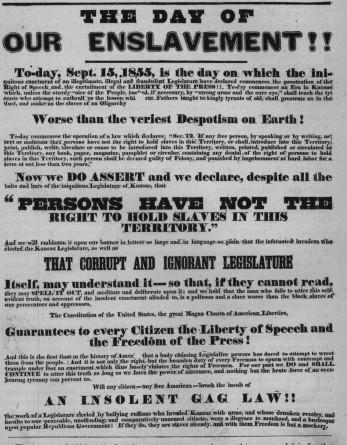
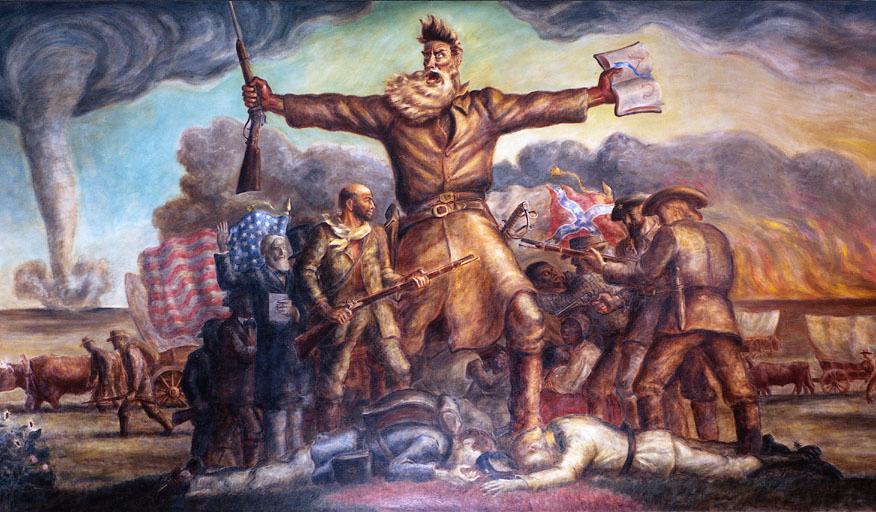
Bleeding Kansas describes the period of armed confrontation and political turmoil in and along the border of the Kansas Territory in the mid to late 1850s. The phrase was applied to a series of clashes between rival settlers and outside partisans drawn to the region by the question of whether slavery should be permitted in the new territory. Observers at the time called it a border war and commentators later framed it as a preview of the larger conflict that would engulf the nation.
Image gallery
8 Images




Legal background and causes
The immediate cause of the fighting was the repeal of earlier compromises by the Kansas–Nebraska Act, which left the question of slavery to local decision by "popular sovereignty." That change overturned legal expectations about the spread of slavery and encouraged organized migration by groups seeking to influence the outcome. Settlers from neighboring Missouri, anti‑slavery emigrants from the North and native territorial residents converged on Kansas, turning political contests into armed confrontations along the border.
Factions, leaders and methods
Three broad alignments competed for control: those who favored allowing slavery (commonly called pro‑slavery), those who opposed slavery outright (often organized as abolitionists), and free‑staters who sought Kansas as a non‑slave state without necessarily identifying with every abolitionist program. Fighters included locally based militias, informal raiding parties known in some accounts as "Border Ruffians," and committed militants who crossed state lines to join clashes. The conflict involved raids, burnings, partisan skirmishes and episodes of summary violence that made national headlines.
Notable incidents
- The attack on several free‑state settlements and the sacking of a town that had been a center of anti‑slavery organizing.
- A series of killings and reprisals on both sides that inflamed public opinion and prompted federal intervention.
- Guerrilla engagements and small battles that spread from the territory into neighboring areas, sometimes drawing in activists from distant states.
Contemporary observers and later historians used vivid language to describe the period. Some labeled it an ugly war marked by violence and moral confrontation. The popular term "Bleeding Kansas" was popularized by newspaper commentary and by figures such as Horace Greeley of the New York Tribune, who highlighted the region's turmoil as a matter of national concern.
Consequences and legacy
The turmoil in Kansas had important political consequences. It hardened sectional lines, contributed to the formation and rise of political organizations opposed to the expansion of slavery, and became a rallying point for activists in both North and South. The disputes foreshadowed the American Civil War and helped set the terms of debate about statehood and federal authority. When Kansas was eventually admitted as a state, the outcome and the memory of the conflict influenced how communities remembered the contest over slavery and how later generations understood the causes of national war.
Today Bleeding Kansas is studied as an episode that demonstrates how legal changes, mass migration, and polarized political movements can produce localized violence with wide national repercussions. Its history is preserved in primary accounts, local records and continuing historical interpretation that emphasizes both the moral stakes and the human costs of violent political struggle.
Questions and answers
Q: What was Bleeding Kansas?
A: Bleeding Kansas was a border war on the Kansas-Missouri border that started with the Kansas–Nebraska Act of 1854 and continued into the American Civil War (1854–1861). It was an ugly war between groups of people who had strong beliefs about slavery.
Q: Who coined the term "Bleeding Kansas"?
A: The term "Bleeding Kansas" was first coined by Horace Greeley of the New York Tribune.
Q: When did Bleeding Kansas take place?
A: Bleeding Kansas took place during the mid to late 1850s.
Q: What were the three different groups fighting for power in Kansas at this time?
A: The three different groups fighting for power in Kansas at this time were those who were pro-slavery, abolitionists and free-staters.
Q: How did Bleeding Kansas relate to events leading up to the American Civil War?
A: Bleeding Kansas, fought over the issue of slavery, was a precursor of events to come in the American Civil War.
Q: What caused BleedingKansas?
A: The cause of BleedingKansas was due to disagreements over slavery which began withthe passageoftheKansas–NebraskaActof1854.
Related articles
Author
AlegsaOnline.com Bleeding Kansas: the violent struggle over slavery in the 1850s Leandro Alegsa
URL: https://en.alegsaonline.com/art/12140
Sources
- nps.gov : "Bleeding Kansas"
- legendsofamerica.com : "Bleeding Kansas"
- u-s-history.com : "Bleeding Kansas"
- kshs.org : "Bleeding Kansas"
- historynet.com : "Causes Of The Civil War"
- eyewitnesstohistory.com : "The Sack of Lawrence, Kansas, 1856"
- kshs.org : "How Bloody Was Bleeding Kansas?"
- homesteadontherange.com : "The Four Kansas Constitutions: Topeka"
- homesteadontherange.com : "The Four Kansas Constitutions: Lecompton"
- homesteadontherange.com : "The Four Kansas Constitutions: Leavenworth"
- homesteadontherange.com : "The Four Kansas Constitutions: Wyandotte"