
Empedocles: philosopher of the four elements and the forces of Love and Strife
Empedocles, a 5th-century BCE thinker from Agrigentum, proposed the four classical elements and the twin powers Love and Strife, composed philosophical poetry, and influenced later natural and ethical thought.
Overview
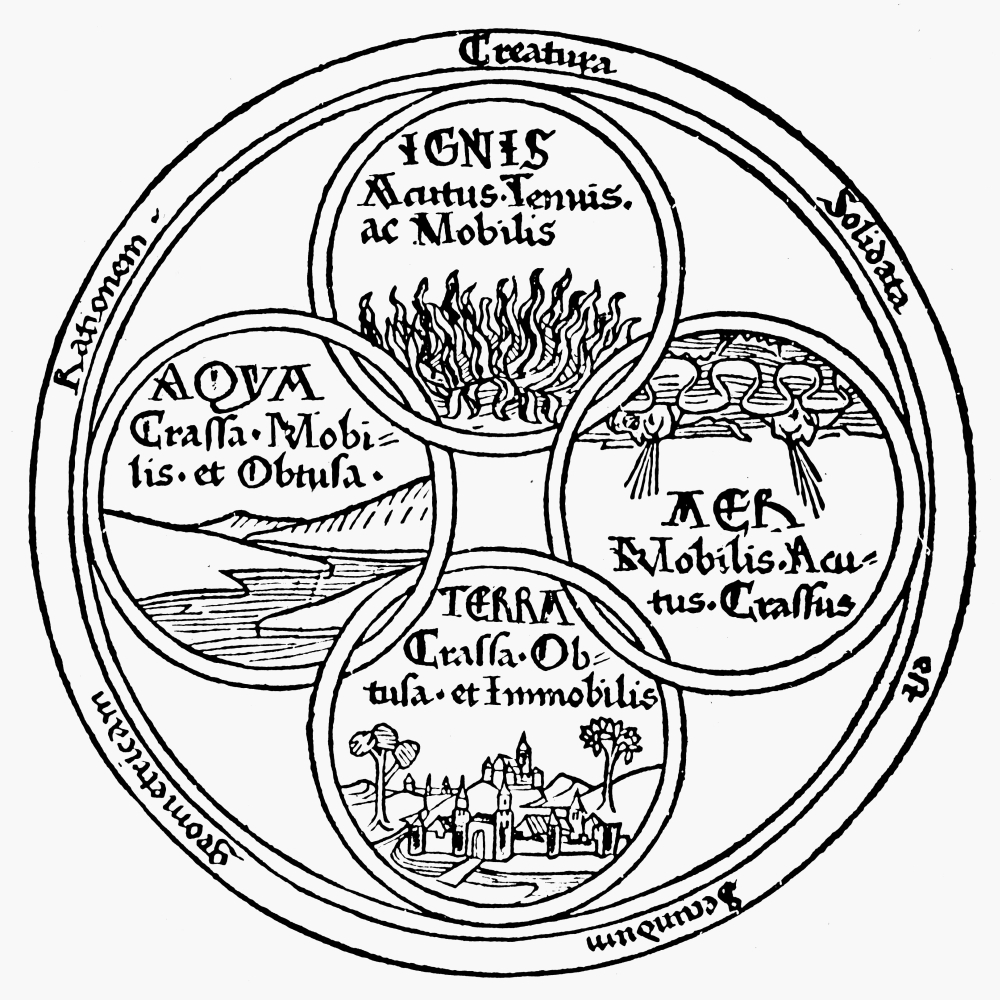
Empedocles was a pre-Socratic philosopher and poet who lived in the Greek city of Agrigentum (Akragas) in Sicily during the fifth century BCE. He is best known for introducing a fourfold elemental theory — earth, air, fire, and water — combined with two cosmic forces, Love and Strife, that alternately mix and separate those elements. Much of what we have of Empedocles survives only in fragments of his verse, but those fragments preserve a distinctive blend of physical speculation, religious teaching and moral reflection.
Image gallery
6 Images


Core doctrines
Empedocles framed physical and biological processes within a cyclical cosmology. His principal claims include:
- Four roots (elements) — earth, air, fire and water operate as irreducible constituents of the physical world.
- Love and Strife — two opposing forces that cause combination and separation of the elements, driving cosmic cycles of unity and division.
- Cosmic cycles — the world undergoes repeated phases in which Love predominates (bringing unity) and Strife predominates (bringing dissolution).
- Biological origins — Empedocles offered early naturalistic accounts of the origin and arrangement of living forms, arguing that body parts could form independently and be combined under favorable conditions.
- Reincarnation and purification — under Pythagorean influence, he taught transmigration of the soul and ethical purification as a religious concern.
Life, works and style
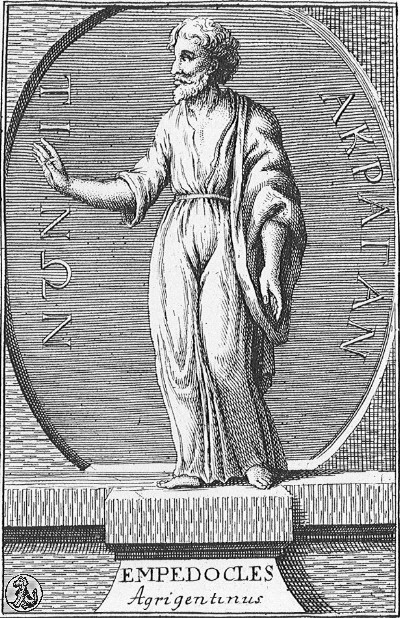
Empedocles wrote his ideas as poetry rather than prose. Two principal poems are often attributed to him: a cosmological poem commonly called "On Nature" and a more religious or initiatory work known as "Purifications" (or similar titles in ancient testimonies). Surviving quotations and fragments are preserved by later authors and provide more textual material for Empedocles than for most other pre-Socratics. His manner combines mythic imagery with attempts at rational explanation, making his fragments a transitional witness between mythic worldview and systematic natural philosophy. He lived and taught in Agrigentum; classical sources mention his interactions with Pythagorean thought and civic life — see historical references to his home at Agrigentum.
Influence and reception
Later Greek thinkers engaged with Empedocles' scheme: his fourfold division influenced the development of elemental theory in classical natural philosophy, and the idea of opposing forces was taken up, adapted or criticized by philosophers including Plato and Aristotle. His reflections on the formation of living things anticipated later debates about the mechanisms of biological organization; historians sometimes note that fragments of his account bear a distant resemblance to later ideas about variation and selection, though he did not formulate a scientific theory of evolution. Empedoclean themes appear in discussions of cosmology and ethics in subsequent centuries, and his belief in reincarnation connected him with continuing religious currents; for discussions of his religious doctrines see works linked at Pythagorean influence and transmigration and studies of cosmological history at cosmogenic accounts.
Notable facts and legacy
Empedocles' death became a subject of legend: ancient sources relate dramatic accounts, including stories that he vanished into a volcano or was removed by the gods — narratives that reflect his later, often mythical reputation. His combination of poetic form and natural speculation made him a distinct figure in the intellectual transition away from mythic explanation toward more abstract theory. Fragments of his poems continue to be studied for their contribution to early science, metaphysics and the history of ideas. For more on his ideas about life and the origins of species, consult introductory materials at empirical and biological fragments.
Summary
Empedocles stands as a pivotal early thinker who fused cosmology, rudimentary natural history and religious ethics. By positing four elemental constituents animated by Love and Strife and by composing his doctrines in verse, he left a complex legacy that influenced both philosophical and literary traditions in the classical world. He remains an important figure for understanding how ancient thinkers sought unified accounts of nature, life and human conduct.
Questions and answers
Q: Who was Empedocles?
A: Empedocles was a Greek pre-Socratic philosopher who lived in Agrigentum, a Greek colony in Sicily.
Q: What is Empedocles' philosophy best known for?
A: Empedocles' philosophy is best known for being the origin of the cosmogenic theory of the four classical elements in the Western world.
Q: What are the powers that Empedocles proposed?
A: Empedocles proposed powers called Love and Strife which would act as forces to bring about the mixture and separation of the elements.
Q: What did Empedocles' physical speculations and history of the universe deal with?
A: Empedocles' physical speculations were part of a history of the universe which also dealt with the origin and development of life.
Q: What doctrine did Empedocles support?
A: Empedocles supported the doctrine of reincarnation, which was influenced by the Pythagoreans.
Q: How is Empedocles' death portrayed in ancient writings?
A: Empedocles' death was mythologized by ancient writers, and has been the subject of a number of literary treatments.
Q: Why is some of Empedocles' work still available today?
A: Some of Empedocles' work is still available today, more so than in the case of any other Presocratic philosopher because he is generally considered the last Greek philosopher to record his ideas in verse.
Related articles
Author
AlegsaOnline.com Empedocles: philosopher of the four elements and the forces of Love and Strife Leandro Alegsa
URL: https://en.alegsaonline.com/art/118485
Sources
- books.google.com : Myth and Philosophy
- mycrandall.ca : Frag. B100
- wikidata.orgQ83375.html : wikidata.orgq83375.html
- authority.bibsys.no : 90248468
- catalogo.bne.es : XX1154313
- catalogue.bnf.fr : cb11929776m
- data.bnf.fr : (data)
- cantic.bnc.cat : a10077601
- ci.nii.ac.jp : DA05811088
- d-nb.info : 118530224
- isni.org : 0000 0003 8281 6072
- id.loc.gov : n79134944
- id.ndl.go.jp : 00620630
- aleph.nkp.cz : jn19981000978
- nla.gov.au : 35064362