
Bismuth(III) nitrate (Bi(NO3)3)
An inorganic nitrate salt of trivalent bismuth used as a laboratory reagent and precursor to bismuth oxides, notable for hydrate formation, hydrolysis to oxynitrates, and applications in materials and catalysis.
Bismuth(III) nitrate is the nitrate salt of trivalent bismuth, commonly written as Bi(NO3)3. It may be described simply as a salt of the element bismuth in the 3+ oxidation state combined with the nitrate anion. In practical chemistry it is encountered in hydrated and basic forms rather than as a single anhydrous molecular species.
Image gallery
1 Image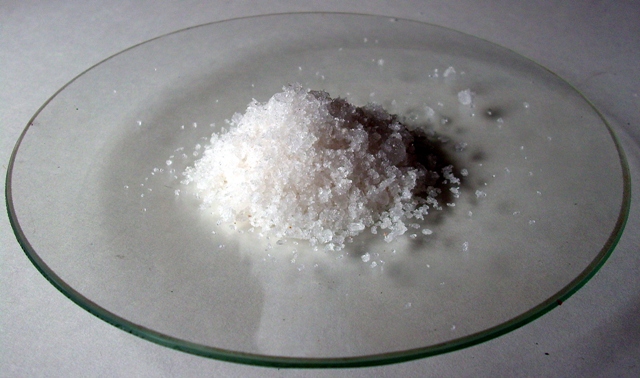
Physical and chemical characteristics
Solid samples are typically pale, white to off-white crystalline materials. The compound often exists as hydrates and polymeric coordination solids; in aqueous media Bi3+ is prone to partial hydrolysis, forming bismuth oxynitrate and related species rather than a persistent simple aquo-ion. On heating, nitrates of bismuth decompose, evolving nitrogen oxides and ultimately yielding bismuth oxides.
Preparation and reactions
Bismuth(III) nitrate is commonly prepared by dissolving bismuth metal or bismuth(III) oxide in nitric acid and evaporating the solution to obtain hydrated nitrates. In chemistry it behaves as a Lewis acid and a source of Bi3+; it hydrolyzes in water and can form basic nitrates and oxynitrates (for example BiONO3) under controlled conditions. Thermal decomposition and acid–base reactions are the primary transformations.
Uses and applications
- Precursor to bismuth oxides and oxide-based materials used in ceramics, pigments, and electronic ceramics.
- Source of Bi3+ in synthesis and research, including preparative inorganic chemistry and materials science.
- Employed as a mild Lewis acid or catalyst in some organic transformations and laboratory procedures.
Safety, handling and notable distinctions
Nitrate salts are oxidizing and should be stored and handled with appropriate precautions; heating can release toxic nitrogen oxides. Bismuth compounds are generally considered less toxic than many other heavy metals, but they should still be treated with standard laboratory protective measures. Distinct from basic bismuth nitrates and bismuth subnitrate, the simple trivalent nitrate functions mainly as a convenient laboratory reagent and precursor rather than a final commercial product.
For further reference on basic concepts related to salts, bismuth chemistry, oxidation states and the nitrate ion see the linked topics: salt, bismuth, oxidation state 3+, and nitrate ion.
Related articles
Author
AlegsaOnline.com Bismuth(III) nitrate (Bi(NO3)3) Leandro Alegsa
URL: https://en.alegsaonline.com/art/11808