
Blister agent (vesicant): effects, history, and uses
Blister agents (vesicants) are chemicals that cause painful burns and blisters on skin, eyes and mucous membranes. This article explains their properties, history, medical uses and safety concerns.
Overview
Blister agents, also called vesicants, are a class of chemical compounds that damage living tissues by producing severe irritation, chemical burns and fluid‑filled blisters. Exposure commonly affects the skin, eyes and mucous membranes. The injuries may range from superficial pain and redness to deep tissue damage depending on the agent, concentration and duration of contact. Because of their symptom profile they are often described by clinicians as causing vesication—formation of blisters—and are therefore called vesicants.
Image gallery
3 Images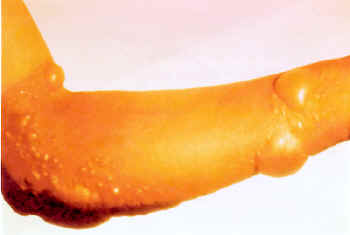

Characteristics and modes of injury
Vesicants act through different chemical mechanisms but share the capacity to destroy cells and provoke inflammation. Typical features include intense pain at the exposure site, delayed onset of visible symptoms in some cases, and the risk of secondary infection where skin integrity is lost. Eye exposure can lead to conjunctivitis, corneal ulceration or vision impairment. Inhalation or ingestion can damage internal mucous membranes and cause severe respiratory or gastrointestinal injury.
History and notable use
Blister agents have been used in conflict and as weapons of terror at various times in modern history. Their use in warfare drew international condemnation and helped lead to treaties restricting chemical weapons. Because of their potential to cause prolonged suffering and long‑term medical complications, most states adhere to conventions that prohibit their production, stockpiling and use.
Medical and civilian uses
Some vesicant chemicals have controlled, therapeutic applications at very small doses or in carefully managed settings. For example, certain agents have been used historically to remove skin growths such as warts or to produce cauterization under medical supervision. Such uses require strict safeguards because accidental exposure can be severe; ingestion or mucosal contact with even small amounts may be life‑threatening.
Prevention, diagnosis and treatment
Early decontamination—removing contaminated clothing and washing affected areas thoroughly—reduces further injury. Medical evaluation focuses on symptom control, wound care to prevent infection, eye protection and respiratory support if inhaled. Long‑term care can include rehabilitation for scarring and chronic pain. Accurate identification of the specific agent, often aided by laboratory tests or exposure history, helps guide treatment and public health responses.
Distinctions and important cautions
- Vesicants differ from irritants and choking agents by producing blistering and tissue necrosis rather than only transient irritation or airway constriction.
- Some authorized medical uses exist, but therapeutic benefit depends on dose and context; unsupervised use is dangerous.
- International law restricts development and deployment of blister agents due to humanitarian concerns.
For more general definitions and clinical guidance, see related resources on chemical hazards: symptoms and signs, skin exposure, eye safety, and chemical burns. Additional information covers the clinical presentation of blisters after exposure, their historical use in chemical warfare, and narrowly controlled medical applications such as wart removal under supervision wart treatment.
Questions and answers
Q: What is a blister agent?
A: A blister agent is a chemical compound that causes severe pain on the skin, in the eyes, and in the mucus membranes.
Q: Can blister agents cause chemical burns on the inside of the body?
A: Yes, blister agents can cause painful water blisters on both the outside and the inside of the body.
Q: Why are they called blister agents?
A: They are called blister agents because they cause painful water blisters on the skin and in the body.
Q: What are some of the effects of blister agents on the human body?
A: Blister agents can cause severe chemical burns, pain in the eyes, and blistering of the skin and mucus membranes.
Q: Have blister agents ever been used for chemical warfare?
A: Yes, throughout history, blister agents have been used for chemical warfare purposes.
Q: Are there any medical uses for blister agents?
A: Some blister agents, for example, are used to remove warts. However, they must be used very carefully.
Q: Is it dangerous to accidentally ingest even a little bit of blister agent?
A: Yes, if a person accidentally ingests even a small amount of blister agent, it can be fatal.
Related articles
Author
AlegsaOnline.com Blister agent (vesicant): effects, history, and uses Leandro Alegsa
URL: https://en.alegsaonline.com/art/12193
Sources
- bt.cdc.gov : "Vesicant/Blister Agent Poisoning: Toxic Syndrome Description"
- bbc.co.uk : "US official: 'IS making and using chemical weapons in Iraq and Syria'"
- independent.co.uk : "Isis 'manufacturing and using chemical weapons' in Iraq and Syria, US official claims"
- bt.cdc.gov : "Facts About Nitrogen Mustards"
- cutaneouslymphoma.stanford.edu : "Topical Nitrogen Mustard (Mustargen)"
- unitproj.library.ucla.edu : "Brassica alba or Sinapis nigra"
- dur.ac.uk : "SCHEDULE 1 CHEMICALS"
- ncbi.nlm.nih.gov : "DNA sequence selectivity of guanine–N7 alkylation by nitrogen mustards"
- doi.org : 10.1093/nar/14.7.2971
- pubmed.ncbi.nlm.nih.gov : 3960738
- jco.org : "Bendamustine: rebirth of an old drug"
- doi.org : 10.1200/JCO.2008.18.7252
- pubmed.ncbi.nlm.nih.gov : 19224851
- cdc.gov : "CDC - The Emergency Response Safety and Health Database: Blister Agent: LEWISITE (L) - NIOSH"