
243 Ida — Koronis-family main-belt asteroid with a small moon
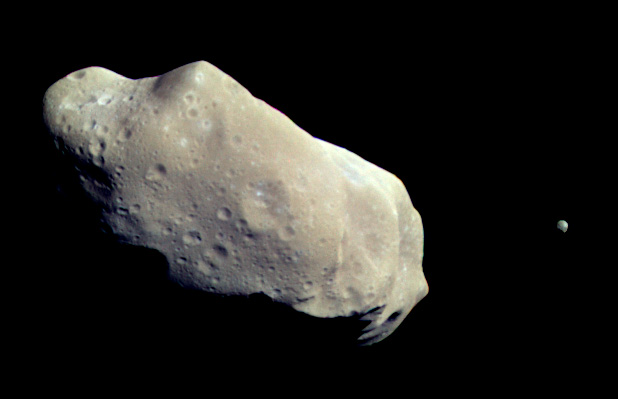
243 Ida is a Koronis-family main-belt asteroid visited by the Galileo spacecraft in 1993. Imaging revealed an irregular, heavily cratered body and the first confirmed asteroid moon, Dactyl.
243 Ida is a stony asteroid located in the main asteroid belt between Mars and Jupiter. It belongs to the Koronis family, a group of asteroids that share similar orbits and are thought to be fragments of a larger body broken apart by collisions. Ida’s irregular, elongated shape and cratered surface mark it as a mature, collisionally processed object in the belt. For context, Ida is classed with other main-belt objects and is widely referred to simply as an asteroid in planetary science literature.
Image gallery
10 Images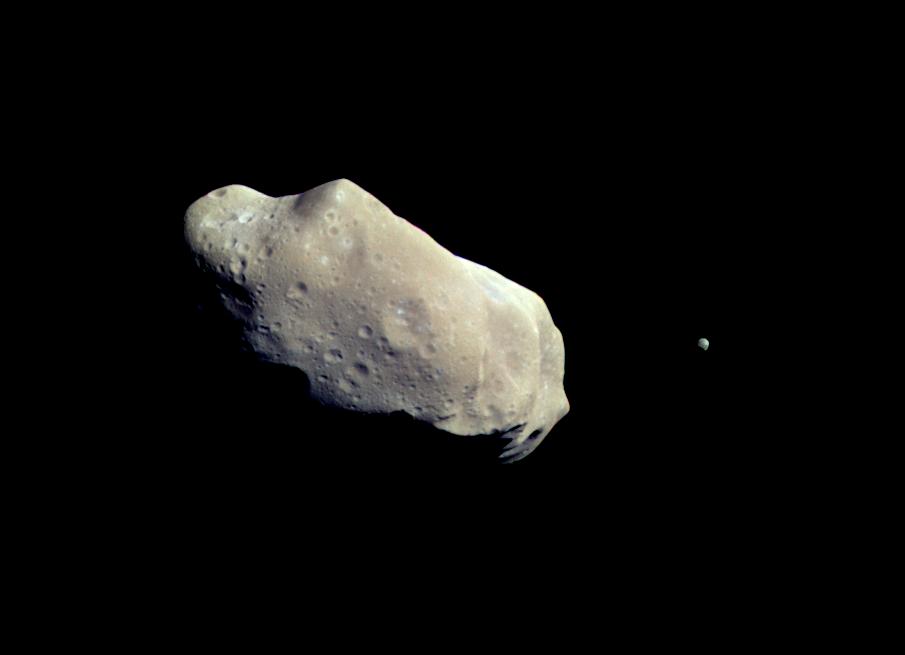





Physical characteristics
Imaging from a spacecraft flyby showed that Ida has a rough, blocky surface covered with craters and boulders. Its surface composition is consistent with S-type (silicaceous) asteroids, indicating a predominantly stony, silicate-rich makeup. Ida’s appearance suggests a thick regolith in places and numerous impact features that record a long collisional history.
Exploration and discovery of a moon
On August 28, 1993, NASA’s Galileo probe passed near Ida and returned the first close-up images of the asteroid. Those images revealed a tiny companion, later named Dactyl, making Ida the first asteroid known to have a natural satellite. The discovery was a milestone because it provided direct evidence that small asteroids can host moons, which has implications for their formation and evolution. The encounter and images are associated with the Galileo mission record.
Context and origin
Ida is a member of the Koronis family, a population believed to originate from a collisional breakup of a larger parent body. Members of this family share orbital elements and similar spectral properties, which help scientists reconstruct the ancient collision that formed them. Studying Ida and Dactyl together offers clues about how fragments reaccumulate or retain companions after disruptive impacts.
Scientific importance and notable facts
- Ida’s satellite, Dactyl, provided the first direct confirmation that some asteroids are binary or multiple systems.
- Detailed images allowed study of crater densities and surface processes on small bodies, informing models of space weathering and regolith development.
- Koronis-family asteroids, including Ida, help link remote asteroid spectra to meteorite types found on Earth, improving our understanding of solar system material distribution.
Since the Galileo flyby, many other small bodies have been found to possess satellites, and binaries are now recognized as a common outcome of collisional and dynamical processes in the asteroid population. Ida remains a landmark object because its satellite was the first such discovery and because the Galileo images transformed how scientists study small bodies in situ.
Related articles
Author
AlegsaOnline.com 243 Ida — Koronis-family main-belt asteroid with a small moon Leandro Alegsa
URL: https://en.alegsaonline.com/art/112739
Sources
- cfa-www.harvard.edu : Discovery Circumstances: Numbered Minor Planets
- adsabs.harvard.edu : The shape of Ida
- adsabs.harvard.edu : The North Pole Direction and the Control Network of the Asteroid 243 Ida
- hnsky.org : Report of the IAU/IAG Working Group on Cartographic Coordinates and Rotational Elements of the Planets and Satellites, 2000
- cfa-www.harvard.edu : IAUC 6082
- commons.wikimedia.org(243)_Ida.html : 243 Ida