
253 Mathilde — Carbonaceous main-belt asteroid
253 Mathilde is a carbon-rich main-belt asteroid discovered in 1885, notable for its very slow 17.4-day rotation, extremely dark surface, high porosity, and a 1997 NEAR Shoemaker flyby that photographed many large craters.
Overview
253 Mathilde is a large, dark body in the main belt of small bodies that orbit the Sun between Mars and Jupiter. Classified as an asteroid, it was discovered in 1885 by the Austrian astronomer Johann Palisa. Mathilde follows a moderately elliptical orbit and requires a little more than four Earth years to complete a circuit of the Sun. It has attracted scientific interest because of its unusually slow rotation, very low reflectivity, and the surface features revealed by a spacecraft flyby.
Image gallery
5 Images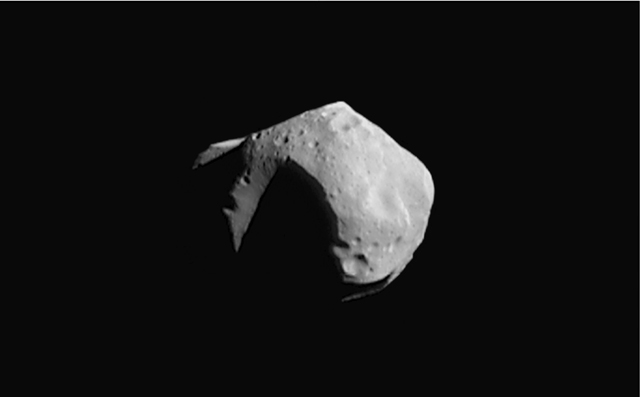

Composition and physical characteristics
Mathilde is classified as a primitive C-type asteroid, indicating a composition rich in carbonaceous material and other volatile-bearing minerals. Its surface is very dark, reflecting only a few percent of incident sunlight, a property described by a low visual albedo. Ground-based observations and spacecraft data indicate Mathilde has a low bulk density and a porous internal structure, commonly interpreted as a rubble-pile assemblage rather than a single solid rock. Such porosity implies that Mathilde retained a large fraction of its original, relatively unaltered material from the early solar system, including organic-rich compounds loosely summarized as carbon.
Size, shape and craters
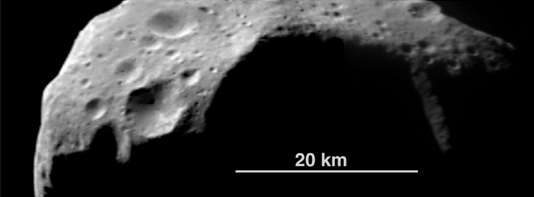
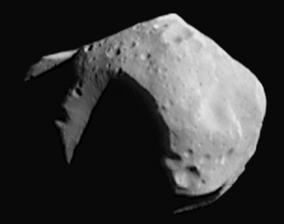
Mathilde is roughly a few tens of kilometres across in average diameter, placing it among the larger asteroids visited by spacecraft. Its shape is irregular, dominated by several large, shallow depressions and impact basins. The flyby images showed craters whose diameters are a significant fraction of the asteroid's own size, producing a heavily pockmarked appearance. These large basins provide evidence of a substantial collisional history in the main belt and help researchers infer surface strength and internal cohesion.
Rotation and thermal effects
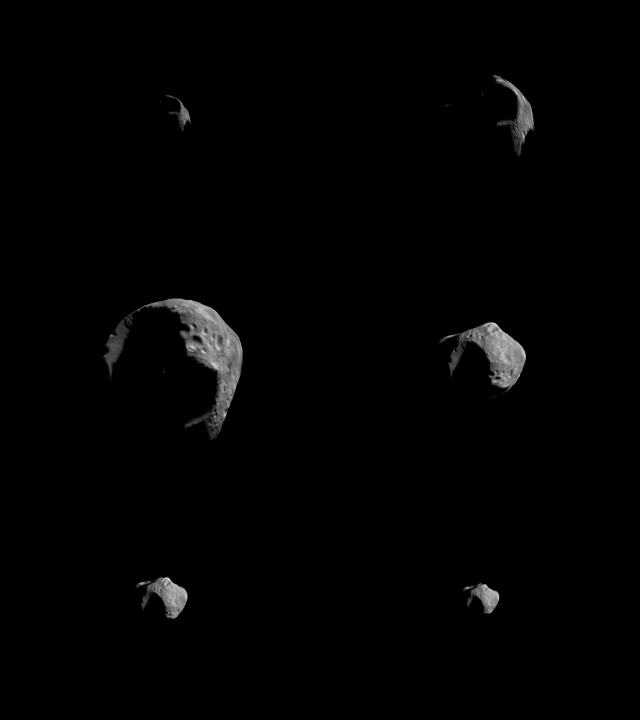
One of Mathilde's most notable properties is its extremely slow rotation: it completes one full rotation in about 17.4 days. This is far slower than the multi-hour spin periods typical of many similarly sized asteroids. A slow rotation influences the asteroid's thermal environment because sunlight heats any given surface region for longer intervals during a single day, affecting thermal inertia and the way surface regolith responds to micrometeorite bombardment. The sluggish spin also meant that the brief spacecraft flyby observed only one hemisphere directly, leaving parts of the body unphotographed.
Exploration: the NEAR Shoemaker encounter
In June 1997 the NEAR Shoemaker spacecraft performed a close flyby of Mathilde while en route to its primary target, 433 Eros. During the encounter the probe acquired images and photometric data of one hemisphere, revealing the dark, coarse surface and numerous large impact basins. The encounter provided the first close-up study of a C-type asteroid, yielding insights into surface morphology, crater populations, and the physical state of carbonaceous asteroids. Although only a portion of the surface was imaged because of Mathilde's slow rotation, the data significantly improved models of low-density, porous asteroid interiors and impact processes on primitive bodies.
Scientific importance
As a primitive, carbon-rich member of the main belt, Mathilde is important for understanding conditions in the early solar system. Studies of its composition, crater record, and inferred porosity inform broader questions about the origin and evolution of asteroids, the transport and preservation of organic and volatile materials, and how collisional evolution sculpts small bodies. Mathilde serves as a reference point for comparisons with other types of asteroids and with meteorites sampled on Earth, helping to place laboratory studies in a wider geologic and dynamical context.
Observation history and notable facts
- Discovery: 1885 by Johann Palisa.
- Classification: Carbonaceous C-type asteroid.
- Orbit: Located in the main belt with a somewhat elliptical orbit about the Sun.
- Rotation: Very slow, approximately 17.4 days per rotation.
- Surface: Very dark, carbon-rich material (carbon) with prominent impact basins.
- Exploration: Imaged during a 1997 flyby by the NEAR Shoemaker spacecraft en route to 433 Eros.
Continued telescopic observations and comparative studies with other asteroids help refine knowledge of Mathilde's surface composition and collisional history. Future missions targeting carbonaceous asteroids, sample-return missions, and improved remote sensing will further illuminate the role objects like Mathilde played in the delivery and preservation of primitive organic material in the inner solar system.
Questions and answers
Q: Who discovered asteroid 253 Mathilde and when?
A: Johann Palisa discovered asteroid 253 Mathilde in 1885.
Q: What is the orbit of asteroid 253 Mathilde like?
A: The orbit of asteroid 253 Mathilde is fairly elliptical and takes more than four years to circle the Sun.
Q: What is the rate of rotation of asteroid 253 Mathilde?
A: The rate of rotation of asteroid 253 Mathilde is unusually slow, taking 17.4 days to complete a 360° revolution about its axis.
Q: What type of asteroid is asteroid 253 Mathilde?
A: Asteroid 253 Mathilde is a primitive C-type asteroid, which means the surface has lots of carbon, giving it a dark surface that reflects only 4% of the light that falls on it.
Q: Which spacecraft visited asteroid 253 Mathilde and when?
A: The NEAR Shoemaker spacecraft visited asteroid 253 Mathilde during June 1997, on its way to asteroid 433 Eros.
Q: What did the NEAR Shoemaker spacecraft discover during its visit to asteroid 253 Mathilde?
A: The NEAR Shoemaker spacecraft took pictures of one side of asteroid 253 Mathilde and found many big craters that have gouged out depressions in the surface.
Q: What is the significance of asteroid 253 Mathilde in terms of space exploration?
A: Asteroid 253 Mathilde is currently the biggest asteroid to be visited by a spacecraft and the first C-type asteroid to be so explored.
Related articles
Author
AlegsaOnline.com 253 Mathilde — Carbonaceous main-belt asteroid Leandro Alegsa
URL: https://en.alegsaonline.com/art/112747
Sources
- ssd.jpl.nasa.gov : "253 Mathilde"
- adsabs.harvard.edu : "NEAR Encounter with Asteroid 253 Mathilde: Overview"
- sciencemag.org : "Estimating the mass of asteroid 253 Mathilde from tracking data during the NEAR flyby"
- adsabs.harvard.edu : "The slow rotation of 253 Mathilde"
- nssdc.gsfc.nasa.gov : "NEAR Flyby of Asteroid 253 Mathilde"
- eetd.lbl.gov : "Pavement Albedo"
- planetarynames.wr.usgs.gov : "Categories for Naming Features on Planets and Satellites"
- ase.tufts.edu : "2. Asteroids and meteorites, Size, color and spin"
- adsabs.harvard.edu : "Search for Satellites of 253 Mathilde from Near-Earth Asteroid Rendezvous Flyby Data"