
Zimbabwean dollar
Official currency of Zimbabwe from 1980 until 2009; experienced severe hyperinflation, multiple redenominations and was abandoned in favour of foreign currencies in 2009.
The Zimbabwean dollar was the national currency of Zimbabwe from independence in 1980 until it was effectively abandoned in 2009. Initially introduced to replace the Rhodesian dollar, it eventually became the focal point of one of the most extreme episodes of price instability in modern history. What began as a regular national currency ended with repeated redenominations, ever-larger banknotes and final displacement by a basket of foreign currencies.
Image gallery
5 Images



History and redenominations
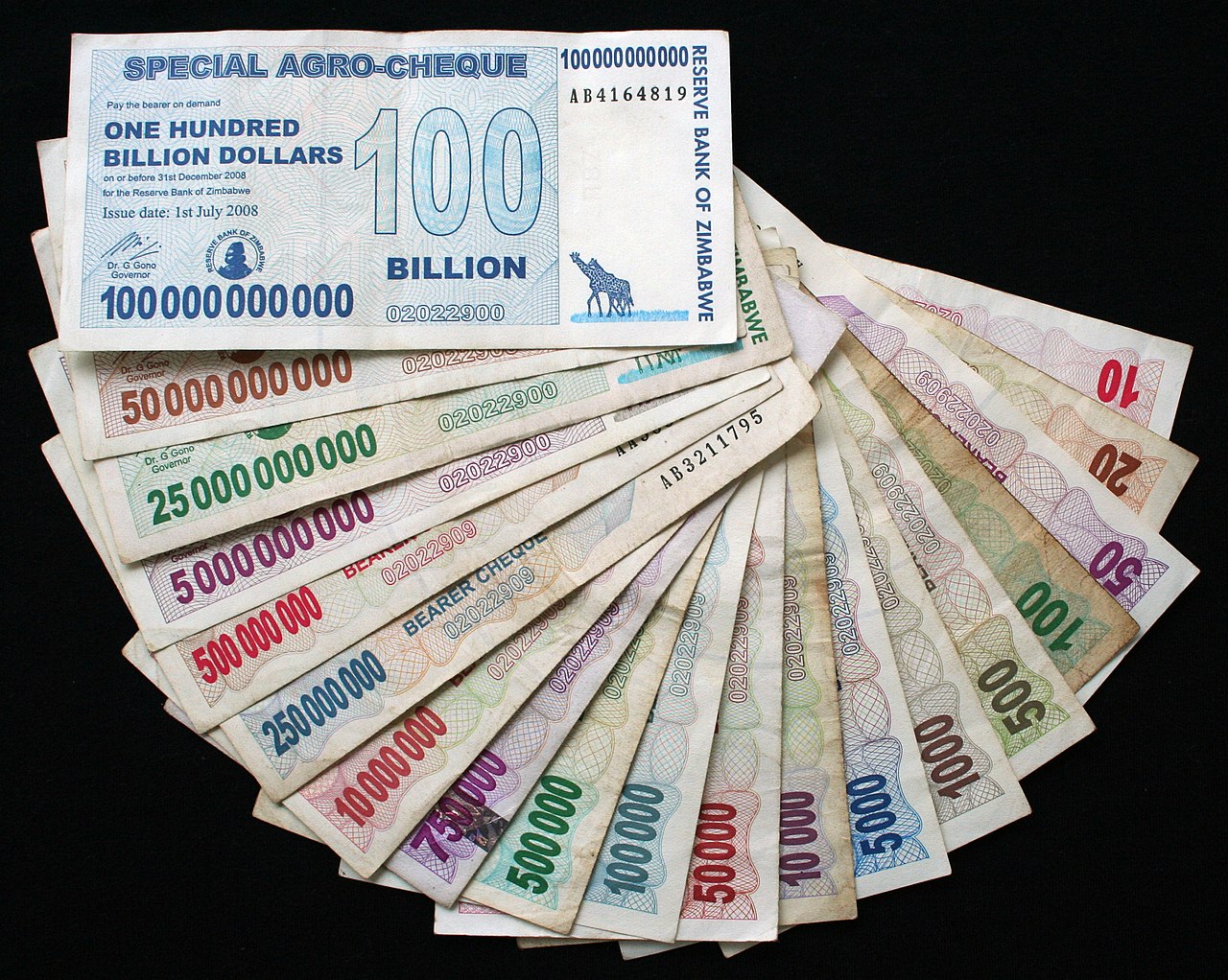
Over the course of its lifetime the currency underwent several official redenominations as authorities tried to contain what has widely been described as hyperinflation. Official redenomination events occurred in 2006, 2008 and 2009 when zeros were removed from banknotes to create new units of account. Despite these changes, inflation accelerated in the late 2000s: by mid-2008 reported inflation rates reached extraordinarily high levels, and the Reserve Bank issued ever-higher denominations, culminating in a note printed in January 2009 for one hundred trillion dollars (100,000,000,000,000).
Causes and characteristics
The currency collapse reflected a mix of structural and policy factors. A rapid expansion of the money supply to finance government deficits, falling domestic production (especially in agriculture), loss of export earnings and declining public confidence all played roles. These dynamics produced extremely fast and volatile price increases—commonly discussed under the term hyperinflation—making day-to-day transactions and long-term savings difficult to manage. Economists and observers also refer broadly to inflationary pressures when describing the period.
Banknotes, savings and social effects
To cope with runaway prices the central bank issued larger and larger denominations and reprinted familiar designs at successively higher face values. Collectors and commentators note the unusual range of issued notes; the series of emergency and high-denomination issues has been widely documented in discussions of banknotes. Redenomination events were intended to simplify accounting and restore confidence, but in practice conversion problems, delays and reports of violence and corruption during some exchanges meant many people lost savings or were unable to convert their cash holdings safely.
Abandonment and legacy
Facing the breakdown of monetary function, Zimbabwe moved away from its national currency in April 2009 and turned to foreign legal tenders for transactions. A multi-currency system relying heavily on the United States dollar and the euro, among others, replaced the local unit for many everyday purposes. This shift restored price stability for a time but also removed independent monetary policy tools, creating new challenges for fiscal management and sovereign currency operations.
Notable facts and context
- The currency’s lifetime spans a period of deep economic and political change in modern Zimbabwe.
- High-denomination notes, including a 100 trillion unit issued in 2009, became symbols of the crisis.
- Attempts to redenominate in 2006, 2008 and 2009 could not reverse the underlying monetary pressures.
- After abandoning the local currency, Zimbabwe relied on foreign currencies for many transactions, a practical but imperfect solution.
For further reading, see general background on the country’s economy and currency history through overview sources on Zimbabwe, the economics of inflation and the mechanics of hyperinflation. Numismatic collections and banknote catalogues provide visual records of the many denominations and emergency issues issued by the Reserve Bank of Zimbabwe (banknotes), while contemporary news and reports discuss the human impacts including reports of violence and corruption during conversion periods. Policy debates after 2009 consider the trade-offs of using a basket of foreign currencies versus restoring a national unit (foreign currencies).
Related articles
Author
AlegsaOnline.com Zimbabwean dollar Leandro Alegsa
URL: https://en.alegsaonline.com/art/110612
Sources
- currency-iso.org : "Current currency & funds code list (Table A.1)"
- cato.org : "New Hyperinflation Index (HHIZ) Puts Zimbabwe Inflation at 89.7 sextillion percent"
- rbz.co.zw : rbz.co.zw/about/inflation.asp