
Yakovlev Yak-42 — Soviet three-engine regional airliner
Three-engined short-to-medium-range airliner designed by Yakovlev in the USSR, produced from 1980 into the early 2000s; notable for rear-mounted engines and T-tail layout.
The Yakovlev Yak-42 (NATO reporting name: Clobber) is a Soviet-era short-to-medium-range passenger aircraft developed by the Yakovlev design bureau. Conceived to replace older turboprop and early jet types on domestic routes, the Yak-42 combines a T-tail and three rear-mounted engines in a configuration that gives it a surface appearance similar to some contemporary Western trijets.
Image gallery
9 Images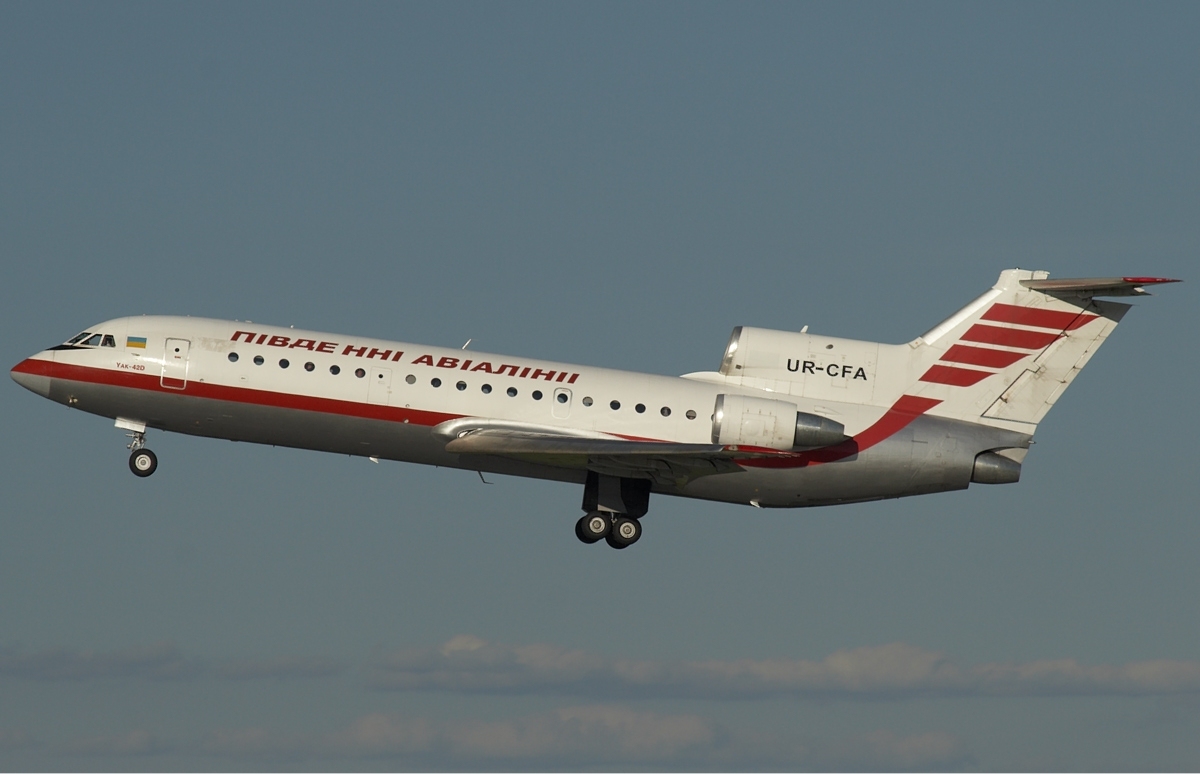


Design and characteristics
The Yak-42 is a narrow-body, low-wing airliner with a pressurised fuselage and three rear fuselage-mounted turbofan engines. Typical cabin layouts seat roughly 100–120 passengers depending on the configuration, with a single aisle and two- or three-abreast seating depending on variant. The configuration places the engines aft and uses a T-tail for pitch control, a layout chosen to keep wings clean of engine installations and to provide good short-field performance.
Development and production
Development began in the 1970s as Soviet airlines sought a modern jet to improve capacity and comfort on regional routes. The type was produced by the Yakovlev bureau and entered serial production around 1980, remaining in manufacture into the early 21st century. The program aimed at an economical aircraft with straightforward systems that could operate from shorter runways at dispersed airports across the USSR.
Operational use and variants
The Yak-42 was operated by state airlines and later by private carriers and charter operators. Variants included passenger, VIP and cargo-adapted versions, and some aircraft were modified for special roles. Major operators in its early career included airline fleets that required rugged, capable short-to-medium range jets. Its layout made it suitable for mixed operations and for airports where ground-based maintenance and refuelling infrastructure were limited.
Comparisons, legacy and notable facts
- The Yak-42 is often compared visually to Western trijets because of its rear-engine and T-tail arrangement; the Boeing 727 is a frequently cited example of a trijet with a similar silhouette (comparison).
- Produced by Yakovlev, the type reflects Soviet design priorities of durability and simplicity for dispersed, cold-weather operations.
- It is primarily a civilian aircraft but has seen use in government, military transport and charter roles; different sources refer to it broadly as an airliner.
Technical descriptions commonly note its three-engined arrangement (trijet), flexible seating capacity (up to about 120 depending on layout) and long production span compared with some contemporaries. For further technical data, service histories or type-specific operational records see specialist references and operator records (production history, design comparisons, engine information, capacity notes).
Today the Yak-42 remains of interest to aviation historians and regional carriers in some parts of the world. Its development reflects a transitional era in Soviet civil aviation when designers balanced proven design concepts with the need for improved performance and passenger comfort.
Related articles
Author
AlegsaOnline.com Yakovlev Yak-42 — Soviet three-engine regional airliner Leandro Alegsa
URL: https://en.alegsaonline.com/art/109560