
Yamanote Line — Tokyo's central circular railway
The Yamanote Line is JR East's 34.5 km urban loop in central Tokyo serving 29 stations. It links major business, shopping and transport hubs with frequent bi‑directional local trains and many transfer connections.
Overview
The Yamanote Line is a circular commuter railway operated by East Japan Railway Company (JR East). Known in Japanese as 山手線 and in Hepburn romanization as Yamanote‑sen, the line completes a roughly 34.5 km loop and serves 29 stations. It links many of Tokyo's principal business, shopping and entertainment districts around central Tokyo, forming a core transit circuit for residents, workers and visitors.
Image gallery
3 Images
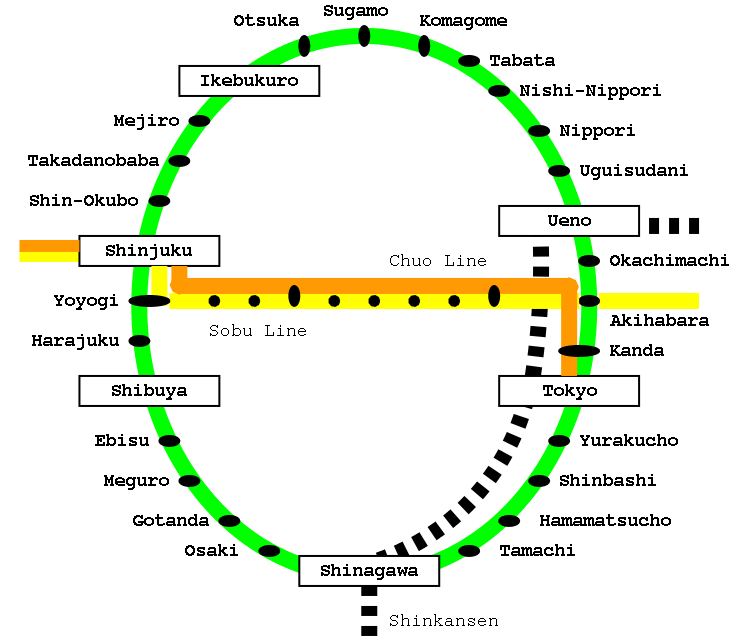

Route and major stations
The loop connects major hubs and districts including the area around Tokyo Station and Marunouchi, the Yūrakuchō and Ginza shopping areas, Shinagawa, Shibuya, Shinjuku, Ikebukuro and Ueno. Most stations on the loop provide direct transfers to multiple subway lines, private railway lines and long‑distance services, making the Yamanote a primary transfer spine within the greater Tokyo rail network.
Operation and services
Trains on the Yamanote operate in both clockwise and counterclockwise directions, providing frequent local service that stops at every station. The line is designed for high throughput, with short headways during peak periods and a consistent stopping pattern that suits short cross‑city trips. Adjacent to the passenger loop there are parallel tracks often described collectively with the Yamanote name; these are used by through services, some limited expresses and freight, as well as other JR East lines for route flexibility.
Rolling stock and infrastructure
Over time JR East has modernized rolling stock and station facilities on the Yamanote to handle large passenger volumes and to improve safety and accessibility. Trains include up‑to‑date passenger information systems, and stations have been adapted with clearer signage and barrier‑free access. Platform edge doors and other crowd‑management measures have been introduced progressively to enhance safety at busy platforms.
History and development
The Yamanote developed from several 19th‑ and early 20th‑century railway segments that were gradually connected and standardized into a continuous urban loop. Throughout the 20th century the line was electrified, straightened in places, and upgraded with modern signaling and operational practices to meet growing demand. Its role evolved along with Tokyo's urban expansion and the growth of suburban commuter flows.
Role in Tokyo's transport network
The Yamanote Line acts as a circulatory backbone inside Tokyo's rail system. By intersecting many radial lines and subway routes it helps distribute passengers across the metropolitan area and provides convenient transfer points for longer journeys. Its stations sit close to corporate headquarters, department stores, cultural venues and government offices, which concentrates both commuter and visitor traffic on the loop.
Cultural and practical importance
Beyond transport, the Yamanote Line is widely used as a geographic and cultural reference for central Tokyo. Being on the Yamanote loop often signals proximity to key commercial and entertainment districts. For practical travel planning, passengers rely on the line for predictable short hops between major neighborhoods and as a gateway to other rail services for suburban or intercity travel.
Further information
For current timetables, station facilities and service notices consult official operator sources and up‑to‑date transit guides. Useful starting points include pages on the line's Japanese name 山手線 and romanization Yamanote‑sen, general information about Tokyo, and pages for specific stations or districts such as Tokyo Station area, Ginza, Shinagawa and Shibuya.
Related articles
Author
AlegsaOnline.com Yamanote Line — Tokyo's central circular railway Leandro Alegsa
URL: https://en.alegsaonline.com/art/109587
Sources
- convenience.typepad.jp : typepad.jp
- matome.naver.jp : matome.naver.jp