
WrestleMania 32
WrestleMania 32 was WWE's 2016 flagship event held April 3 at AT&T Stadium in Arlington, Texas. Notable for a disputed attendance claim, the rebranding of the women's title, a six-second match, and a 12-match card.
WrestleMania 32 was the thirty-second annual edition of WWE's flagship spectacle, staged on April 3, 2016. The event was presented as the company's premier WrestleMania show and promoted by the World Wrestling Entertainment promotion (WWE) as a large-scale pay-per-view evening of professional wrestling. It took place at AT&T Stadium in Arlington, Texas, and formed part of a weekend of fan events, media appearances and ancillary activities staged around the main card.
Image gallery
10 Images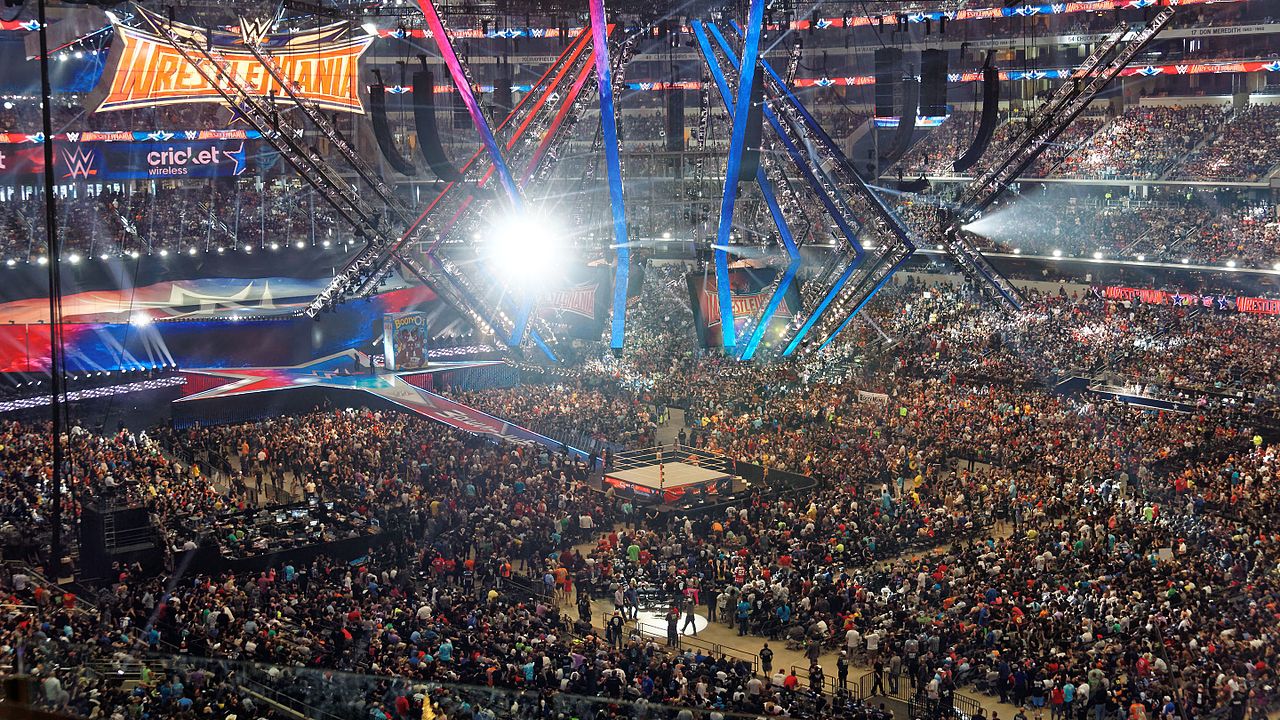




Card and structure
The televised card featured twelve matches, mixing championship contests, specialty attractions and celebrity involvement. The card was built around several long-running storylines and included a world title match that served as the main event. Matches ranged from multi-competitor bouts to single matches designed to advance ongoing narratives or to highlight individual performers' status within the promotion.
Notable matches and outcomes
Among the most widely discussed moments was the in-ring rebranding of WWE's top women's prize. The long-running Divas Championship was retired and replaced by a new WWE Women's Championship, a change announced and highlighted on the WrestleMania stage; the decision was presented as a shift in the way women performers were positioned within the promotion. Another high-profile, brief encounter saw a celebrity-associated match end almost immediately when Dwayne "The Rock" Johnson defeated Erick Rowan; ring announcer Lilian Garcia declared the bout a six-second finish, which was reported as the shortest WrestleMania match to that point and was widely noted in contemporary coverage.
Attendance and the ensuing controversy
WWE promoted the show with an announced attendance figure that it said exceeded historic live gates for professional wrestling at stadium shows. The promoted number was presented as a new benchmark, exceeding figures commonly cited for earlier landmark cards such as WrestleMania III. Public discussion and journalistic scrutiny quickly followed; prominent wrestling journalist Dave Meltzer and others reported significantly lower independent estimates of the in-stadium crowd, and referenced comparisons with gatherings such as SummerSlam (1992). Debate over the accurate figure exemplified how attendance reporting for major sporting-entertainment events may vary depending on counting methods and promotional practice.
Critical reception and legacy
Critical and fan reaction to WrestleMania 32 was mixed. Praise was frequently directed at the scale of production, staging elements and some individual performances; criticism focused on booking choices, match ordering and the duration of the overall show. The retirement of the "Divas" moniker and the introduction of a new women's championship were broadly seen as a notable moment in WWE's presentation of its women's division, reinforcing a longer-term shift toward elevated prominence for female wrestlers in major events.
Historical context
WrestleMania 32 was the third WrestleMania to be held in Texas, and it reflected WWE's strategy of turning WrestleMania into a destination weekend with significant local economic impact and a range of ticketed and free events. The event was discussed not only for in-ring outcomes but also for marketing and promotional decisions, continuing an industry pattern in which headline attendance numbers and headline-grabbing finishes become part of the event narrative beyond the scripted contests themselves.
Quick facts
- Date and venue: April 3, 2016, AT&T Stadium, Arlington, Texas.
- Number of matches: twelve on the card, including title matches and special attractions.
- Attendance: WWE announced a six-figure crowd; independent reporting from observers such as Meltzer gave lower estimates, prompting debate.
- Notable moments: retirement of the Divas Championship and coronation of a new Women's Championship; a six-second match announced by Lilian Garcia; comparisons to historical events such as WrestleMania III.
WrestleMania 32 is frequently cited in discussions of modern wrestling promotion for its blend of spectacle, championship changes and controversy over reported attendance. Past, short matches such as the eleven-second finish involving Kane and Chavo Guerrero, Jr. at WrestleMania XXIV were often referenced in contemporary coverage to contextualize the six-second finish promoted at this event. Readers seeking a full match-by-match record, entrant lists and detailed results can consult official WWE records and independent event archives for comprehensive breakdowns and contemporaneous reportage.
Because some elements of the event remain debated—particularly crowd totals—interested readers should compare multiple sources when seeking precise numeric data or a complete accounting of ticketed attendance. The event remains a subject of analysis for those studying trends in sports-entertainment promotion, the treatment of women's divisions in major shows, and the marketing of stadium-scale wrestling events.
Related articles
Author
AlegsaOnline.com WrestleMania 32 Leandro Alegsa
URL: https://en.alegsaonline.com/art/109187
Sources
- wwe.com : "AT&T Stadium to host WrestleMania 32"
- forbes.com : "Could WrestleMania 32 At AT&T Stadium Become The Biggest WrestleMania Ever?"
- latimes.com : "Wrestlemania 32 results: Roman Reigns defeats HHH; The Undertaker defeats Shane McMahon"
- independent.co.uk : "WrestleMania 32 results: Roman Reigns beats Triple H, Shane McMahon defeated after giant 20-foot leap"
- f4wonline.com : "WWE WrestleMania 32 live results: HHH vs Roman Reigns, Undertaker vs Shane McMahon"
- wwe.com : "The Undertaker vs. Shane McMahon - Hell in a Cell Match"
- wwe.com : "WWE World Heavyweight Champion roman reigns Defeated Triple h ( the game) Reigns"