
Work hardening (strain hardening): principles, methods, and applications
Work hardening, or strain hardening, is the strengthening of metals and polymers by plastic deformation at temperatures below recrystallization; it increases strength and hardness while reducing ductility.
Overview
Work hardening, also called strain hardening, is the process by which a metal or polymer becomes stronger and harder after it is plastically deformed at relatively low temperatures. The deformation introduces permanent changes to the material's internal structure that make further deformation more difficult. Typical cold-working is performed at or near room temperature, below the material's recrystallization temperature, and is widely used in manufacturing to tailor mechanical properties without altering composition.
Image gallery
1 Image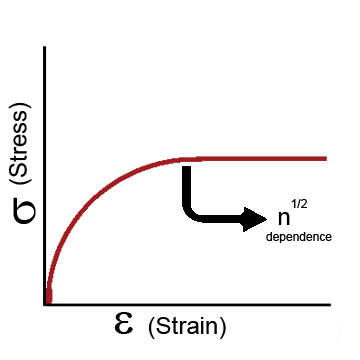
Mechanism and characteristics
At the microscopic level, work hardening is largely governed by the generation and interaction of dislocations within a crystalline material. As plastic strain is applied, dislocation density rises and dislocations tangle or pile up against obstacles. These defects impede the motion of other dislocations, requiring higher applied stress for additional plastic flow. The net result is increased yield strength and tensile strength, along with higher hardness, but often at the cost of reduced ductility. The degree of hardening depends on the material, amount of strain, and the specific forming process used.
Common cold‑working operations
Cold-working is achieved by a range of mechanical operations. Major categories include:
- Squeezing and rolling: reducing thickness or altering cross-section by compressive forces.
- Bending and forming: creating shapes by plastically deforming sheet or bar stock.
- Shearing and blanking: cutting operations that can introduce localized strain.
- Drawing and extrusion (cold): elongating metal through dies to change geometry and grain structure.
These operations typically use presses, rolls, dies and punches in controlled sequences so the part achieves the desired dimensions and mechanical properties.
Control, recovery and heat treatment
Because cold work raises internal energy and residual stresses, subsequent heat treatment is often used to recover ductility. Annealing above the recrystallization temperature allows new, strain‑free grains to form, reversing much of the work hardening. The balance between cold work and annealing lets engineers tune strength, toughness and formability for a given application.
Materials and applications
Many common engineering metals respond to work hardening. Examples include aluminum, copper, brass, steel and stainless steel. Work hardening is used to produce springs, fasteners, wire, tubing and formed sheet parts where increased strength or wear resistance is required without changing alloy chemistry. It is also exploited in metalworking techniques such as cold rolling, deep drawing, stamping and bending operations.
Notable distinctions and practical considerations
Work hardening differs from other strengthening methods such as solid-solution or precipitation hardening because it modifies defect structure by mechanical means rather than chemistry. It is reversible by recrystallization, unlike some forms of age hardening. Designers must consider trade-offs: while higher strength and hardness can be beneficial, loss of ductility and the introduction of residual stresses may reduce fatigue life or lead to cracking if not managed. Process planning typically specifies allowable percent cold work and whether intermediate anneals are required to meet part performance.
For further technical guidance on forming limits, process design and material-specific behavior, consult specialized texts and material data sources that address the interaction between strain, temperature and microstructure.
Related articles
Author
AlegsaOnline.com Work hardening (strain hardening): principles, methods, and applications Leandro Alegsa
URL: https://en.alegsaonline.com/art/109048