
Stainless Steel: Properties, Types, History and Practical Uses
An accessible overview of stainless steel: its composition, principal families, properties and limits, brief history, common applications, and how grades and finishes affect performance.
Overview
Stainless steel (sometimes called inox) is a category of corrosion-resistant iron-based alloy defined primarily by the presence of chromium. When exposed to oxygen chromium forms a thin, stable oxide layer on the surface that retards further oxidation and helps the metal resist staining, rusting, and general corrosion. Modern standards typically specify a chromium content of roughly ten to eleven percent or more by mass as a baseline for stainless behaviour, although many commercial grades contain additional elements to tailor performance.
Image gallery
10 Images




Composition and principal types
Stainless steels are a family rather than a single material. In addition to chromium, common alloying elements include nickel, molybdenum, manganese, nitrogen, titanium and niobium. These additions modify mechanical properties, weldability and resistance to localized forms of corrosion such as pitting and crevice attack.
- Austenitic: non-magnetic, excellent corrosion resistance and formability; widely used in kitchenware and process equipment.
- Ferritic: magnetic, good resistance to stress corrosion, often used in automotive and industrial parts.
- Martensitic: heat-treatable and hardenable for cutlery, turbines and valves.
- Duplex: hybrid microstructure combining strength and corrosion resistance, used in chemical and marine environments.
- Precipitation‑hardening: engineered for very high strength in aerospace and specialized components.
Properties and limitations
Stainless steel is valued for its combination of strength, toughness and resistance to oxidation. Surface finish, heat treatment and alloy selection strongly influence performance. Despite its name, stainless steel is not absolutely stain-proof: in aggressive environments, particularly those containing chlorides (such as salt water), it can suffer localized corrosion, including rust formation, pitting or crevice corrosion. Welding and overheating can also change microstructure and reduce corrosion resistance unless appropriate grades or post‑weld treatments are used.
History and development
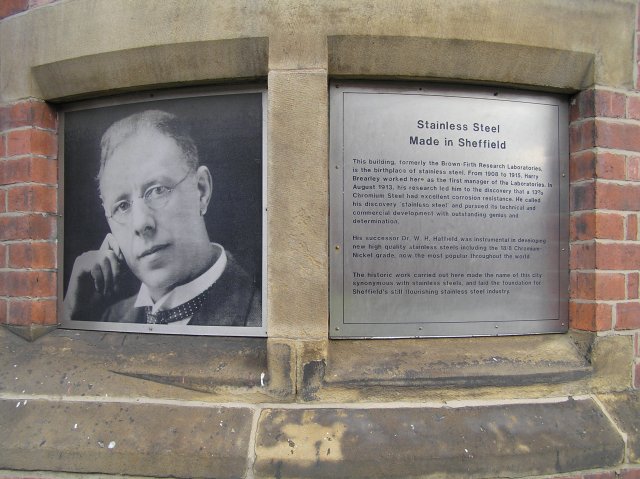
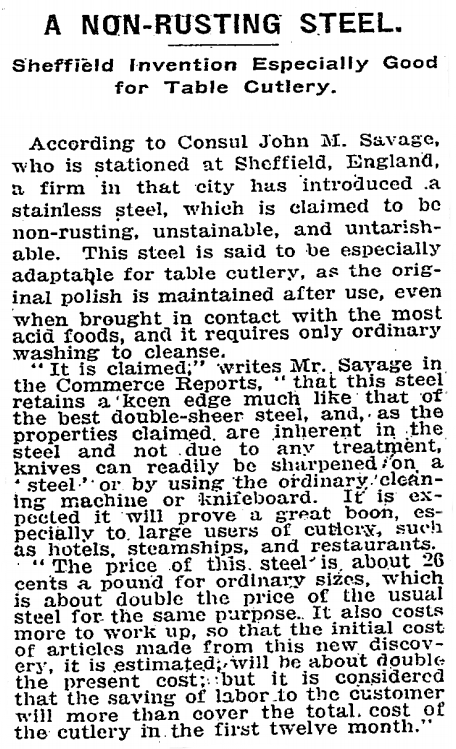
The concept of a corrosion-resistant chromium-rich iron alloy emerged in the 19th century, but practical and reproducible production took several decades of metallurgical research. A landmark moment is commonly dated to 1913, when Harry Brearley in Sheffield produced an alloy that combined useful hardness with improved resistance to staining; this achievement helped establish Sheffield as a center for stainless cutlery and related manufacturing. Over the 20th century the number of engineered grades expanded to meet diverse industrial needs; today there are many families and well over a hundred commercial grades, with a small subset used most frequently.
Uses and significance
Stainless steel is used across a wide range of sectors because it balances corrosion resistance, hygiene, and mechanical performance. Typical applications include kitchen cutlery and appliances, food processing and medical equipment (where cleanability matters), architectural façades and handrails, chemical process plants, and structural components in marine, energy and transportation industries. Specialized high-strength grades have found applications in aerospace and rocketry as designers seek combinations of light weight, strength and heat resistance.
Grades, finishes and selection
Selection of a stainless grade depends on environment, mechanical demands and fabrication methods. Surface finishes from matte to mirror-like polish influence appearance and ease of cleaning. Engineers and fabricators consult standards and corrosion data when choosing a grade for a given service to avoid problems such as sensitization, intergranular attack or chloride-induced pitting.
Further reading and references
For technical standards, metallurgy primers and application notes consult authoritative sources and industry publications. Historical accounts and industry case studies describe the role of innovators like Harry Brearley and manufacturing centers such as Sheffield, Yorkshire. Practical notes on composition and classification include discussions of chromium content and alloying effects (chromium, composition). Materials guides often categorize stainless for corrosion behaviour (corrosion), oxidation and resistance to rust. Industry applications are diverse: kitchen and cutlery, the historic mid‑century Sheffield manufacturing boom (mid-20th century), aviation and aerospace components, and modern space‑launch hardware where selected high‑performance stainless alloys may be used in structural parts and propulsion systems. For introductory reading, look for resources that explain the tradeoffs among families, heat treatment, and surface finish before selecting a grade for service.
Additional technical details and supplier data sheets can clarify suitability for specific environments and fabrication methods; consult industry standards and material databases for validated properties and recommended practices (alloy, composition, chromium, corrosion, rust, aviation, Brearley, Sheffield, Yorkshire, cutlery, mid-20th century).
Questions and answers
Q: What is stainless steel?
A: Stainless steel is a steel alloy with a minimum of 10.5 or 11% chromium content by mass. It is resistant to oxidation and corrosion, and has different grades and surface finishes depending on its use.
Q: Who invented modern stainless steel?
A: Modern stainless steel was invented in 1913 by Harry Brearley in Sheffield, Yorkshire.
Q: How long did it take to develop a reliable industrial method for producing stainless steel?
A: It took about 80 years to develop a reliable industrial method for producing stainless steel.
Q: What are some common uses of stainless steel?
A: Common uses of stainless steel include cutlery, rockets, and other applications requiring resistance to oxidation and corrosion.
Q: Is there more than one grade of stainless steel?
A: Yes, there are over 150 grades of stainless steel, with fifteen being the most used.
Q: Is all stainless steels stain-proof?
A: No, not all types of stainless steels are stain-proof; the term 'corrosion resistant' is used when the alloy has less than 12% minimum chromium content.
Related articles
Author
AlegsaOnline.com Stainless Steel: Properties, Types, History and Practical Uses Leandro Alegsa
URL: https://en.alegsaonline.com/art/93268
Sources
- worldstainless.org : "The stainless steel family"
- steel.org : "Steel glossary"
- stainless-online.com : "Why is stainless steel stainless?"
- bbc.co.uk : bbc.co.uk/news/magazine-26935867