
William T. Anderson ("Bloody Bill")
William T. "Bloody Bill" Anderson (1840–1864) was a notorious pro-Confederate guerrilla leader on the Missouri–Kansas border, known for violent raids against Union forces and civilian supporters during the American Civil War.
Overview
William T. Anderson (1840 – October 26, 1864), commonly called "Bloody Bill," was a prominent and controversial pro-Confederate irregular commander active on the Kansas–Missouri border in the American Civil War. He led small, highly mobile units of bushwhackers and rangers that fought Union troops and attacked civilians suspected of Union sympathy. His activities are part of the larger story of irregular warfare that accompanied the conventional armies during the American Civil War, and he is often cited as one of the conflict's most brutal guerrilla leaders.
Image gallery
7 Images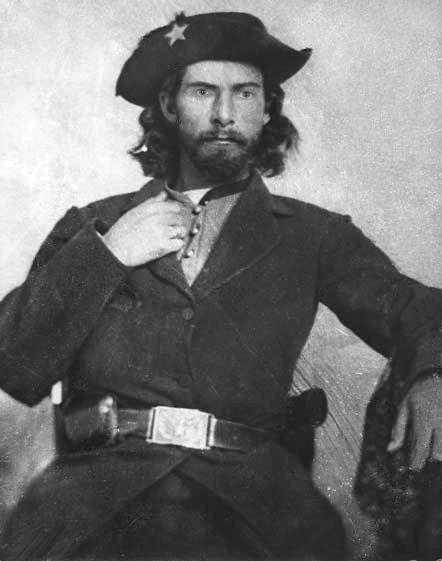


Characteristics and tactics
Anderson's band relied on surprise, speed and intimate knowledge of local terrain. Operating without regular uniforms or formal discipline, his men were typical of the border guerrillas whose violence blurred the lines between military action and revenge-driven raids. Contemporary accounts emphasize his willingness to attack both military targets and civilian supporters of the Union cause, a practice that intensified the cycle of retaliation in the region. Anderson and similar leaders are frequently described in sources dealing with Confederate partisan activity.
Notable actions and death
Anderson took part in several high-profile raids on settlements and military detachments in Missouri and Kansas, and his force attacked local Union loyalists and federal soldiers. He fought alongside and sometimes under leaders associated with guerrilla groups, including men linked to the infamous Lawrence raid in 1863, and he later led violent operations that shocked contemporaries. In 1864 he was killed during an encounter with Union forces; his death ended one of the most feared careers among border bushwhackers.
Legacy and interpretation
Anderson remains a divisive historical figure. To some descendants of Confederate sympathizers he has been portrayed as a partisan warrior; to others he is an example of the excesses of irregular warfare. Historians study Anderson to understand how localized grievances, revenge, and partisan politics produced extended cycles of civilian violence on the border. His life illustrates how the Civil War in the trans-Mississippi West often differed in scale and character from battles in the eastern theaters.
Key facts and context
- Active theaters: border regions of Missouri and Kansas.
- Opponents targeted: Union loyalists and federal soldiers as well as civilian communities seen as hostile to the Confederacy.
- Part of broader irregular warfare trends documented in studies of Union loyalists, bushwhackers, and partisan conflict.
For further reading, consult specialized studies of Confederate partisan warfare and regional histories of the American Civil War border campaigns. Primary and secondary accounts offer differing views of Anderson's motives and the scale of his actions; historians commonly treat his career as emblematic of the brutal local dimensions of the conflict. See also related materials on Confederate irregulars and the social impact of guerrilla warfare in the Civil War era.
Questions and answers
Q: Who was William T. Anderson?
A: William T. Anderson was a pro-Confederate guerrilla leader in the American Civil War who led a group called the volunteer rangers that attacked Union loyalists and federal soldiers in Missouri and Kansas.
Q: When was William T. Anderson born?
A: William T. Anderson was born in 1840.
Q: When did William T. Anderson die?
A: William T. Anderson died on October 26, 1864.
Q: What was William T. Anderson's nickname?
A: William T. Anderson's nickname was "Bloody Bill" Anderson due to his violent raids.
Q: What did William T. Anderson do during the American Civil War?
A: William T. Anderson led a group of volunteer rangers who attacked Union loyalists and federal soldiers in the states of Missouri and Kansas as a pro-Confederate guerrilla leader.
Q: Why is William T. Anderson famous?
A: William T. Anderson is famous for being one of the deadliest and most famous pro-Confederate guerrilla leaders in the American Civil War.
Q: What was the name of the group that William T. Anderson led?
A: William T. Anderson led a group of volunteer rangers.
Related articles
Author
AlegsaOnline.com William T. Anderson ("Bloody Bill") Leandro Alegsa
URL: https://en.alegsaonline.com/art/108302
Sources
- wikidata.org : wikidata.org/wiki/Q717758
- d-nb.info : 1182056954
- isni.org : 0000 0001 0219 1291
- id.loc.gov : no2017013330
- data.bibliotheken.nl : 184885345
- snaccooperative.org : w6v124w0
- viaf.org : 77615225
- worldcat.org : lccn-no2017013330