
Western meadowlark (Sturnella neglecta)
A grassland bird of western North America known for its bright yellow breast, flute-like song, ground nesting, and designation as the state bird of six U.S. states.
Overview
The Western meadowlark (Sturnella neglecta) is a medium-sized songbird of open habitats in western and central North America. Recognized for its vivid yellow underparts and clear, melodious song, it is a familiar presence on prairies, pastures, and agricultural fields.
Image gallery
4 Images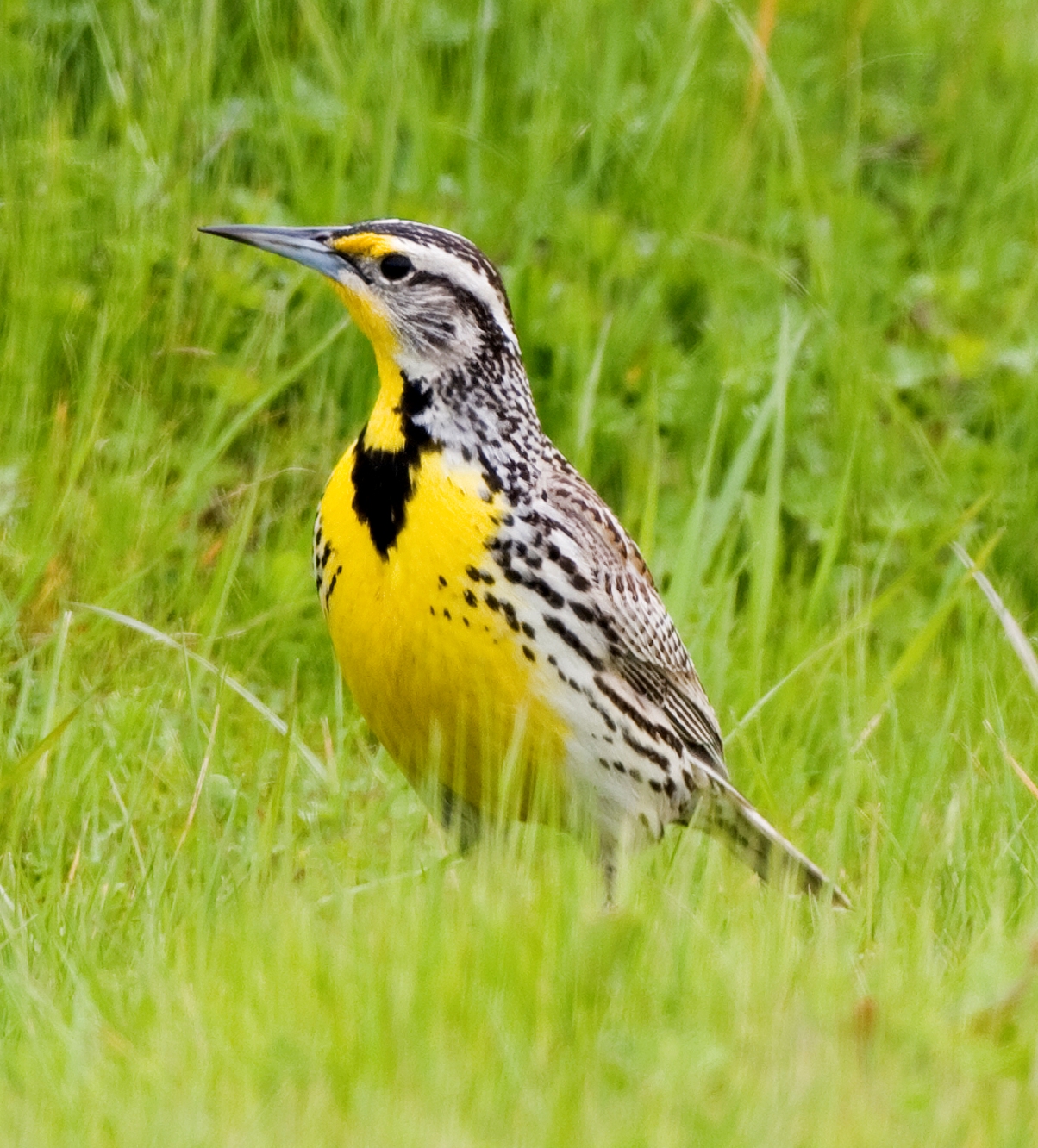


Identification
Adults show a bright yellow throat and breast marked by a distinctive black "V" on the upper chest, streaked brown upperparts, and a long, slightly curved bill. Its song is a rich, flute-like sequence often delivered from elevated perches; this song pattern helps separate it from the similar Eastern meadowlark.
Habitat and range
Western meadowlarks occupy a variety of open grassy environments including native prairie, hayfields, and lightly grazed rangelands. Their range extends across much of the western and central United States and into parts of Canada and Mexico. They are largely resident in many areas but may move locally in response to weather and food availability.
Behavior and breeding
These birds feed primarily on insects and seeds, gleaned from the ground. They nest on the ground, concealed in grass clumps or under vegetation; clutches typically contain several eggs (often three to five). Males sing to establish territories and attract mates, and both parents may provision nestlings.
Human connections and conservation
The Western meadowlark is culturally prominent: it serves as the official state bird of several U.S. states. See the list below for specific designations. While the species is not currently considered globally threatened, populations rely on healthy grassland habitat and can decline where prairie and meadow are lost or heavily altered.
Distinguishing notes
Compared with the Eastern meadowlark, the Western meadowlark typically has a slimmer bill and a different song pattern; range overlap can make visual and vocal cues important for correct identification. Conservation efforts that preserve native grasslands benefit this and many other grassland-dependent species.
Related articles
Author
AlegsaOnline.com Western meadowlark (Sturnella neglecta) Leandro Alegsa
URL: https://en.alegsaonline.com/art/107524