
Montana — geography, history, and significance
An overview of Montana: its geography, borders, history, economy, and notable features including mountains, prairies, sparse population, and cultural heritage.
Overview
Montana is a state of the United States located in the northwestern interior of the continent. Its capital is Helena and the largest city is Billings (also linked here: Billings). The state is often called "Big Sky Country" for its expansive skies and wide, open landscapes. Montana ranks among the largest U.S. states by area while remaining one of the least densely populated.
Physical geography
Western Montana is dominated by mountain ranges and high country, including part of the Rocky Mountains. These ranges contain rugged peaks, alpine lakes and glaciers that influence regional climate and water resources; the term mountains is linked here: mountains. By contrast, most of eastern Montana is broad, rolling prairie and grassland used for grazing and dryland farming. Major rivers originate here and cross the state, shaping valleys and supplying irrigation.
Borders and neighbors
Montana shares a long international boundary with Canada. That frontier is often described as one of the world’s longest undefended borders — meaning there are no permanent foreign troops on either side — and the description sometimes clarifies that there are no standing soldiers or organized armies stationed along it. The state borders three Canadian provinces: British Columbia, Alberta, and Saskatchewan, more than any other U.S. state.
- To the east: North Dakota
- To the southeast: South Dakota
- To the south: Wyoming
- To the west and southwest: Idaho
History and peoples
The first inhabitants of the territory were Indigenous peoples who lived across the plains, river valleys and mountains for thousands of years; these groups are commonly referred to as Native Americans. European exploration, fur trade, and later settlement by miners, ranchers and homesteaders transformed the region in the 18th and 19th centuries. Mining towns, railroad development and agricultural expansion played major roles in Montana’s growth before it joined the Union in the late 19th century.
Economy, land use and recreation
Montana’s economy blends agriculture (notably cattle ranching and grain production), mineral extraction, energy, and increasingly, outdoor recreation and tourism. Famous national parklands and wilderness areas draw visitors for hiking, fishing, hunting and winter sports. Conservation and land-management debates balance resource development with protection of wildlife habitat, watersheds and scenic values.
Notable facts and identity
Montana’s combination of mountains, plains and rivers gives it a diverse natural character. It is sparsely populated compared with most states and is known for wide vistas, outdoor lifestyles and a strong sense of regional identity. Cities and towns retain links to frontier history while serving as centers for commerce, education and culture in their regions.
For more information about specific subjects mentioned here, follow the embedded links to related topics and regional resources: Montana overview, mountain regions, prairie landscapes, and the provincial and state neighbors listed above.
Geography
Montana borders the Canadian provinces of British Columbia, Alberta and Saskatchewan to the north, the US states of North Dakota and South Dakota to the east, Wyoming to the south, and Idaho to the southwest and west. Western Montana consists of high, rugged mountains (see Rocky Mountains), while the east is characterized by vast plains (see Great Plains). With an estimated population of 101,876, Billings is the largest city in Montana. Montana is home to Glacier National Park and a small part of Yellowstone National Park. The Missouri River, the Milk River, the Flathead River, and the Yellowstone River are the four main rivers. The shortest river in the world, the Roe River, also flows through Montana.
Structure
The state is divided into 56 individual counties (comparable to the German Landkreise). The county with the largest population is Yellowstone County in the south of the state with over 129,000 inhabitants.
See also: List of counties in Montana
Population
| Population development | |||
| Census | Inhabitants | ± in % | |
| 1870 | 20.595 | - — | |
| 1880 | 39.159 | 90,1 % | |
| 1890 | 142.924 | 265 % | |
| 1900 | 243.329 | 70,3 % | |
| 1910 | 376.053 | 54,5 % | |
| 1920 | 548.889 | 46 % | |
| 1930 | 537.606 | −2,1 % | |
| 1940 | 559.456 | 4,1 % | |
| 1950 | 591.024 | 5,6 % | |
| 1960 | 674.767 | 14,2 % | |
| 1970 | 694.409 | 2,9 % | |
| 1980 | 786.690 | 13,3 % | |
| 1990 | 799.065 | 1,6 % | |
| 2000 | 902.195 | 12,9 % | |
| 2010 | 989.415 | 9,7 % | |
| 2019 estimate | 1.068.778 | 8 % | |
| Before 1900 1910-20102018 | |||
Montana is one of the least populous states in the USA, with just over one million inhabitants. In addition, Montana is the state with the third lowest population density, after Alaska and Wyoming. Since the 1980s, the region has seen an influx of retirees and nature lovers, while younger people and old-established farm families often leave.
The population is 89% white (85.9% non-Latino white), followed by Native Americans (American Indians) at 6.6%. Latin Americans make up 4%.
The 13 Indian tribes are the Kootenai, Blackfoot, Assiniboine, Northern Cheyenne, Salish and Anishinabe, Cree, Pend d'Oreille, Gros Ventre, Chippewa, Sioux, Crow and Little Shell. Approximately two-thirds of them now live on reservations. Between 2000 and 2010, the Native American population grew by 18%.
Indian Reservations
There are seven Indian reservations in Montana, divided among twelve tribes. In addition, there is the Little Shell Tribe, which has no reservation. The reservations are:
- Blackfeet Indian Reservation (Blackfeet)
- Crow Reservation (Absarokee)
- Flathead Indian Reservation (Salish, Pend d'Oreille and Kutenai)
- Fort Belknap Reservation (Gros Ventre, Assiniboine)
- Fort Peck Indian Reservation (Dakota, Assiniboine)
- Northern Cheyenne Indian Reservation (Cheyenne)
- Rocky Boy's Reservation (Cree, Chippewa)
Religions
The religious denominations with the largest number of members in 2000 were the Catholic Church with 169,250, the Evangelical Lutheran Church in America with 50,287, and the Church of Jesus Christ of Latter-day Saints (Mormons) with 32,726 adherents.
Largest cities
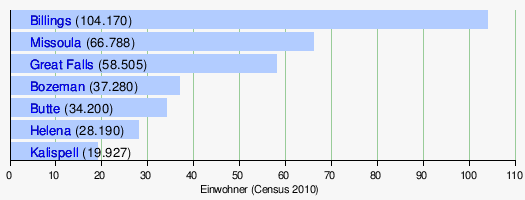
See also: List of cities and towns in Montana and List of skyscrapers in Montana


Related articles
Author
AlegsaOnline.com Montana — geography, history, and significance Leandro Alegsa
URL: https://en.alegsaonline.com/art/66248
Sources
- commons.wikimedia.org : Montana
- census.gov : "Montana: Population estimates"
- kff.org : "Median Annual Household Income"