
West Frisian (Frysk): language of Fryslân, Netherlands
West Frisian (Frysk) is a West Germanic language spoken in the Dutch province of Friesland. It has several hundred thousand speakers, regional dialects, a literary tradition, and official recognition in the province.
Overview
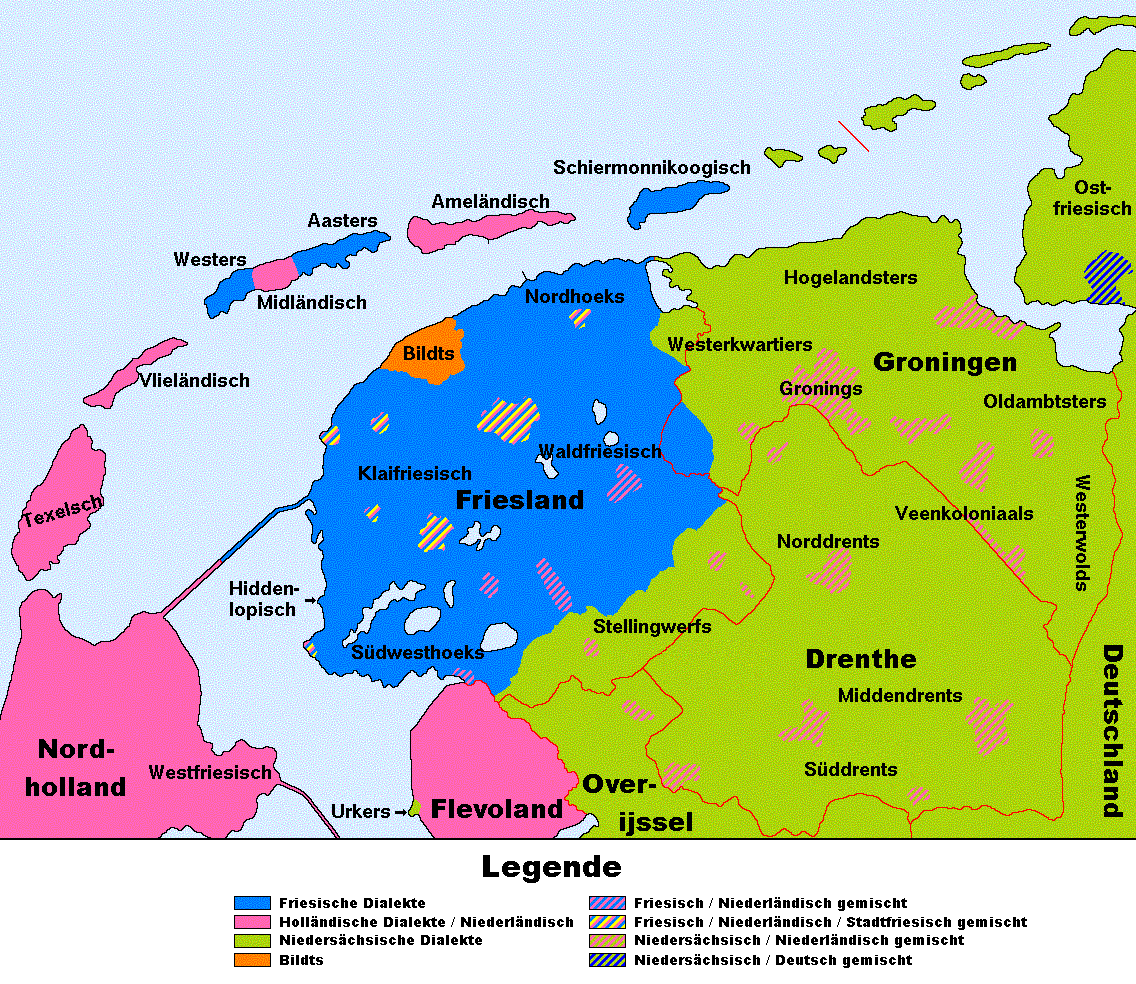
West Frisian, called Frysk in the language itself and sometimes referred to by its Dutch name Westerlauwers Fries, is a West Germanic language spoken primarily in the province of Friesland (Fryslân) in the northern part of the Netherlands. It belongs to the Frisian branch, historically and linguistically close to English and other continental Germanic languages; for broad purposes it can be described as one of the closest living relatives of English within the Germanic family (language family overview). Estimates vary, but several hundred thousand people use West Frisian to some degree, and it remains a living community language in many towns and rural areas.
Image gallery
3 Images

Characteristics
West Frisian uses the Latin alphabet with a spelling system oriented toward its phonology. It retains a number of archaic features relative to neighboring Dutch while also showing loanwords and influences from Dutch. The language has a subject–verb–object tendency like English and Dutch, a rich system of vowel contrasts, and morphological markers on verbs and nouns that reflect number and definiteness. Regional varieties exist, and a standardized written form is used in education, media, and publishing.
History and development
West Frisian descends from Old Frisian spoken along the North Sea coast in the early Middle Ages. Over centuries it diverged from its Frisian relatives to the east and north, and it developed under strong contact with Middle Dutch and later modern Dutch. From the late 19th and 20th centuries onward there were conscious efforts to document, standardize, and revive Frisian language and literature, including the production of newspapers, books, and translations that helped maintain a literary and cultural presence.
Uses and official status
Within Friesland, West Frisian has an established role in education, regional broadcasting, local government, and cultural institutions; it is recognized by Dutch authorities as the regional language of the province and supported by organizations such as regional academies and cultural foundations. As of 2005, survey figures showed widespread passive knowledge and varying active skills among residents: a large majority understood West Frisian, many could speak and read it, while a smaller share reported writing ability. The language appears in school programs, radio and television programs, and local signage.
Importance and distinctions
- Distinct from Frisian languages spoken in Germany (North and Saterland Frisian), West Frisian is the only Frisian variety with a substantial modern speaker base in the Netherlands.
- Its relative closeness to English makes it of interest to historical linguistics and comparative studies within Germanic languages.
- Contemporary efforts focus on maintaining intergenerational transmission, expanding literacy, and balancing regional dialects with a standard written form.
Further reading and resources
Readers seeking more information may consult regional language institutes, academic studies, and local media in Frisian and Dutch. Institutional and cultural pages provide introductions to orthography, teaching materials, and contemporary literature; for general background on its classification see language-family summaries and regional overviews. Example resources include academic centers and provincial information portals that document Frisian history and promote its use.
Dutch name and usage • Family classification • Friesland • Netherlands
Related articles
Author
AlegsaOnline.com West Frisian (Frysk): language of Fryslân, Netherlands Leandro Alegsa
URL: https://en.alegsaonline.com/art/107375