
Beowulf: the Geatish hero of the Old English epic
Beowulf is the central hero of the Old English epic poem Beowulf. A Geatish warrior and later king, he is best known for his battles with Grendel, Grendel's mother and a dragon and for themes of courage, kingship, and fate.
Overview
Beowulf is the protagonist of the Old English epic commonly known by the poem's name. He is introduced as a member of the Wægmunding clan and the son of Ecgþeow; he serves as a loyal retainer to his own people and later becomes king of the Geats. His deeds—most notably the defeat of the monster Grendel, the slaying of Grendel's mother, and a final mortal struggle with a dragon—form the core action of the poem and illustrate ideals of heroic conduct in early medieval northern Europe. This narrative has been preserved in a single medieval manuscript and has exerted wide influence on later literature and scholarship (the poem itself).
Image gallery
3 Images

Genealogy and social role
Beowulf is described as the son of Ecgþeow, who had been involved in a blood-feud and was given refuge by the Danish king Hroðgar. That relationship helps explain why Beowulf travels to the Danes: to assist Hroðgar when his hall is terrorized by a marauding creature. Beowulf's identity is close to both kinship and fealty: he is a warrior who gains renown by protecting lords and communities, and later he takes on the responsibilities of kingship for his native Geatland. His career moves from youthful champion to an aged ruler whose final act confirms themes of legacy and mortality.
Major exploits
Three episodes usually define Beowulf's fame:
- Grendel: Beowulf travels across the sea to help King Hroðgar and confronts Grendel, a fierce attacker of Hroðgar’s mead-hall. Choosing to fight without the aid of blade or shield to ensure an even contest, Beowulf overpowers the creature and rips off its arm, an act that ends Grendel's raids.
- Grendel's mother: After Grendel is slain, his mother seeks vengeance. Beowulf pursues her to an underwater lair, fights in close combat, and kills her with a great forged sword he finds in her hall. He then beheads Grendel and returns with trophies.
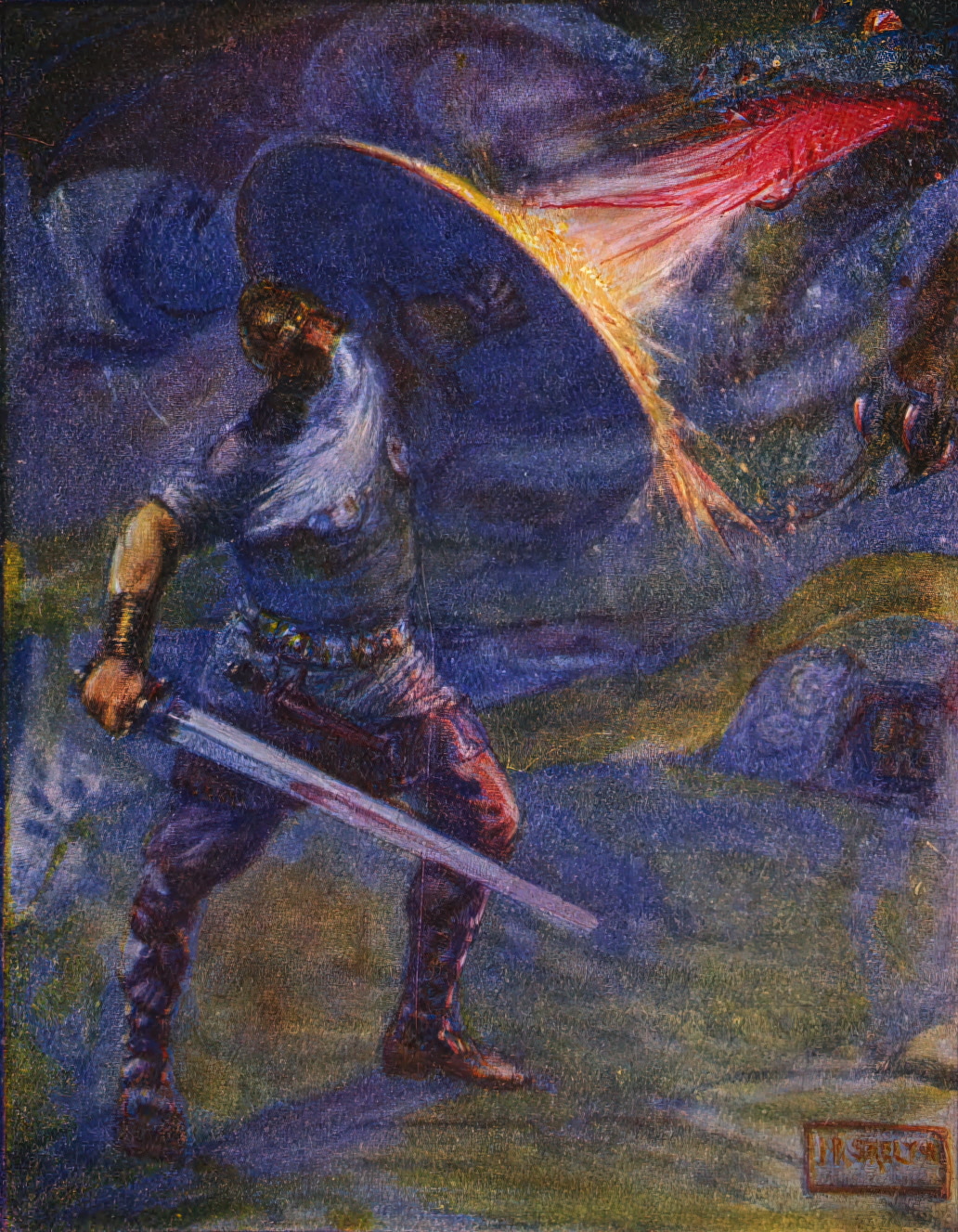
- The dragon: Decades later, while ruling as king, Beowulf faces a dragon angered when a treasure is stolen from its hoard. He manages to defeat the dragon but receives a mortal wound. He names a faithful warrior, Wiglaf, as his heir and is given a funerary pyre with the treasure he won.
These confrontations are often presented as measures of personal bravery, the obligations of leadership, and the tension between heroic reputation and human vulnerability.
Themes, values, and literary features
The poem juxtaposes heroic idealism—courage, loyalty, hospitality, reputation—with the inevitability of decline. It explores the ethics of gift-giving and lord-retainer bonds, the unpredictability of fate, and the responsibilities of rulers. The language and style of the Old English original include formal boasts, vivid combat scenes, and extended digressions that connect the local story to wider Scandinavian history and folklore. Modern readers and scholars examine its blend of pagan heroic ethos and references to a Christian moral framework.
Manuscript, dating and reception
The narrative survives in a single medieval codex that has been the focus of textual study, translation, and interpretation. Scholarly estimation of the poem's composition and compilation spans a range of centuries within the early Middle Ages, and debate continues about its precise origins and oral versus written transmission. Its survival in one manuscript made it a fragile but central source for understanding Anglo-Saxon literature and culture. For more on the poem and its context, see Ecgþeow, the Danes and details on Grendel.
Legacy and modern significance
Beowulf has been translated, adapted and reinterpreted across centuries: it appears in scholarly editions, retellings for young readers, dramatic and cinematic adaptations, and work of fiction that borrows its motifs. The hero's final scenes—his loyalty to his people, his naming of Wiglaf as successor, and his death—and the funerary pyre that follows, underscore the poem's ongoing appeal as a meditation on the cost of heroism. The dragon episode is often linked in commentaries to broader medieval concerns about treasure, greed and communal security; see also material on dragons in the poem (the dragon).
Because the poem mixes historical echoes with mythic elements, modern readers approach Beowulf both as a work of imaginative storytelling and as a window into early medieval social values. Scholarship continues to balance close literary reading with archaeological and comparative study of the Scandinavian and Anglo-Saxon world that shaped the epic’s vision.
Related articles
Author
AlegsaOnline.com Beowulf: the Geatish hero of the Old English epic Leandro Alegsa
URL: https://en.alegsaonline.com/art/10642