
Benzaiten: Japanese goddess of music, water, eloquence, and fortune
Benzaiten is the Japanese adaptation of the Hindu goddess Saraswati, introduced with Buddhism. She is associated with water, music, speech, and prosperity and appears in temples, shrines, legends and art.
Benzaiten is the Japanese form of the South Asian goddess Saraswati. As a syncretic deity she combines elements from Hindu, Buddhist and native Japanese belief and is widely revered for domains that "flow"—water, speech, music and the arts—as well as for protection and good fortune. The name Benzaiten itself is the Japanized reading of characters used to render her Sanskrit name and attributes; she entered the Japanese religious landscape during the spread of Buddhism from continental Asia between the 6th and 8th centuries.
Image gallery
10 Images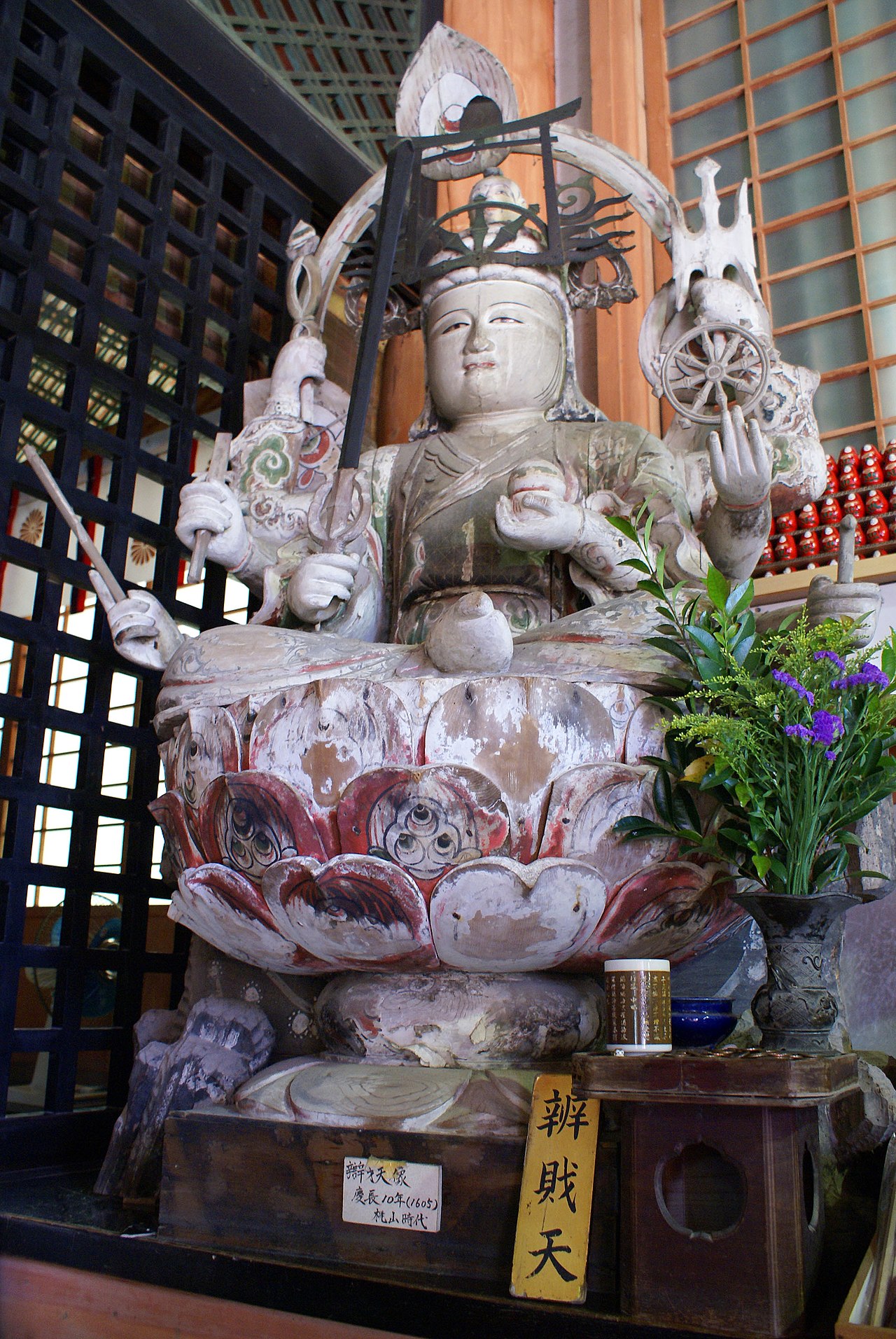




Characteristics and iconography
In Japan Benzaiten commonly appears as a graceful woman often holding a lute-like instrument (biwa) or another musical implement, emphasizing her role as patron of music, poetry and eloquence. She is also linked with flowing bodies of water: rivers, springs, wells and the sea. Artistic representations vary: some portray her accompanied by a white snake or dragon; others show a jewel (symbolizing wish-fulfillment) or a mirror. In earlier Indian and Tibetan forms she can appear with multiple arms and different attributes, but the typical Japanese image simplifies these into a largely human figure emphasizing artistic and verbal gifts.
Origins and historical transmission
Benzaiten traces back to the Vedic and later Hindu figure Sarasvatī, originally a river goddess who became associated with speech, learning and the arts. Vedic hymns depict Sarasvatī with both nourishing and formidable qualities; in some strands of the tradition she is linked to triumph over serpentine foes, a motif that later influenced East Asian storytelling and visual associations with snakes and dragons. The cult of Benzaiten arrived in Japan via China and Korea alongside Buddhist scriptures, notably texts such as the Sutra of Golden Light, which presented her as a protector figure. Over centuries she was incorporated into both Buddhist temples and Shinto shrines through the practice of syncretism (shinbutsu shūgō).
Worship, shrines and legends
Benzaiten is worshipped at many coastal, island and lakeside sites where water and protection are emphasized. Notable centers of devotion include the island of Enoshima, celebrated in local legend and the medieval chronicle Enoshima Engi written by the monk Kokei in the Heian period, and sacred islets such as Chikubu-jima on Lake Biwa. Legends often present her as connected with dragons or a dragon-king of a central lake—figures that combine Buddhist cosmology and local lore. In many shrines she is merged with indigenous deities such as Ugajin, sometimes depicted as a rice-holding snake-headed spirit, reflecting religious blending unique to Japan.
Functions, festivals and cultural importance
Practically, devotees pray to Benzaiten for success in creative pursuits, for eloquence in speech and writing, for safe passage across water, and for prosperity. Her inclusion among the Seven Lucky Gods made her an object of popular devotion in the medieval and early modern periods, and she remains a common figure in festivals, temple art and folk talismans. Musicians, writers and merchants have historically sought her favor; in fine arts she is a recurring subject in prints, paintings and temple sculpture.
Notable distinctions and facts
- Benzaiten’s origin in a river goddess highlights the shift from natural to cultural domains—water to words and music.
- Her iconography blends Indian, Chinese and Japanese motifs: multi-armed forms exist in imported Buddhist art, while local depictions often emphasize the biwa and dragon companions.
- She exemplifies religious syncretism: simultaneously a Buddhist deity, a Shinto-associated kami in many shrines, and a figure assimilated into popular luck-bringing belief.
For further reading on the historical texts that contributed to Benzaiten’s role in Japan, see discussions of the Sutra of Golden Light and references to Sarasvatī in Vedic literature such as the Rigveda. General introductions to her cult and its regional variants appear in studies of the Japanese reception of Buddhist deities, accounts of the Sarasvati tradition and surveys of sites like Sagami Bay and the many island shrines that preserve her local legends.
Benzaiten remains a living presence in Japanese religiosity: a deity who bridges water, art and worldly fortune and whose diverse images and stories reflect centuries of cultural exchange across Asia.
Questions and answers
Q: What is the Japanese name of the goddess Saraswati?
A: The Japanese name of the goddess Saraswati is Benzaiten (弁才天, 弁財天).
Q: How did worship of Benzaiten arrive in Japan?
A: Worship of Benzaiten arrived in Japan mainly through Chinese translations of the Sutra of Golden Light during the 6th to 8th centuries.
Q: What does her Sanskrit name mean?
A: Her Sanskrit name, "Sarasvatî Devî", means "flowing water".
Q: Why is Benzaiten associated with words, speech and music?
A: Because her Sanskrit name translates to "flowing water", Benzaiten became associated with anything that flows, including words, speech and music.
Q: How did she become a protector of people in Japan?
A: Through the Sutra of Golden Light, she became a protector of people in Japan.
Q: How is she linked to snakes and dragons in Japan?
A: In the Rig-Veda (6.61.7), Sarasvati killed the three-headed snake Vritra which likely contributed to her close link with snakes and dragons in Japan.
Q: Where is there a shrine dedicated to her?
A: There is a shrine dedicated to Benzaiten on Enoshima Island located 50 kilometers south Tokyo in Sagami Bay.
Related articles
Author
AlegsaOnline.com Benzaiten: Japanese goddess of music, water, eloquence, and fortune Leandro Alegsa
URL: https://en.alegsaonline.com/art/10631