
Vought F4U Corsair: U.S. Navy fighter and carrier fighter-bomber
The Vought F4U Corsair was a carrier-capable US fighter of World War II and Korea, noted for its inverted gull wing, powerful R-2800 engine, long production run and use by multiple allied naval air arms.
The Vought F4U Corsair was a single‑seat naval fighter developed in the early 1940s and deployed during World War II and the Korean War. Built originally by Chance Vought and later under license by other manufacturers, the aircraft combined a very powerful radial engine with a distinctive inverted gull wing and a large propeller. Its combination of speed, climb rate and firepower made it one of the most effective piston‑engine fighters fielded by the United States, and it served in a variety of roles from fleet air defense to ground attack.
Image gallery
10 Images




Design and technical characteristics
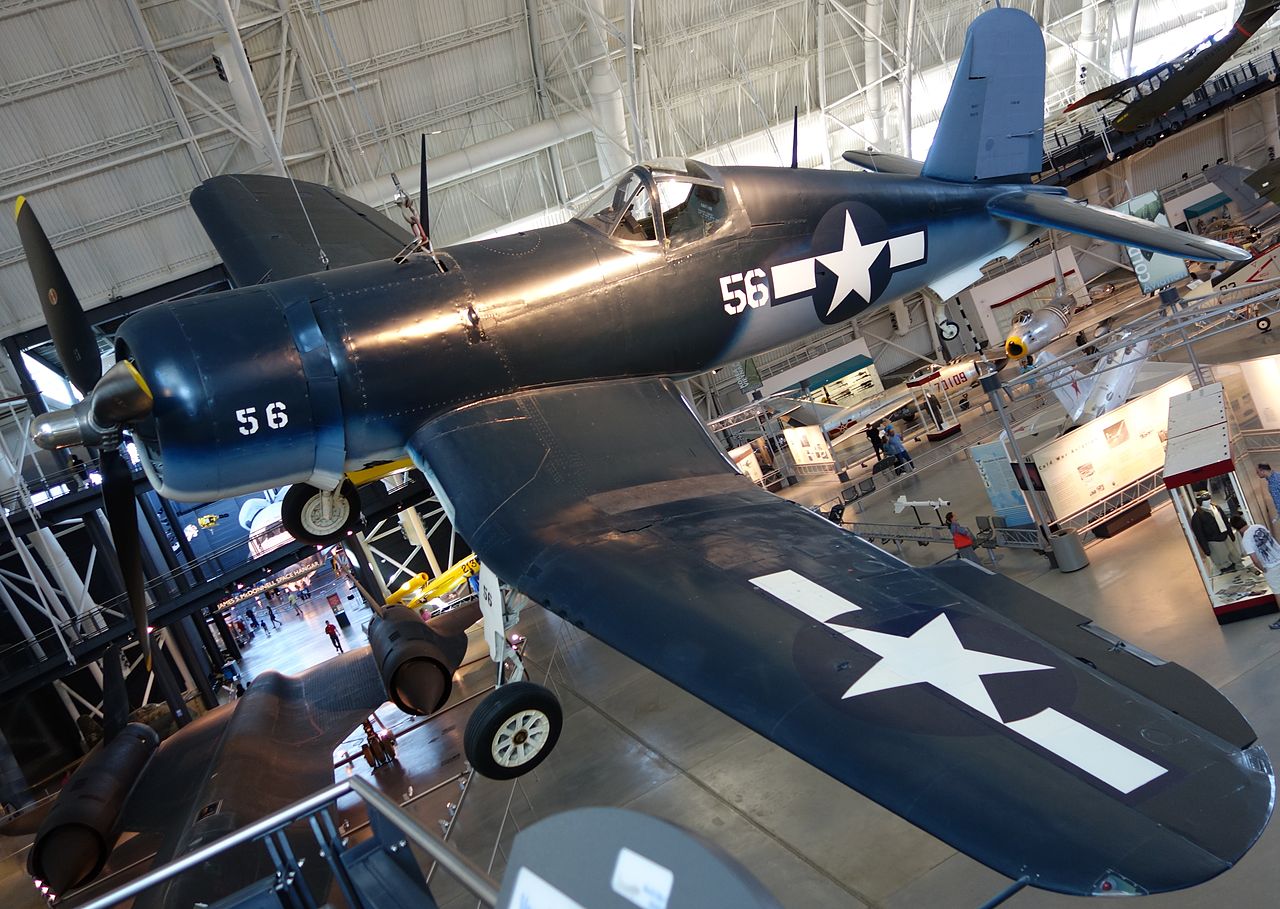
The Corsair was powered by the Pratt & Whitney R‑2800 Double Wasp 18‑cylinder radial engine, which produced roughly two thousand horsepower in combat variants and gave the type high speed and strong acceleration for its era. The airframe’s most obvious feature is the inverted gull wing: the wing bends downward from the fuselage and then back up toward the tips. This layout allowed short, robust landing gear while preserving clearance for the large diameter propeller and improved landing shock absorption.
- Performance: early Corsairs were among the first American single‑engine fighters to exceed 400 mph in level flight under combat conditions.
- Armament: typical armament arrangements included six .50‑caliber machine guns, or mixed layouts with four 20 mm cannons in certain export or later variants. The airframe could also carry rockets and bombs for strike missions.
- Visibility and carrier handling: the long nose and high power produced visibility and landing‑characteristics challenges that required specific deck procedures and pilot experience.
Production, variants and operators
Demand for the Corsair outstripped Vought’s factory capacity; under license, Goodyear and Brewster produced large numbers. The type was manufactured in several major series and many subvariants to fulfill fighter, fighter‑bomber and night‑fighter duties. Commonly cited early variants include the F4U‑1 series with machine‑gun armament and the F4U‑1C with heavier cannon armament; later models improved engines, propellers, cockpit visibility and carrier suitability.
Beyond the U.S. Navy and U.S. Marine Corps, the Corsair was operated by allied naval and air services: the British Fleet Air Arm, the Royal New Zealand Air Force, the French Aéronavale and other services used Corsairs in the latter stages of World War II and in postwar conflicts. Production continued well into the late 1940s and early 1950s, giving the Corsair one of the longest production runs of any American piston‑engined fighter.
Operational history and combat use
Introduced into combat in the Pacific, the Corsair quickly proved effective against Japanese fighters and in strike missions against shipping and ground targets. Early in its career the type was used primarily from land bases because early models had a high landing speed, tricky approach characteristics and reduced visibility over the nose—factors that made carrier landings difficult until procedural and design refinements were made. Pilots and commentators often compared the Corsair with the Grumman F6F Hellcat; the Hellcat was regarded as more forgiving to fly from carriers, while the Corsair offered superior performance in many flight regimes.
Throughout World War II the Corsair flew tens of thousands of combat sorties and was credited with a large number of aerial victories and ground attack successes. It saw renewed combat use in the Korean War as a fighter‑bomber, supporting ground forces with bombs, rockets and strafing runs. Corsairs also turned up in several regional conflicts after World War II, including operations in Central America during the late 1960s, demonstrating the platform’s longevity.
Legacy and notable facts
The Corsair is remembered for its distinctive silhouette—most notably the inverted gull wing and upward‑swept wingtips—and for its role in naval aviation history. The basic design produced many variants adapted to different missions and users. Its designer, Rex Beisel, and the engineering decisions embodied in the airframe helped reconcile the need for a very large propeller driven by a powerful engine with the structural and folding requirements of carrier aviation.
Today the F4U Corsair remains a popular type at airshows and in museum collections, prized both for its dramatic appearance and for its record as a frontline naval fighter. For further technical specifications and unit histories see dedicated reference works and museum collections; introductory summaries and operational narratives are available via general aviation resources and naval aviation histories (fighter aircraft overview, World War II context, Korean War context).
Note: This article summarizes widely reported aspects of the Corsair’s design and service. Detailed variant designations, squadron records and precise production figures are covered in specialized references and archival sources.
Related articles
Author
AlegsaOnline.com Vought F4U Corsair: U.S. Navy fighter and carrier fighter-bomber Leandro Alegsa
URL: https://en.alegsaonline.com/art/105948