
VGA connector — analog video interface (DE-15)
VGA connector: a common 15-pin D-sub analog video plug used to carry RGB and sync signals between computers and displays; legacy standard with widespread adapter options and simple mechanical design.
Overview
The VGA connector is a widely recognized analog video plug used to connect computers and other sources to display devices. It carries red, green and blue color signals plus synchronization information rather than a purely digital stream. The term often refers both to the 15-pin D-subminiature physical connector and to the family of signals that it transmits. For basic information about connectors in computing see computer connectors.
Image gallery
6 Images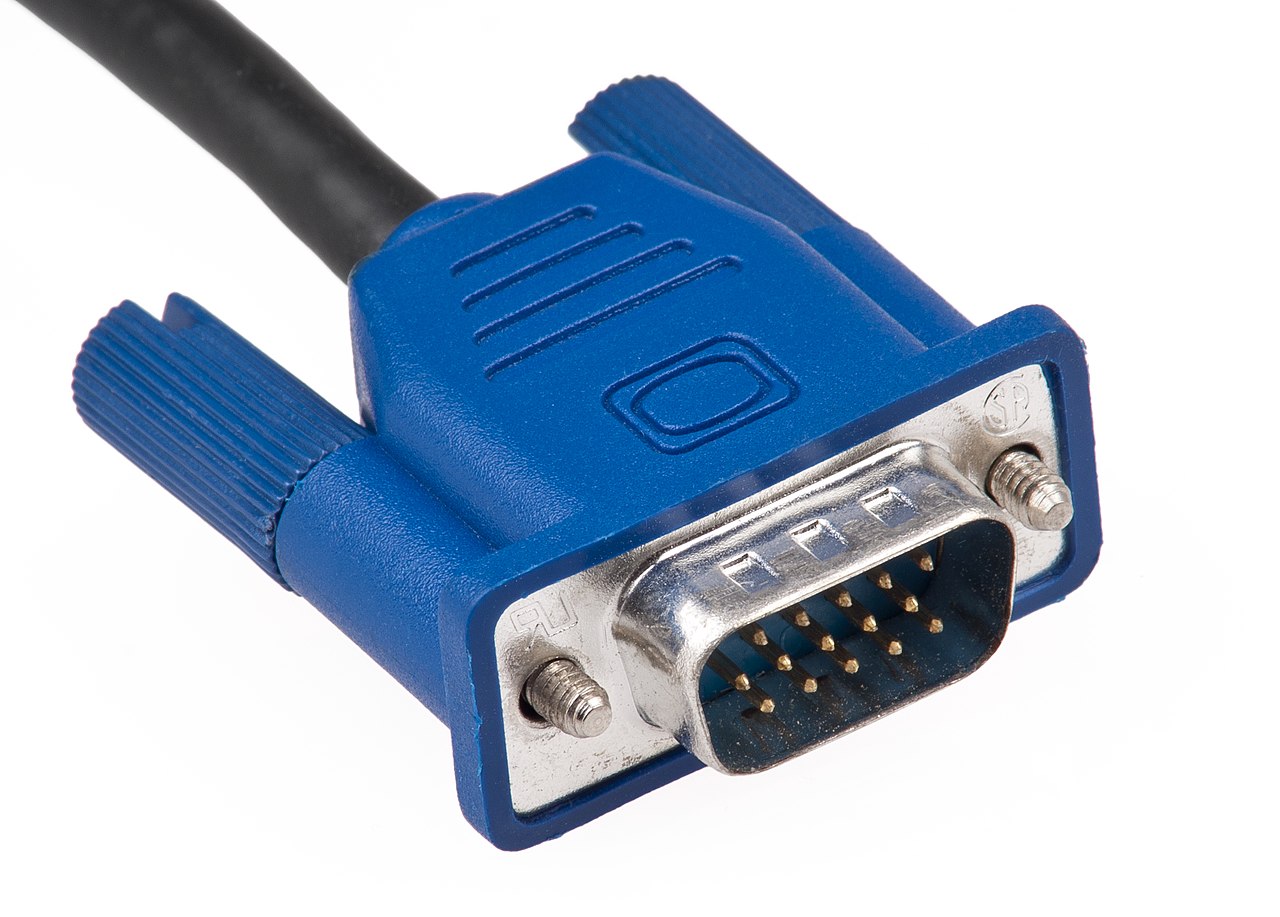


Physical characteristics
Most VGA connectors have 15 pins arranged in three rows of five and are typically implemented as a female receptacle on monitors and a male plug on cables. Some variants use three rows of six pins; these are less common. The connector shell is a D-shaped metal shield that secures with two thumbscrews or captive screws. Cables can vary in shielding and pin quality, which affects image stability and susceptibility to interference.
Signals and limitations
VGA carries analog video: separate color channels plus horizontal and vertical sync. Because the signal is analog, image quality depends on cable length, shielding and the signal path; long or poor-quality cables can blur or distort the image. While VGA can display a wide range of resolutions and refresh rates, its analog nature makes it less suitable for modern high-bandwidth digital formats. For a contrast, see modern digital interfaces such as HDMI.
History and development
VGA originated in the late 1980s as part of the video standard for personal computers and quickly became a de facto connector for PC displays. Over decades it remained common on desktop monitors, projectors and some televisions even as digital interfaces grew. Its longevity is due in part to simplicity and broad hardware support.
Uses, adapters and compatibility
VGA is still used for legacy equipment, projectors, some professional displays and scenarios where an analog path is acceptable. Adapters and converters allow VGA to interoperate with other standards: passive adapters can connect certain combined analog/digital ports to VGA, while active converters are required to translate pure digital outputs to analog VGA. Examples: analog video devices, legacy output gear, display devices, and some television models television.
Notable facts and distinctions
- VGA is analog; it differs fundamentally from digital interfaces in signal encoding.
- The common 15-pin D-sub connector is often called DE-15 or HD-15 in product listings.
- Despite being largely superseded, VGA remains in use because of backwards compatibility and simple mechanical design.
Related articles
Author
AlegsaOnline.com VGA connector — analog video interface (DE-15) Leandro Alegsa
URL: https://en.alegsaonline.com/art/104841