
Venturi effect: fluid speed, pressure changes, and practical uses
The Venturi effect describes how a fluid’s velocity increases and its static pressure decreases when flowing through a constriction, a consequence of mass and energy conservation used in meters, atomizers, and pumps.
Overview
The Venturi effect is the observed drop in static pressure that occurs when a fluid flows through a narrowed section of a pipe or channel. As cross‑sectional area decreases the flow must accelerate to conserve mass, and some of the fluid's static pressure is converted into kinetic energy. The effect is a specific manifestation of broader fluid dynamics principles, most often explained by the continuity concept and Bernoulli's principle.
Image gallery
6 Images



Basic principles
In many practical situations the effect is analyzed using two connected ideas. First, the conservation of mass (for incompressible flow), often expressed by the continuity equation, links cross‑sectional area and velocity. Second, conservation of mechanical energy in a flowing fluid means that increases in velocity are accompanied by reductions in static pressure, reflecting a redistribution of energy rather than creation or destruction of energy; this idea is related to conservation of energy and is embodied in Bernoulli’s relation.
Typical form and components
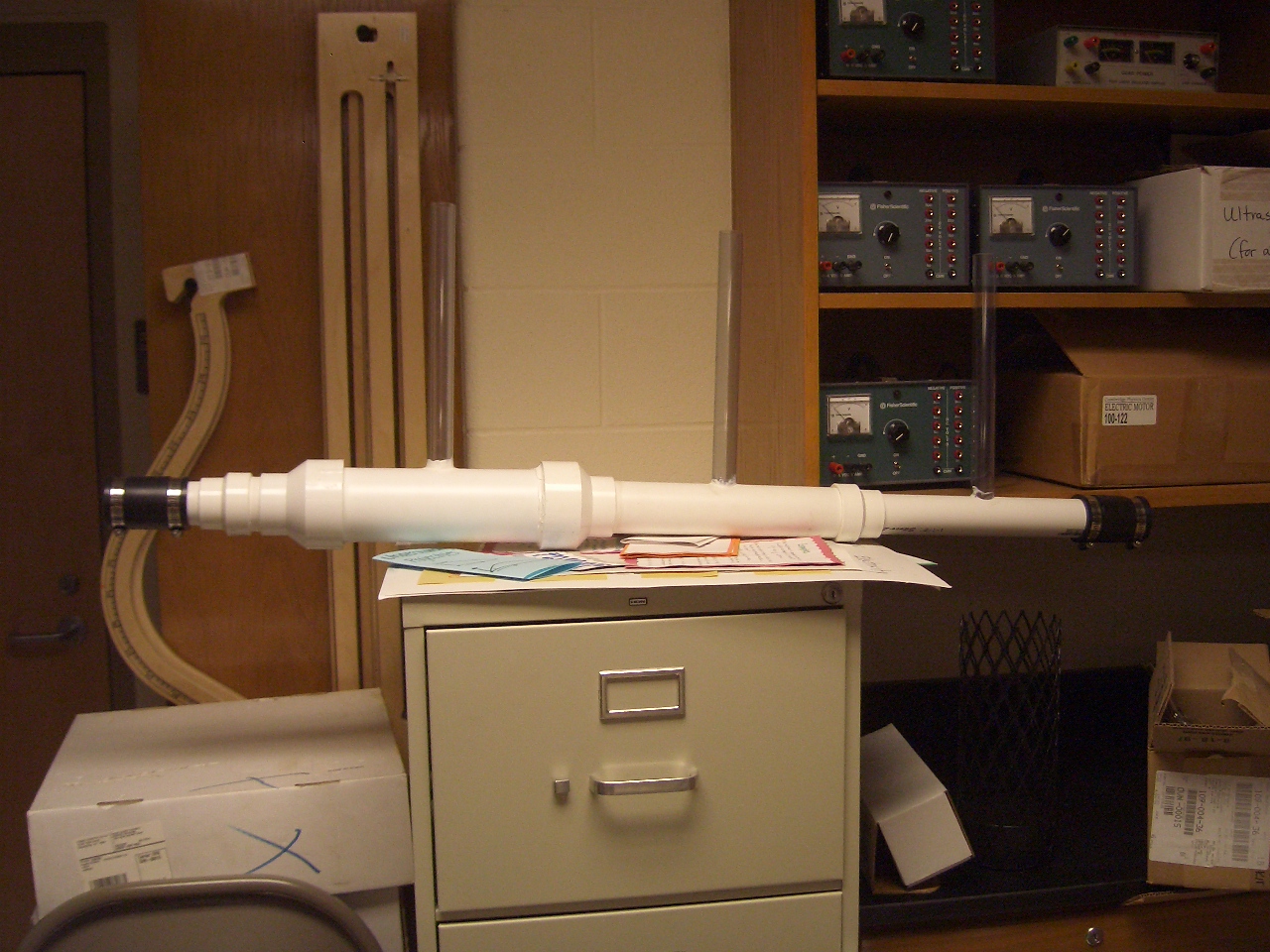
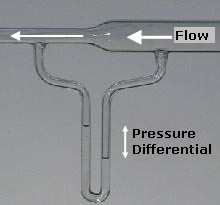
A common engineering implementation is the Venturi tube, which has a converging inlet, a narrow throat and a diverging outlet. Measuring the pressure difference between the wide section and the throat allows flow rate estimation because the pressure change depends on the speed change. Practical installations include gentle tapers to reduce turbulence and allow partial recovery of pressure downstream.
Applications and examples
- Flow meters and orifice devices for measuring liquid and gas flow.
- Carburetors and atomizers, where low pressure at a throat draws in fuel or spray.
- Aspirators and vacuum pumps that use a high‑speed jet to entrain a secondary fluid.
- Medical nebulizers and laboratory gas mixers.
Limitations and notable facts
The simple picture assumes steady, frictionless flow of an incompressible fluid. In reality viscosity causes head loss and incomplete pressure recovery, and compressibility becomes important at high speeds (leading to choking or shock phenomena). In liquids, excessive pressure reduction can cause cavitation if pressure falls below the vapor pressure. Despite these limits, the Venturi effect remains a robust, widely used concept linking geometry, flow velocity and pressure in fluid systems.
Related articles
Author
AlegsaOnline.com Venturi effect: fluid speed, pressure changes, and practical uses Leandro Alegsa
URL: https://en.alegsaonline.com/art/104598