
Vatnajökull: Iceland’s largest ice cap and its landscape
Vatnajökull is Iceland’s largest glacier and an active ice cap. It covers over 8% of the country, contains outlet glaciers, subglacial volcanoes, and is central to Icelandic natural hazards, tourism and research.
Overview
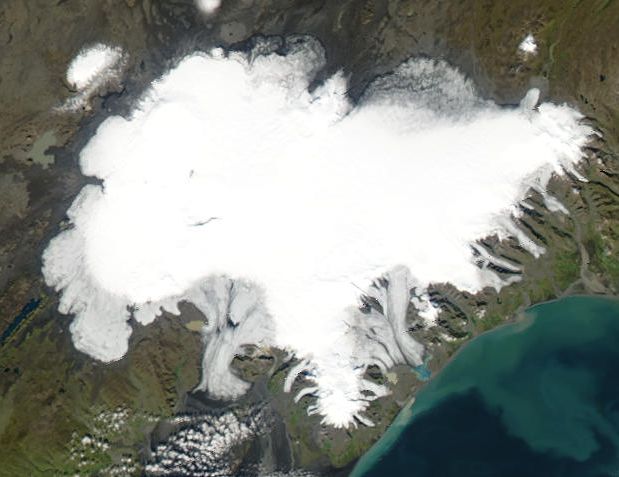
Vatnajökull is the largest glacier in Iceland and one of the biggest ice caps in Europe, covering more than 8% of the island. The name is commonly rendered in English as "Glacier of Lakes" and in Icelandic reflects a long relationship between ice and water in the landscape. It lies in southeastern Iceland and forms a dominant feature of the countryside, rising above surrounding plains and feeding many of the country’s glacial rivers and lagoons.
Image gallery
6 Images


Characteristics and structure
Vatnajökull is classified as an ice cap: a dome-shaped mass of ice that spreads outward in all directions and feeds numerous outlet glaciers. Its average thickness is around 400 metres, and in places the ice reaches about 1,000 metres. The high points of the ice cap include peaks such as Hvannadalshnúkur, near the southern margin of the ice, which reaches roughly 2,110 metres above sea level. The surface shows the full range of glacial features — crevasses, moulins, bergschrunds and moulting zones — while its margins produce large glacial rivers and proglacial lagoons.
Geology, volcanism and floods
Vatnajökull overlies an active volcanic region. Several significant volcanoes lie beneath or at the ice edge, and subglacial eruptions have produced dramatic events. When a subglacial eruption melts sufficient ice, sudden glacial outburst floods (jökulhlaups) can occur, carrying large volumes of water and sediment downstream and reshaping valleys. Notable volcanic systems associated with the ice cap include Grímsvötn and Bárðarbunga, which have produced eruptions and rifting episodes in recent decades.
History, conservation and change
Like many glaciers worldwide, Vatnajökull has shown long-term variability. In the late nineteenth and early twentieth centuries parts of the ice advanced in some intervals, but much of the cap has been in net retreat since the early twentieth century and especially in recent decades. Conservation efforts led to the creation of Vatnajökull National Park, which protects large portions of the ice and adjacent landscapes and supports scientific monitoring of ice mass, hydrology and volcanic activity.
Human use, tourism and research
The glacier is a major destination for tourists: guided glacier walks, ice-cave visits, snowmobile excursions and scenic viewpoints at glacier lagoons draw visitors year-round. Scientists study Vatnajökull to understand ice dynamics, climate change signals, subglacial volcanism and downstream impacts on rivers and ecosystems. Hydropower schemes and hazard planning also rely on data from the ice cap because sudden floods can threaten infrastructure and communities.
Notable facts and distinctions
- Vatnajökull supplies many outlet glaciers and glacial rivers that shape southeastern Iceland’s landscape.
- The ice cap sits above active volcanic systems; eruptions beneath the ice can trigger jökulhlaups and create new landforms.
- There is a widely reported claim — documented by Guinness World Records — that Vatnajökull has been sighted from the Faroe Islands, some 550 km away, a phenomenon attributed to extreme atmospheric refraction. That claim and the underlying observation have been subject to technical analysis and debate.
- For readers wanting basic translations and place information see: name and translation, general information on glaciers and on Iceland. For glacier classification and terminology consult: ice cap definition. Cultural and geographic context for the sightline claim can be explored via sources on the Faroe Islands.
Vatnajökull remains a landscape of contrasts: an immense store of freshwater ice, a stage for powerful volcanic forces, a laboratory for climate and glaciological research, and a scenic centerpiece for communities and visitors in southeastern Iceland.
Related articles
Author
AlegsaOnline.com Vatnajökull: Iceland’s largest ice cap and its landscape Leandro Alegsa
URL: https://en.alegsaonline.com/art/104356