
Panama Canal: History, design, and global significance
The Panama Canal links the Atlantic and Pacific across Panama. This article explains its geography, lock system, historical construction, 2016 expansion, economic role and notable technical and political facts.
Overview
The waterway known as the Panama Canal is a human-made canal that crosses the country of Panama in Central America. It provides a navigable route between the Atlantic Ocean and the Pacific Ocean, dramatically shortening journeys that would otherwise have to go around South America. Because of the S-shaped curve of the Panamanian isthmus, the Pacific entrance lies somewhat farther east than the Atlantic entrance, an arrangement that is the opposite of what many people assume when picturing a simple east–west crossing.
Image gallery
1 Image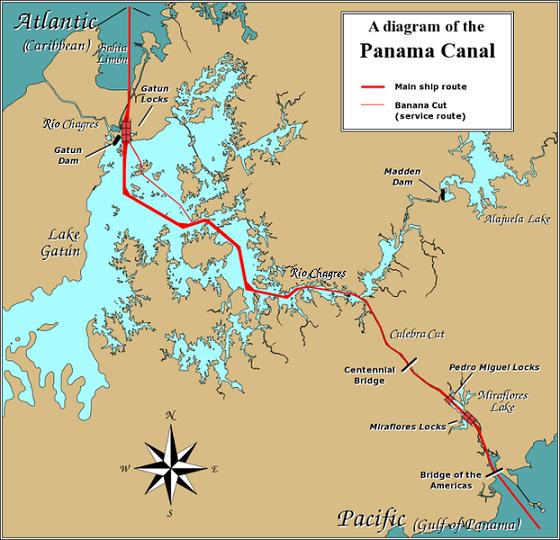
Design and main features
The canal stretches roughly 77 km across the isthmus and relies on a system of locks rather than a sea-level cut. At each end and near the central lake there are lock complexes: three parallel chambers on the Atlantic side and a similar set on the Pacific side that lift and lower vessels on different water levels. These locks and the associated approach channels allow ships to traverse the route in a matter of hours rather than days or weeks.
Lock dimensions and expansion
Original lock chambers were about 110 feet wide and roughly 1,050 feet long with a usable length near 1,000 feet, defining the maximum vessel size known as "Panamax." To accommodate growing ship sizes, a major expansion opened in 2016 introducing larger chambers — the New Panamax or Neopanamax locks — with greater width, length and depth. The expansion included new approach channels and water-saving basins so that many more and larger commercial vessels can transit the canal, increasing its capacity and changing global shipping patterns.
Construction and historical development
The first major attempt to build an interoceanic canal across Panama was led by Ferdinand de Lesseps, the French engineer who had earlier overseen the Suez Canal; that effort failed in the 1880s due to engineering problems, financial collapse and high mortality from tropical disease (Ferdinand de Lesseps). Work later resumed under the authority of the United States, during the administration of Theodore Roosevelt, and was completed in the early 20th century after large investments in excavation, lock construction and public-health measures. The canal opened in 1914 and remained under U.S. control until the end of the 20th century, when sovereign administration transferred to Panama following bilateral agreements.
Economic role and operations
By providing a shortcut between oceans, the canal reduces voyage distance and time for commercial shipping, saving fuel and lowering freight costs for many routes. Tens of thousands of transits have taken place since opening; in recent decades annual traffic has been measured in the low tens of thousands of ships. Cargo carried through the canal includes containerized freight, bulk commodities and petroleum products. The canal's owner-operator controls scheduling and tolls and must balance commercial demand with constraints such as freshwater supply for lock operation and environmental protections for adjacent watersheds.
Notable facts and distinctions
- The canal is not a sea-level passage but a lock-based route that relies on a large artificial lake as a water source and elevation step.
- Ships built to the size limits of the old chambers were termed "Panamax"; the newer, larger locks created a "New Panamax" class with substantially greater cargo capacity.
- Health and engineering advances—particularly mosquito control and sanitary works—were decisive in making construction feasible during the American phase of work.
- The facility remains strategically and economically important for global trade and regional development, prompting continued study of capacity, climate impacts and operational resilience.
For further technical specifications, historical timelines and operational rules consult authoritative sources and the canal authority publications, or follow links that provide detailed maps, engineering diagrams and transit guidance.
waterway canal country Panama Central America Atlantic Ocean Pacific Ocean farther east opposite 77 km isthmus locks ships South America Ferdinand de Lesseps United States Theodore Roosevelt
Questions and answers
Q: What is the Panama Canal?
A: The Panama Canal is a waterway (a canal) in the country of Panama in Central America, that connects the Atlantic Ocean and the Pacific Ocean.
Q: How long is the Panama Canal?
A: The Panama Canal is 77 km (48 miles) long and cuts across the Isthmus of Panama.
Q: What are the locks used for at each end of the canal?
A: At each end it uses three pairs of locks for lifting and lowering ships on different water levels. This saves ships 15,000 km (10,000 miles) compared to going around South America.
Q: How many ships come through the canal each year?
A: Each year, about 14,000 ships come through the canal. By 2002, around 800,000 ships had come through.
Q: What are Panamax and New Panamax vessels?
A: Panamax vessels are currently the biggest ships that can go through the Panama Canal and they are 110 ft (33.53 m) wide by 1,050 ft (320 m) long and 41.2 feet (12.6 m) deep with a usable length of 1,000 ft (305 m). New Panamax vessels are more than twice as big as Panamax vessels; they are 55 m (180 ft) wide by 427 m (1,400 ft) long and 18.3 m (60.0 ft) deep with new channels connecting to them at both ends of the canal.
Q: Who first attempted to build a Panama Canal?
A: Ferdinand de Lesseps tried building a Panama Canal in 1880 but could not finish it due to various difficulties encountered during construction process .
Q: Who completed construction of this project ?
A: The project was started again in 1904 by United States under presidency Theodore Roosevelt who spent ten years & 375 million dollars building it . It was finally finished in 1914 , at cost approximately 25 , 000 lives .
Related articles
Author
AlegsaOnline.com Panama Canal: History, design, and global significance Leandro Alegsa
URL: https://en.alegsaonline.com/art/74304