
George H. W. Bush
Biography of George Herbert Walker Bush, 41st U.S. president (1989–1993): Navy service, business career, long public service including vice presidency, presidency, policies, family, and legacy.
Overview
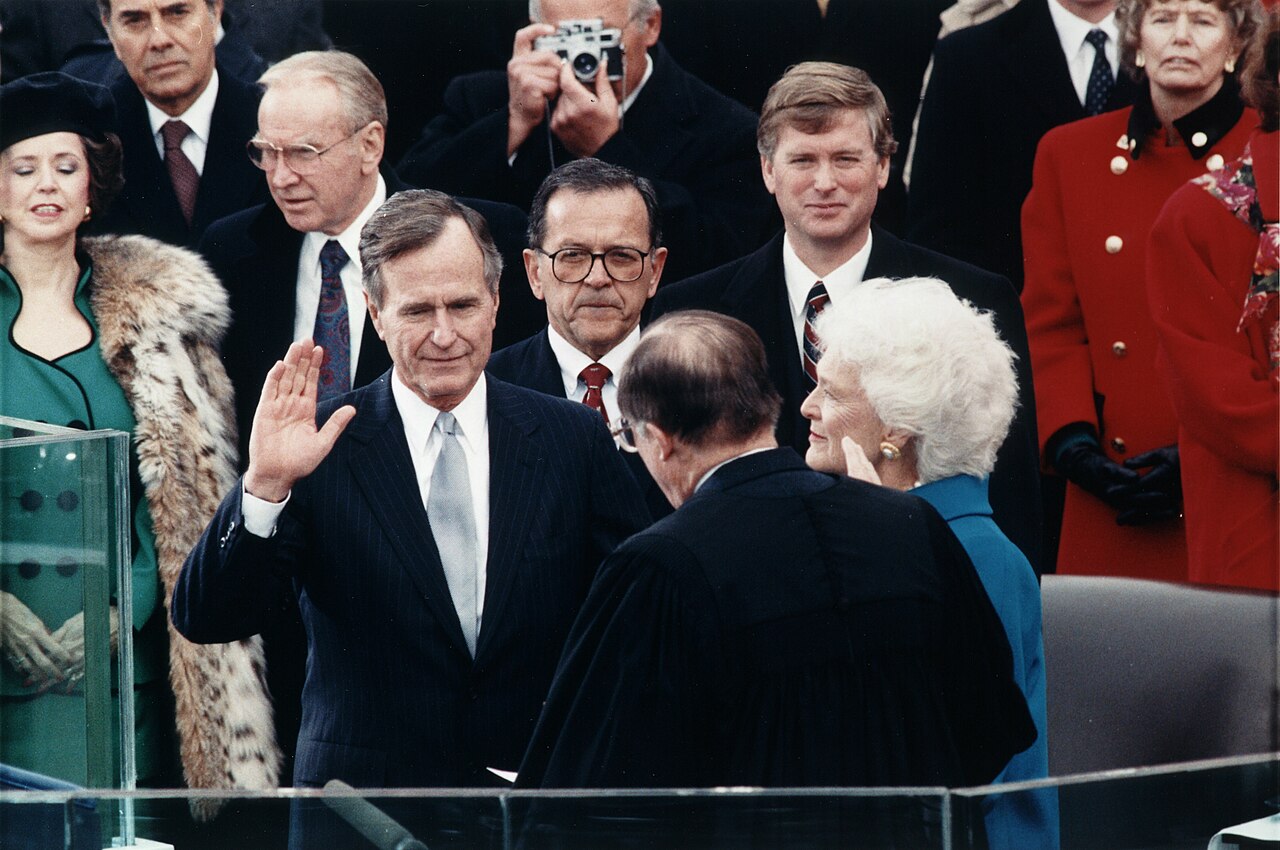
George Herbert Walker Bush (June 12, 1924 – November 30, 2018) was an American politician and businessman who served as the 41st president of the United States from 1989 to 1993. He held a long series of public offices before his presidency, including two terms as vice president under Ronald Reagan, Director of Central Intelligence, U.S. Ambassador to the United Nations, and a term in the U.S. House of Representatives. A member of the Republican Party, Bush was known for a pragmatic foreign policy during the ending years of the Cold War and for domestic choices that reflected both conservative and centrist tendencies.
Image gallery
10 Images



Early life, family and education
Bush was born in Milton, Massachusetts, and grew up primarily in Greenwich, Connecticut. He came from a family active in business, finance, and public affairs. He attended Phillips Academy and left school to join the United States Navy Reserve during World War II, serving as a naval aviator. After the war he enrolled at Yale University, where he completed his degree before moving to Texas to pursue a career in the oil industry. His marriage to Barbara Bush endured for more than seven decades and produced six children, including George W. Bush and Jeb Bush, both of whom pursued political careers.
Military service and business career
Bush's wartime service as a young naval aviator and his return to civilian life shaped his sense of duty and public responsibility. In Texas he entered the oil business as an entrepreneur and executive; his work in the energy sector helped build his reputation as a pragmatic manager and provided both resources and a network for his later political activity. He combined business experience with a public-service orientation that led him to seek elective office in the 1960s.
Political rise (1960s–1976)
After an unsuccessful bid for the U.S. Senate in 1964, Bush won a seat in the U.S. House of Representatives in 1966. He later moved into appointed diplomatic and party roles: in 1971 he became U.S. Ambassador to the United Nations, he served as chairman of the Republican National Committee, and in the mid-1970s he was named by President Gerald Ford to be the chief of the United States liaison office in China. In 1976 he was appointed Director of the Central Intelligence Agency, a post that added to his foreign policy credentials and broadened his national profile.
Vice presidency (1981–1989)
After seeking the Republican presidential nomination in 1980 and failing to win it, Bush was chosen as the vice presidential running mate for Ronald Reagan. He served two terms as vice president, a period in which he was involved in both domestic and foreign policy discussions and developed relationships across the Republican coalition. His time as vice president positioned him as a leading figure for the party and set the stage for his 1988 presidential campaign.
1988 campaign and presidential transition
In 1988 Bush secured the Republican nomination and defeated Democratic nominee Michael Dukakis in the general election. His campaign emphasized experience, steady leadership, and continuity with the foreign policy approaches of the Reagan years. Upon election he began a transition that emphasized coalition diplomacy abroad and responsible governance at home.
Presidency: foreign policy and international events
Bush's presidency coincided with major global changes. He navigated the final phase of the Cold War, engaged with Soviet and post-Soviet leaders, and worked with allies to manage the shift in Europe and Asia. He led a broad international coalition in response to Iraq's invasion of Kuwait, overseeing the military campaign commonly known as the Gulf War that restored Kuwaiti sovereignty. He also authorized operations aimed at removing the Panamanian leader Manuel Noriega from power in order to protect U.S. interests and restore a civilian government.
Domestic policy and key legislation
On the domestic front, Bush signed landmark bills and pursued a policy agenda that blended conservative goals with pragmatic compromise. He signed the Americans with Disabilities Act, a major civil-rights statute that prohibited discrimination on the basis of disability and expanded access to employment, public facilities, and transportation. He negotiated trade initiatives that contributed to the framework later formalized as NAFTA. In fiscal policy he agreed to a budget compromise that included revenue increases intended to reduce the federal deficit; the decision contrasted with his campaign pledge of "no new taxes" and proved politically costly.
Judicial appointments and institutional influence
Bush appointed two justices to the Supreme Court, David Souter and Clarence Thomas, shaping the court's composition and influencing legal debates for years afterward. His judicial selections and broader appointments to federal courts were an important element of his presidential legacy, affecting rulings on civil rights, administrative law, and other long-term issues.
1992 election and post-presidential activities
Facing economic concerns and an energetic Democratic challenge, Bush lost his bid for reelection in 1992 to Democrat Bill Clinton. After leaving office in 1993, he remained active in public life. He engaged in humanitarian projects and partnered with former political rivals on relief efforts, most visibly with President Clinton in coordinating responses to disasters and in supporting charitable causes. His post-presidential years were marked by steady involvement in civic activities and by the continuing public roles of members of his family.
Family, later years and death
Bush's large family included children who remained active in public and political life: George W. Bush became the 43rd president of the United States, and Jeb Bush served as governor of Florida and later sought the Republican presidential nomination. Bush spent his later years in Houston, Texas, where he died in 2018 at age 94. His marriage to Barbara Bush and their long partnership were widely noted as a significant personal anchor through decades of public life.
Legacy and historical assessment
Historians and public opinion assessments generally regard Bush as strong on foreign policy, praising his diplomatic skill, coalition building, and measured leadership during rapid geopolitical change. Evaluations of his domestic record are more mixed: he achieved significant legislative successes such as the ADA but faced criticism for economic decisions and political costs associated with fiscal compromises. He is often described as a model of public service whose career spanned elected office, diplomacy, intelligence, and executive leadership, and who combined a commitment to international engagement with a pragmatic approach to governance.
For fuller treatments of his life and presidency, consult scholarly biographies, contemporaneous archival material, and official records that document his roles in pivotal events at the end of the twentieth century.
Questions and answers
Q: Who was George Herbert Walker Bush?
A: George Herbert Walker Bush was an American politician and businessman who served as the 41st president of the United States from 1989 to 1993. He was also the 43rd vice president from 1981 to 1989, an ambassador to the United Nations, a congressman, and Director of Central Intelligence.
Q: When did he serve as President?
A: George Herbert Walker Bush served as President from 1989 to 1993.
Q: What other roles did he have before becoming President?
A: Before becoming President, George Herbert Walker Bush held various roles such as being the 43rd Vice President under Ronald Reagan's administration, Ambassador to the United Nations, Congressman and Director of Central Intelligence.
Q: Who was his wife?
A: His wife was Barbara Bush whom he married in 1945 until her death in 2018.
Q: How many children did they have?
A: They had six children together including their son George W. Bush who became the 43rd president of the United States and their son Jeb Bush who became governor of Florida in 1998.
Q: What significant events happened during his presidency?
A: During his presidency, George Herbert Walker Bush led America through the end of The Cold War, presided over Panama's invasion and The Gulf War and signed The Americans with Disabilities Act which prohibited discrimination against disabled people. He also signed NAFTA which went into effect in 1994 and appointed two Supreme Court justices David Souter and Clarence Thomas.
Q: How is he ranked among presidents? A: He is ranked as an above-average president by historians
Author
AlegsaOnline.com George H. W. Bush Leandro Alegsa
URL: https://en.alegsaonline.com/art/138823