
Tyndall effect — light scattering that makes beams and colours visible
The Tyndall effect is the scattering of light by particles in a colloid or suspension, producing visible beams and wavelength-dependent colours such as the blue of the sky and blue eyes.
Overview
The Tyndall effect is the phenomenon in which light is scattered by tiny particles suspended in a transparent medium, causing a beam or cloud of light to become visible. Named after the 19th-century physicist John Tyndall, it is commonly demonstrated when sunlight, a flashlight, or a laser beam passes through dust, smoke, mist, milk in water, or other colloidal mixtures.
Image gallery
10 Images





Physical mechanism
Scattering arises because particles interrupt and re-radiate portions of an incident light wave. Shorter wavelengths (blue and violet) are scattered more strongly than longer wavelengths (red) under many conditions, so the scattered light often appears blue. This wavelength-dependent scattering is why distant skies look blue and why some structural colours appear blue without blue pigment. The effect depends on the relative size of the particles compared with the light's wavelength; that relation determines whether scattering is more selective in colour or nearly wavelength-independent.
Regimes and distinctions
Scientists describe light scattering with several related frameworks. When particles are much smaller than the wavelength, scattering follows a strong wavelength dependence (often called Rayleigh scattering and discussed alongside the Tyndall effect); when particles are comparable to or larger than the wavelength, scattering behavior shifts toward Mie scattering and becomes less colour-selective. The term "Tyndall effect" is often used in laboratory and classroom contexts to identify visible beam-scattering in colloids, whereas specialized terms like Rayleigh or Mie are used in quantitative theory. For practical purposes the Tyndall effect highlights the visibility of light due to suspended particles rather than absorption by pigments.
Examples and observable cases
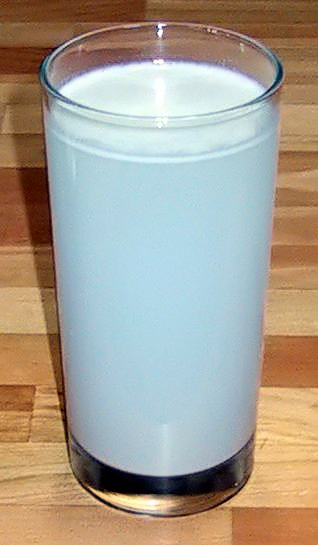
Common instances include the blue of a clear sky, the optical appearance of blue eyes, and the glow of sunlight through a dusty room. Larger droplets or particles, such as fog or coarse aerosols, scatter more uniformly across wavelengths and therefore appear white or grey rather than blue — this is why fog and clouds are not strongly coloured. Other familiar examples are the whitish appearance of stirred milk and the opalescence of some glasses and gemstones.
Uses, measurements and demonstrations
The Tyndall effect provides a simple test to distinguish true solutions (molecularly dissolved) from colloidal suspensions: a beam will cross a colloid and be visible, but not a true solution. Instruments that quantify scattered light — nephelometers and related devices — are used in atmospheric science and air quality monitoring to measure aerosols. Laboratory light-scattering techniques also help estimate particle size and concentration. Easy classroom demonstrations include shining a laser through diluted milk or smoke; for further reading, see introductory texts on light scattering and specific descriptions of Rayleigh scattering.
History and practical notes
John Tyndall's experiments in the 1800s documented how suspended particles make light paths visible and helped distinguish scattering from absorption. Modern work builds on that foundation to model atmospheric optics, design optical materials that exploit scattering for effect, and develop instruments like the Tyndallometer for monitoring. Practical observers should remember that particle composition, size distribution and viewing geometry all influence how strongly and in which colours light is scattered; simple demonstrations capture the core idea but more precise measurements require controlled equipment and calibration. For historical context and biography, consult sources on Tyndall and the study of light.
Related articles
Author
AlegsaOnline.com Tyndall effect — light scattering that makes beams and colours visible Leandro Alegsa
URL: https://en.alegsaonline.com/art/102321