
TurboGrafx-16 (PC Engine): Overview, Hardware, History and Legacy
Home video game console by NEC and Hudson Soft (PC Engine in Japan). Released 1987 (Japan) and 1989 (North America). Noted for compact design, HuCard cartridges and pioneering CD-ROM add-on.
The TurboGrafx-16, known in Japan as the PC Engine, is a fourth-generation home video game console developed by Hudson Soft and sold by NEC Home Electronics. First released in Japan in 1987 and later in North America in 1989, the system challenged established 8-bit platforms and arrived before many competitors of the so-called 16-bit era. Although its central processor is an 8-bit design, the console paired that CPU with more advanced graphics hardware and was marketed in some regions as a 16-bit machine.
Image gallery
10 Images


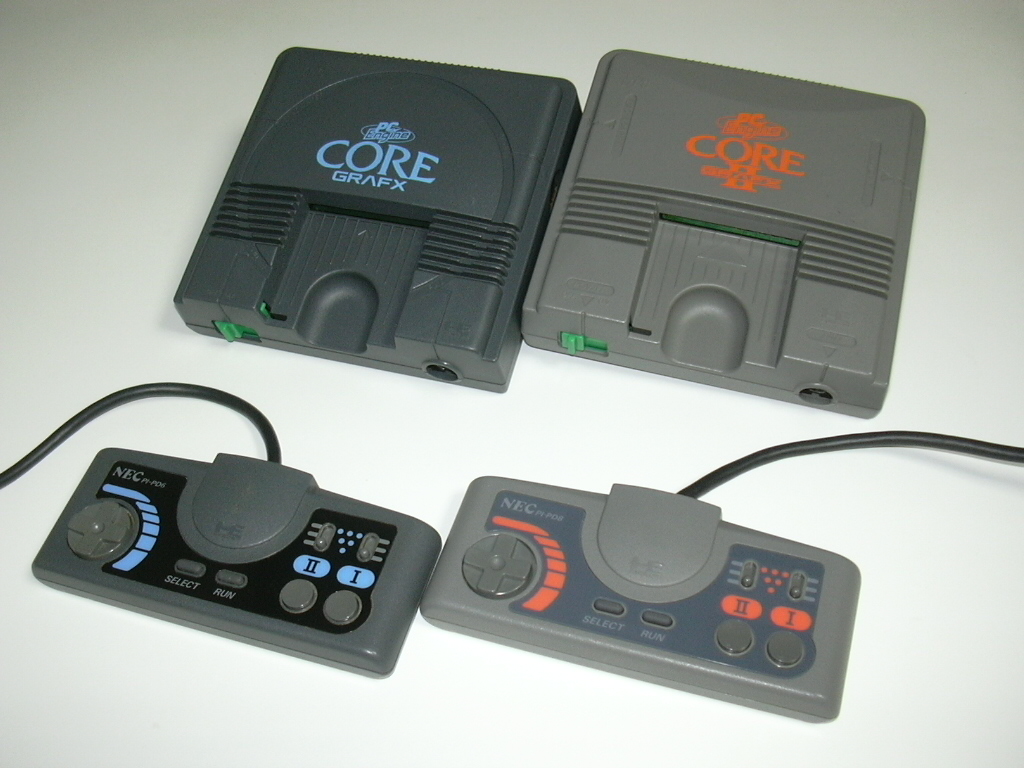
Hardware and technical characteristics
The system is distinct for its compact form factor and for using small, credit-card sized game cards called HuCards (or TurboChips in some markets) rather than larger cartridges. Key hardware characteristics include a tile- and sprite-based graphics subsystem capable of colorful backgrounds and fast scrolling, a sound subsystem suited to chiptune-style music and effects, and a cartridge slot designed for the slim HuCards. The platform also supported a modular expansion approach: optional add-ons provided additional functionality such as CD-ROM playback and enhanced storage.
- Processor and graphics: An 8-bit CPU paired with a 16-bit-capable graphics chipset, enabling effects that exceeded many contemporaneous 8-bit consoles.
- Media: HuCard cards for most games; later CD-ROM titles used the PC Engine CD-ROM² system.
- Expandability: An early and influential CD add-on extended the console's audio and storage capabilities.
History and market positioning
The console was the product of a collaboration between Hudson Soft, which handled much of the system design and software relationships, and NEC, which manufactured and marketed the hardware. In Japan the PC Engine was launched to compete with the dominant Famicom and performed strongly in its home market, thanks to a steady flow of titles and third-party support. Its North American incarnation, renamed TurboGrafx-16 to emphasize a 16-bit identity, arrived later and faced stiff competition from the Sega Genesis (Mega Drive) and, after 1991, the Super Nintendo Entertainment System.
Models, expansions and software
As the platform evolved, NEC and Hudson released several variants and bundles. Some models combined the HuCard slot and CD-ROM interface into a single unit, simplifying ownership for players who wanted both media. The CD add-on paved the way for longer games, redbook audio music, and multimedia experiments that were uncommon on earlier home consoles. The library included a variety of genres, with particular strength in shoot 'em ups, action, and Japanese role-playing games — many of which achieved cult status outside Japan.
Legacy and notable facts
The TurboGrafx-16/PC Engine is remembered for a number of notable points: it was among the first consoles to offer a commercially successful CD-ROM peripheral; it used unusually compact HuCards; and it occupied a unique technical niche with an 8-bit CPU combined with 16-bit graphics capabilities. While its impact was most pronounced in Japan, the system retains a devoted fan community worldwide. Interest in its games and hardware continues through official re-releases, retro collections, emulation projects, and a lively collector market.
Further reading
Related articles
Author
AlegsaOnline.com TurboGrafx-16 (PC Engine): Overview, Hardware, History and Legacy Leandro Alegsa
URL: https://en.alegsaonline.com/art/102060