
People's Republic (political designation)
A state title commonly adopted by governments that claim to represent the people, often associated with socialist or communist regimes; used historically across Europe and Asia and still present in several official names.
Overview
"People's Republic" (sometimes rendered "Popular Republic") is a formal element in the official names of some states. The phrase signals that sovereignty is claimed for the people rather than a monarch, and in the 20th century it became closely associated with governments that identified as socialist or communist. The most internationally prominent example is the People's Republic of China. The name also appears in compound forms such as the Democratic People's Republic of Korea.
Image gallery
1 Image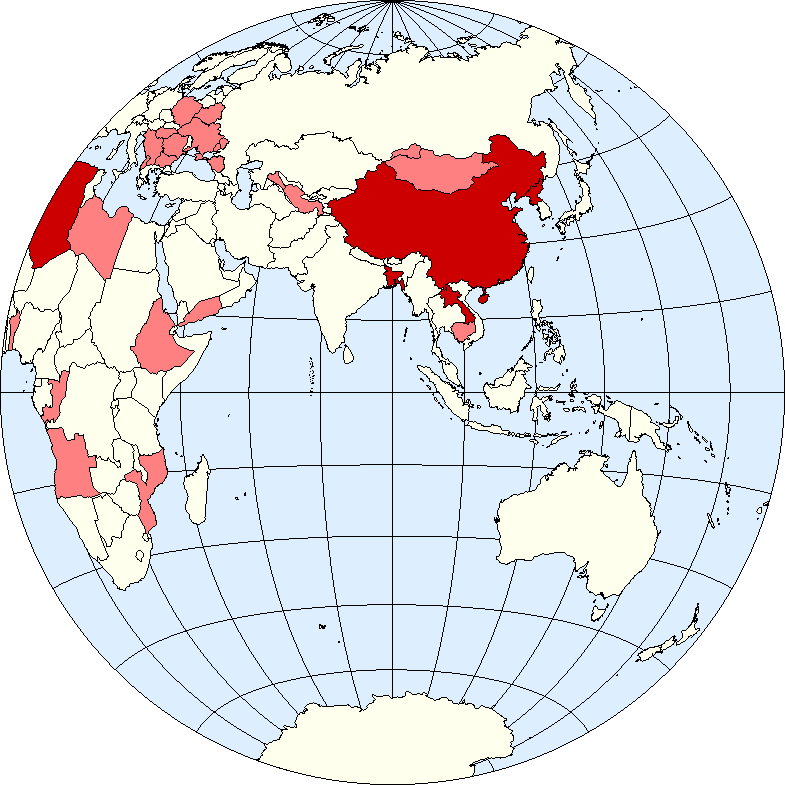
Characteristics
States using the "People's Republic" label have varied widely, but common features include rhetoric stressing popular sovereignty, social equality, and national renewal. In many cases the designation accompanied one-party rule, centralized economic planning, or state-led modernization programs; in other cases the name has been retained for historical or constitutional reasons without implying a specific economic model.
History and development
The usage of "People's Republic" increased during the 20th century, especially after major political upheavals and decolonization. Revolutions and leftist movements adopted the term to emphasize a break with monarchies, colonial administrations, or previous elites. In Europe, several post-war governments in the Eastern Bloc adopted the title as they reorganized political and economic life along socialist lines. Similar language was later used by revolutionary or newly independent states in Asia, Africa, and elsewhere.
Examples and current usage
- Contemporary: the People's Republic of China is the most widely recognized current state with this short-form title; the Democratic People's Republic of Korea uses a related formulation.
- Other modern and historical examples include states that have borne the name during periods of socialist or single-party rule or as part of their constitutional name; some have since changed names after political transitions.
Uses and significance
Adopting "People's Republic" serves both symbolic and practical aims: it projects legitimacy by invoking the people, differentiates new regimes from prior governments, and conveys ideological commitments. For international audiences the label can signal alignment with socialist movements or simply indicate a republican form of government. For domestic audiences it is part of official identity and ceremonial language.
Distinctions and notable facts
Not every country with "People's Republic" in its name follows the same policies or ideology; the precise meaning depends on each country's constitution and practice. Variants such as "Democratic People's Republic" or "Popular Republic" reflect local choices in emphasis. The presence of the phrase is therefore an indicator of political intent and historical context rather than a fixed legal or economic program.
Related articles
Author
AlegsaOnline.com People's Republic (political designation) Leandro Alegsa
URL: https://en.alegsaonline.com/art/75683