
Trigonometric functions
Functions relating angles to ratios of triangle sides or coordinates on the unit circle; fundamental in geometry, analysis, physics, engineering and signal processing.
The trigonometric functions are basic mathematical functions that connect angles with ratios of sides in right triangles and with coordinates on the unit circle. In elementary settings the primary functions are sine, cosine and tangent. Additional functions — cotangent, secant and cosecant — are defined as reciprocals of those three. These concepts appear throughout mathematics and the physical sciences because they describe periodic phenomena and relate linear and angular measures.
Image gallery
10 Images



Definitions and key properties
There are two complementary viewpoints for defining trigonometric functions. In right-triangle geometry, for an acute angle θ the sine is the ratio of the side opposite θ to the hypotenuse, cosine the adjacent side divided by the hypotenuse, and tangent the opposite divided by the adjacent side. On the unit circle (radius one) each angle corresponds to a point (cos θ, sin θ), which extends definitions to all real angles and connects trig functions to rotational symmetry.
- Periodicity: sine and cosine are periodic with period 2π; tangent has period π.
- Parity: cosine is even (cos(−θ)=cos θ), sine is odd (sin(−θ)=−sin θ).
- Pythagorean identity: sin²θ + cos²θ = 1.
- Calculus relations: derivatives and integrals of trig functions are fundamental in analysis (for example d/dθ sin θ = cos θ).
History and development
Ideas equivalent to trigonometric ratios were used by ancient astronomers and surveyors. Greek mathematicians systematized chord tables; later Indian and Islamic scholars developed sine and cosine in modern form. During the 17th–18th centuries calculus and complex analysis placed trigonometric functions on a firm analytic footing, and Euler's formula linked them to the exponential function. For background on angles and geometric origins see angles and classical treatments such as triangle geometry.
Uses and examples
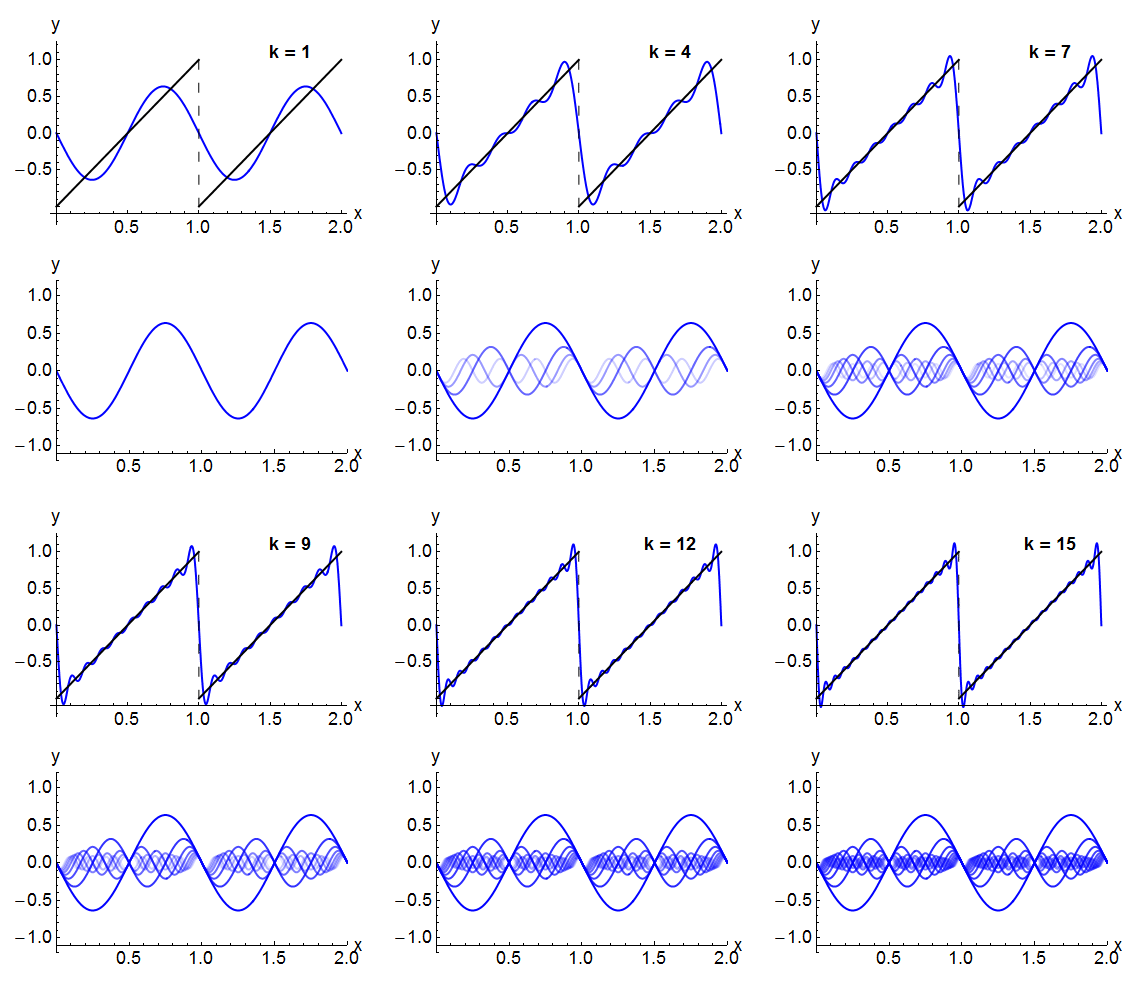
Trigonometric functions model oscillations, waves and rotations. They appear in navigation and astronomy (bearing and celestial coordinates), in engineering (signal processing, alternating current theory), and in applied mathematics (Fourier series and transforms). Simple examples include representing a vibrating string or decomposing a periodic signal into sine and cosine components; many textbooks and applications illustrate these uses in detail here.
Related functions and distinctions
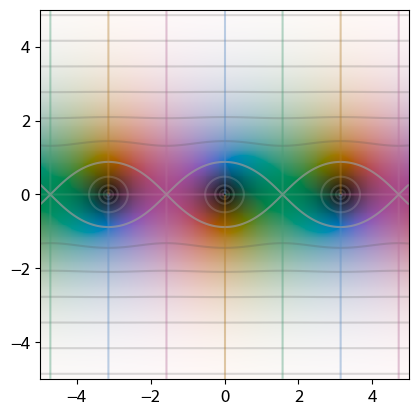
Besides the six classical functions, inverse trigonometric functions (arcsin, arccos, arctan) return angles from ratios. Hyperbolic functions (sinh, cosh, tanh) are analogous but arise from exponential definitions rather than circular geometry. Extending trig functions to complex arguments reveals deep links to exponentials and analytic continuation; more on these analytic aspects is available in advanced references.
Questions and answers
Q: What are trigonometric functions?
A: Trigonometric functions are a set of functions in mathematics that establish a relationship between angles and sides of a right triangle.
Q: What are the three most common trigonometric functions?
A: The three most common trigonometric functions are sine, cosine, and tangent.
Q: What is the difference between reciprocal trigonometric functions and other trigonometric functions?
A: Reciprocal trigonometric functions act as the reciprocals of other trigonometric functions.
Q: What are the names of the reciprocal trigonometric functions?
A: The names of the reciprocal trigonometric functions are cotangent, secant, and cosecant.
Q: Why are secant and cosecant rarely used?
A: Secant and cosecant are rarely used because they can be expressed as the inverse of sine and cosine, respectively.
Q: What is the relationship between trigonometric functions and right triangles?
A: The relationship between trigonometric functions and right triangles is that they relate angles to the sides of a right triangle.
Q: How many trigonometric functions are there?
A: There are many trigonometric functions, but the most common ones are sine, cosine, and tangent, followed by cotangent, secant, and cosecant.
Related articles
Author
AlegsaOnline.com Trigonometric functions Leandro Alegsa
URL: https://en.alegsaonline.com/art/101510
Sources
- www-history.mcs.st-andrews.ac.uk : "Madhava of Sangamagramma"
- mathworld.wolfram.com : "Tangent"