
Truncated icosahedron
An Archimedean solid formed by truncating a regular icosahedron: 12 pentagons and 20 hexagons, 60 vertices and 90 edges. Familiar as the classic soccer-ball pattern and the C60 molecule shape.
Overview
The truncated icosahedron is one of the Archimedean solids and arises by cutting (truncating) the corners off a regular icosahedron. The operation replaces each original vertex with a new pentagonal face and transforms the original triangular faces into hexagons, producing a polyhedron composed of 32 faces: 12 regular pentagons and 20 regular hexagons. It is often cited as a canonical example of a semiregular, or uniform, polyhedron because all its vertices are equivalent under its symmetry group. For more on its classification see Archimedean solids.
Image gallery
10 Images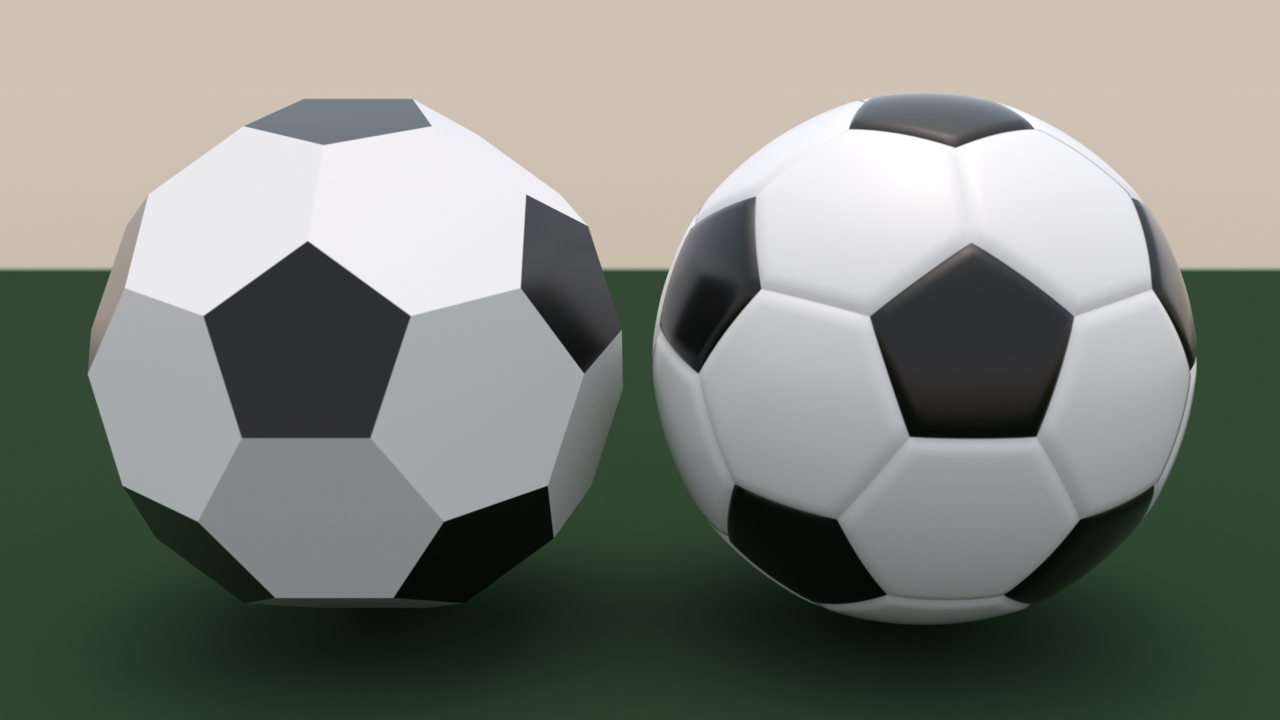


Structure and basic properties
Important numerical data are simple and widely used: 32 faces (12 pentagons + 20 hexagons), 90 edges and 60 vertices, which satisfy Euler's formula V − E + F = 2 (60 − 90 + 32 = 2). Each vertex has the configuration 5.6.6, meaning one pentagon and two hexagons meet at every vertex. The polyhedron inherits the full icosahedral symmetry of its parent, the regular icosahedron; that symmetry is commonly described as icosahedral symmetry (rotational group of order 60, full group of order 120). The truncated icosahedron can be obtained by truncating the vertices of a regular icosahedron, often denoted by the truncation notation t{3,5} in polyhedral notation.
Construction and geometry
Truncation means slicing off each corner of the original icosahedron at a plane that cuts each incident edge at the same fraction of its length. The original triangular faces become hexagons because each triangle's three corners are removed and replaced by additional edges; the five triangles that met at a vertex produce a pentagonal face in its place. The resulting faces are regular polygons when truncation is performed at the appropriate depth, so the shape is a uniform polyhedron. Geometrically it provides a good approximation to a sphere while remaining composed of flat polygonal faces.
History, names and notation
The name simply records the operation (truncation) applied to the icosahedron. It appears in classical lists of semiregular solids and in later systematic studies of uniform polyhedra. In notation used by geometers the shape is sometimes written as t{3,5} or called the truncated icosahedron; individual face types are often referred to by their polygon names, e.g. pentagons (pentagon) and hexagons (hexagon).
Uses and cultural significance
The truncated icosahedron is best known visually as the pattern used on many traditional soccer balls: a patchwork of pentagons and hexagons. In chemistry the same geometry describes the carbon-60 molecule, buckminsterfullerene (C60), whose atoms occupy the vertices and whose bonds follow the polyhedron's edges. Architects and designers use truncated icosahedral geometry for geodesic-like structures and tilings because it combines aesthetic appeal with structural regularity. It also serves as a standard example in education for discussing symmetry, truncation, and uniform polyhedra.
Notable facts and distinctions
- The truncated icosahedron is uniform but not regular: it has more than one kind of face but all vertices are equivalent.
- Each vertex joins one pentagon and two hexagons (5.6.6), and the figure is one of the 13 classic Archimedean solids.
- It is frequently used when a spherical approximation is needed with a small number of flat panels; its combination of pentagons and hexagons is shared by several natural and engineered structures.
Questions and answers
Q: What is a truncated icosahedron?
A: A truncated icosahedron is an Archimedean solid.
Q: How many faces does a regular icosahedron have?
A: A regular icosahedron has 20 faces.
Q: What happens when a regular icosahedron is truncated?
A: When a regular icosahedron is truncated, each "corner" or vertex is replaced by a pentagon as there are five edges at each corner.
Q: What is a truncated icosahedron made of?
A: A truncated icosahedron is made of 12 regular pentagons and 20 hexagons.
Q: How many vertices does a truncated icosahedron have?
A: A truncated icosahedron has 60 vertices.
Q: How many edges does a truncated icosahedron have?
A: A truncated icosahedron has 90 edges.
Q: What is the difference between a regular icosahedron and a truncated icosahedron?
A: The difference between a regular icosahedron and a truncated icosahedron is that the latter has each "corner" replaced by a pentagon, and is made of 12 regular pentagons and 20 hexagons, while the former is made of 20 faces.
Related articles
Author
AlegsaOnline.com Truncated icosahedron Leandro Alegsa
URL: https://en.alegsaonline.com/art/101817