
Trigonometry: functions, principles, history, and applications
Survey of trigonometry: definitions, main functions and identities, historical development, practical uses in science and engineering, and how it relates to geometry and the unit circle.
Overview
Trigonometry is the branch of mathematics that studies relationships involving angles, lengths and periodic functions. Its name comes from Greek roots often rendered as trigonon (triangle) and metron (measure). Traditionally part of elementary mathematics, trigonometry connects with geometry and also forms a foundation for many applied fields by encoding how quantities vary with angle or time.
Image gallery
5 Images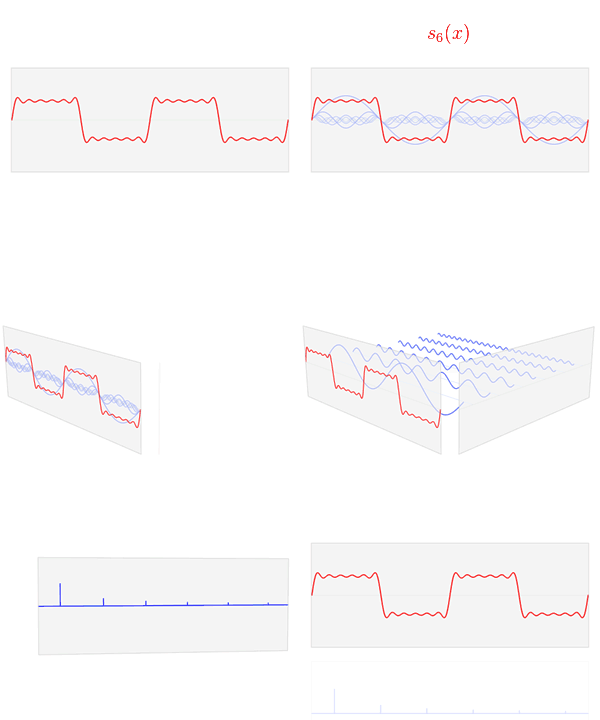



Core concepts
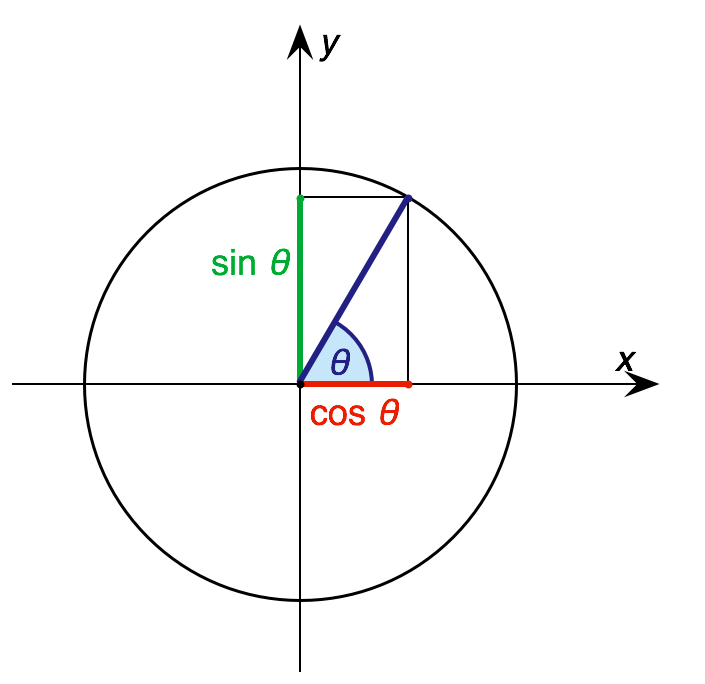
At its simplest, trigonometry began with relationships inside triangles, especially right triangles. The basic trigonometric functions—sine, cosine and tangent—relate an acute angle to ratios of two sides of a right triangle. Modern treatments extend these functions to the unit circle, where an angle corresponds to a point on a circle and the coordinates give values of sine and cosine. For further reading on angles and definitions see angles and trigonometric functions.
Fundamental functions and identities
- Primary functions: sine (sin), cosine (cos), tangent (tan).
- Reciprocal functions: cosecant (csc), secant (sec), cotangent (cot).
- Core identity: sin²θ + cos²θ = 1 (Pythagorean identity).
- Other relations include angle-addition formulas and the laws of sines and cosines, which connect side lengths and angles in any triangle.
History and development
Trigonometric ideas appear in ancient astronomy and surveying. Early practitioners in different cultures tabulated chord or sine values to solve problems involving angles. Over centuries the subject evolved from geometric tables to analytic functions, integrated into calculus and complex analysis. Contributions came from Greek, Indian, and medieval Islamic mathematicians and later European scholars who formalized the algebraic and analytic viewpoint.
Applications and examples
Trigonometry is used widely in navigation, surveying, astronomy, architecture, mechanical and electrical engineering, and signal processing. Example tasks include determining a distant height from an observed angle, converting time-varying signals into frequency components (via Fourier methods that rely on trig functions), and modeling periodic phenomena such as sound or light waves.
Distinctions and notable facts
Although closely linked to geometry, trigonometry can be approached algebraically, analytically (via the unit circle and series expansions), or geometrically. Its functions extend to complex arguments and form a gateway to advanced topics such as spherical trigonometry (useful in global navigation) and harmonic analysis. For topic overviews and educational resources see origin, etymology, and general references at mathematics, angle theory, function tables, and broader geometric contexts.
Questions and answers
Q: What is trigonometry?
A: Trigonometry is a branch of elementary mathematics that deals with angles, triangles, and trigonometric functions like sine, cosine, and tangent.
Q: What does the term trigonometry mean?
A: The term trigonometry comes from two Greek words - trigonon, which means three angles, and metron, which means measure.
Q: Which mathematical topics are covered in trigonometry?
A: Trigonometry deals with angles, triangles, and trigonometric functions like sine, cosine, and tangent.
Q: Are there any connections between trigonometry and geometry?
A: There is some connection between trigonometry and geometry, although there is disagreement on what that connection exactly is. Some argue that trigonometry is just a section of geometry.
Q: What are some common abbreviations used for sine, cosine, and tangent functions?
A: Sine is abbreviated as sin, cosine is abbreviated as cos, and tangent is abbreviated as tan.
Q: Is trigonometry considered a complex or basic mathematical concept?
A: Trigonometry is considered a basic mathematical concept that is usually introduced to students in high school.
Q: What is the importance of trigonometry in mathematics?
A: Trigonometry is important in mathematics because it helps solve real-world problems involving angles and distances. It is also used in physics, engineering, and astronomy, among other subjects.
Related articles
Author
AlegsaOnline.com Trigonometry: functions, principles, history, and applications Leandro Alegsa
URL: https://en.alegsaonline.com/art/101511