
Transverse wave
A transverse wave is one in which oscillations of the medium or field are perpendicular to the direction of energy propagation; includes waves on strings, light, and seismic S-waves.
A transverse wave is a disturbance in which the individual particles or field vectors move at right angles to the direction the wave travels. In simple mechanical examples the medium's displacement is perpendicular to the energy flux; in field examples, such as electromagnetic radiation, the electric and magnetic fields oscillate transversely to the direction of propagation. For a concise primer see an overview.
Image gallery
4 Images
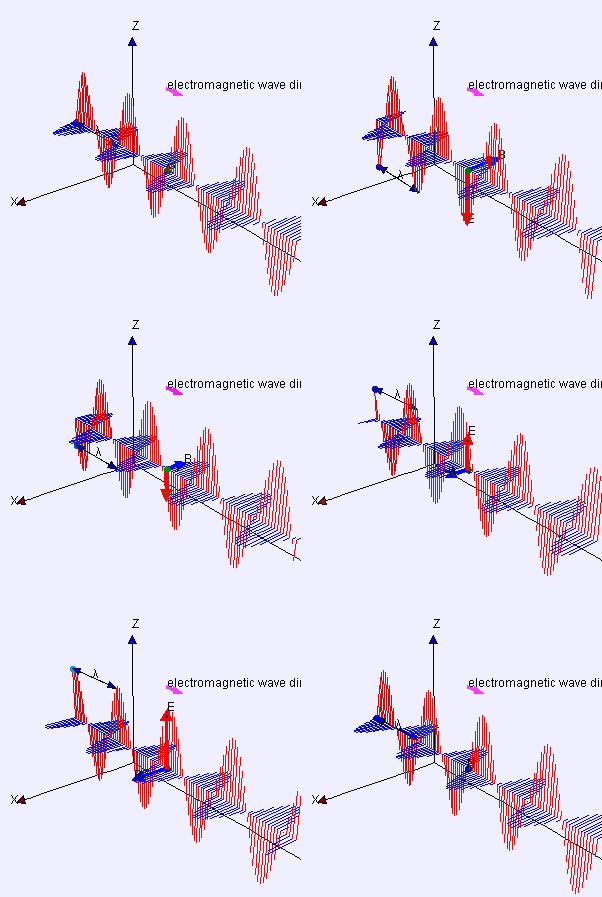

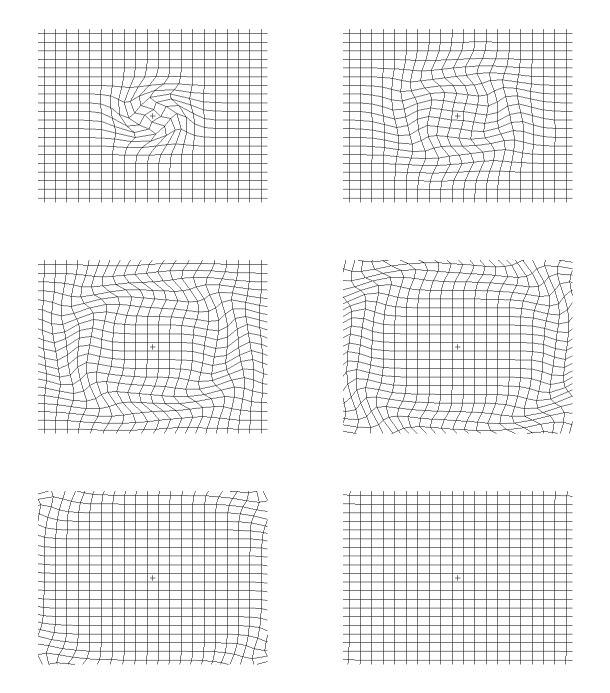
Characteristics
Several general properties describe transverse waves. The amplitude measures the maximum displacement from equilibrium, wavelength is the distance between repeating points, and frequency counts oscillations per unit time. Wave speed, frequency, and wavelength are related by the common relation v = fλ. Transverse waves allow distinctive behaviors such as polarization, which arises because oscillations have a direction perpendicular to travel and can be oriented in particular planes.
- Particle displacement: perpendicular to propagation direction.
- Supports polarization: orientation of oscillation is observable.
- Found in both mechanical media (strings, surfaces) and fields (light).
- Characterized by amplitude, wavelength, frequency, period, and speed.
- Can transfer energy without transporting matter over long distances.
Historically, the study of transverse motion dates to investigations of vibrating strings and optics. Experiments with ropes and slinkies made the perpendicular motion apparent, while later work in electromagnetism revealed that visible light and other transverse field waves travel through empty space. In seismology, transverse motion appears in S-waves, which move the ground at right angles to the wavefront and provide information about Earth's interior.
Common examples include waves on a stretched string or rope, ripples on a surface where particle paths are partly transverse, electromagnetic waves such as light and radio waves, and shear waves in solids. Laboratory demonstrations often use a plucked string or a ripple tank; for classroom resources and demonstrations see related materials.
Distinguishing transverse waves from longitudinal waves is important: longitudinal waves feature particle motion parallel to propagation and cannot be polarized in the same way. Understanding transverse wave behavior is central to optics, materials testing, seismology, and many engineering applications where directionality and polarization affect performance and measurement.
Related articles
Author
AlegsaOnline.com Transverse wave Leandro Alegsa
URL: https://en.alegsaonline.com/art/101211