
Turbulence (fluid dynamics) — chaotic motion in fluids
Turbulence is the complex, irregular motion of fluids characterized by vortices, energy cascades and strong mixing. It contrasts with laminar flow and affects weather, engineering, mixing and transport processes.
Overview
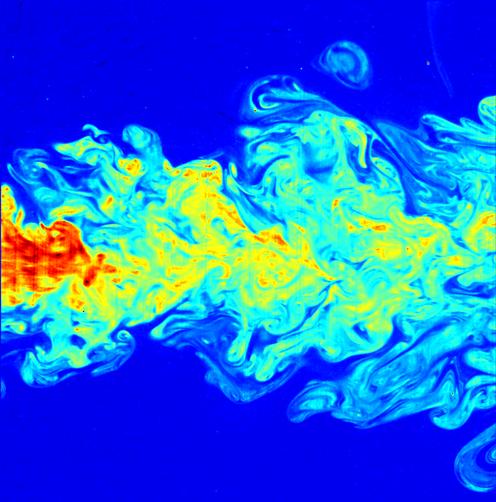
Turbulence is a state of fluid motion marked by irregular, three-dimensional, and time-dependent fluctuations in velocity and pressure. Unlike smooth laminar flow, turbulent flow contains a wide range of interacting eddies and vortices that produce rapid mixing and increased momentum and heat transfer. The transition to turbulence is commonly associated with a dimensionless parameter called the Reynolds number; higher values tend to favor turbulence.
Image gallery
4 Images


Characteristics and mechanisms
Turbulent flows display several recognizable features: strong fluctuations, a broad spectrum of eddy sizes, and enhanced transport of mass, momentum and energy. Energy introduced at large scales cascades to smaller scales until it is dissipated by viscosity at the smallest scales. This process, often described as the energy cascade, was formalized in statistical theories by researchers such as Kolmogorov.
History and scientific study
Systematic investigation of turbulence began in the 19th century with experiments and observations that distinguished smooth from chaotic flows; the name Reynolds is commonly associated with early work on flow transition. In the 20th century, theoretical and statistical frameworks were developed to describe average properties and spectra of turbulent motion. Modern study uses laboratory experiments, direct numerical simulation (DNS), large-eddy simulation (LES) and averaged models (RANS) to approach different scales.
Practical importance and examples
Turbulence occurs in natural and engineered settings: atmospheric weather systems, ocean currents, river flows, combustion in engines, blood flow in arteries and airflow over aircraft wings. Its tendency to mix and transport makes it crucial for pollutant dispersion, heat exchange and chemical reactions, but it also increases drag and can cause structural vibration.
Distinctions and modeling challenges
While laminar flow remains orderly and predictable, turbulent flow is chaotic and sensitive to initial conditions, so exact prediction of instantaneous motion is typically impossible beyond short timescales; instead, statistical descriptions are used. Engineers and scientists use simplified models and computational methods to estimate mean forces, rates of mixing, and probable extremes. Ongoing research aims to improve turbulence modeling and control to reduce energy losses or enhance mixing.
- fundamental descriptions — definitions and theory
- applications — where turbulence matters in nature and technology
- modeling approaches — numerical and experimental techniques
Related articles
Author
AlegsaOnline.com Turbulence (fluid dynamics) — chaotic motion in fluids Leandro Alegsa
URL: https://en.alegsaonline.com/art/102065