
Two-body problem (classical mechanics)
The two-body problem describes motion of two masses interacting under mutual forces. It reduces to a one-body problem in relative coordinates and has exact solutions for central inverse-square forces (Kepler problem).
The two-body problem is a fundamental question in classical mechanics: how two bodies move under their mutual interaction. In the simplest idealization each object is treated as a point mass or as rigid spheres, interacting through a force that depends only on their separation. Typical forces include Newtonian gravity and the Coulomb force; in many cases the two masses orbit each other or scatter and then separate.
Image gallery
2 Images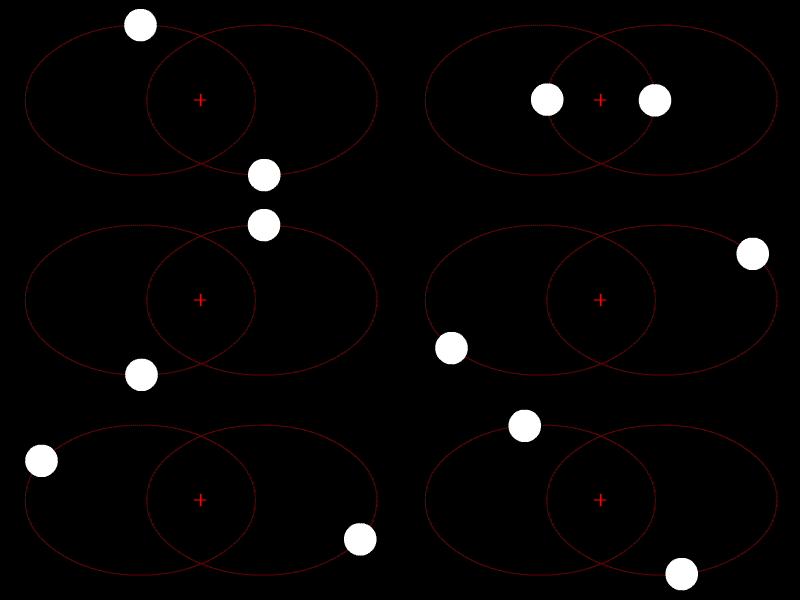

Mathematical reduction and key properties
Although the original formulation involves six degrees of freedom (three for each body), the problem simplifies dramatically. By separating the motion of the center of mass from the relative motion, one obtains an equivalent single‑body problem with a reduced mass. Conservation laws — total momentum, total angular momentum and energy — restrict the motion to a plane and reduce the problem to one spatial coordinate plus its conjugate momentum.
Types of trajectories and exact solutions
For the important case of an inverse‑square central force (the Kepler problem) the relative orbit is a conic section: circles, ellipses, parabolas or hyperbolas, depending on the energy and angular momentum. Bound systems follow elliptical paths and satisfy Kepler’s laws; unbound encounters follow parabolic or hyperbolic paths. Other central forces can be treated by quadrature, but only a few yield the simple closed orbits found in the inverse‑square or harmonic cases.
Conservation and classifications
- Conserved quantities: total linear momentum, total angular momentum, total energy.
- Common orbit types: circular (special case), elliptical (bound), parabolic/hyperbolic (scattering).
History, uses and generalizations
The two‑body model underpinned Newton’s explanation of planetary motion and was central to the development of celestial mechanics. Practically, it describes satellites around planets, binary stars, and the hydrogen atom in nonrelativistic quantum mechanics (using reduced mass). When more than two bodies interact, no general closed‑form solution exists and one must use numerical methods; similarly, in general relativity the two‑body problem is more complex and typically treated approximately.
Distinctions and notable facts
The two‑body problem is integrable for central forces and is often taught as the gateway to the n‑body problem. Idealizations may treat bodies as rigid circles in two dimensions or as spheres in three, but the essential mathematics relies on the symmetry of the force. For deeper analytical methods and modern treatments see resources on higher-level mathematics and computational celestial mechanics.
Related articles
Author
AlegsaOnline.com Two-body problem (classical mechanics) Leandro Alegsa
URL: https://en.alegsaonline.com/art/102276