
Oscillation
Repetitive back-and-forth or cyclical motion seen in physical, biological, and engineered systems; characterized by amplitude, frequency, phase and affected by damping and forcing.
Overview
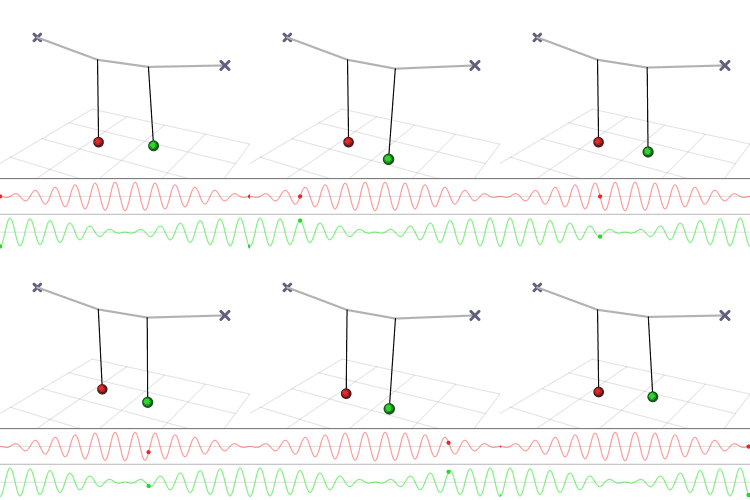
Oscillation refers to any motion or signal that repeats regularly in time around an equilibrium position. In everyday language it often means a back-and-forth movement, but oscillations also include cyclic changes in voltage, population numbers, or biological rhythms. Key quantitative features are amplitude (size of the variation), period and its inverse the frequency (how fast it repeats), and phase (the position within a cycle).
Image gallery
3 Images

Characteristics and basic models
Many simple oscillators follow Hooke's law or its analogues: a restoring tendency proportional to displacement produces simple harmonic motion. Energy alternates between forms (for example kinetic and potential energy in a mass on a spring). Real systems usually experience damping, which reduces amplitude over time unless energy is supplied. When an external periodic force acts on an oscillator, resonance can occur if the driving frequency is near the system's natural frequency, greatly amplifying the response.
Types and examples
- Mechanical: pendulums, vibrating strings, beams and vehicle suspension systems.
- Electrical: LC circuits, alternating current and electronic oscillators used in clocks and radios.
- Biological and ecological: heart rhythms, circadian cycles, predator–prey population cycles.
- Nonlinear and chaotic: coupled oscillators, limit cycles, and systems that display complex, non-repeating behavior.
History and development
Observations of oscillatory motion date back to antiquity, but quantitative analysis advanced with studies of pendulums and springs in the 16th–18th centuries. Scientists formulated the mathematical harmonic oscillator as a fundamental model. Later work extended these ideas to electrical circuits and to nonlinear dynamics, giving rise to modern fields such as signal processing and the study of chaos.
Applications and important distinctions
Understanding oscillation is central to timekeeping, communications, engineering design, and medicine. Distinctions to note: free versus driven oscillations, linear versus nonlinear behavior, and periodic versus quasi-periodic or chaotic dynamics. Poorly controlled resonant oscillations can damage structures, while controlled oscillations enable technologies like radio transmitters and medical diagnostic devices. For introductory resources and further context see further reading.
Related articles
Author
AlegsaOnline.com Oscillation Leandro Alegsa
URL: https://en.alegsaonline.com/art/73359