
Tiananmen Square, Beijing: overview, history, and significance
Tiananmen Square is a vast public plaza at the heart of Beijing, named for the Gate of Heavenly Peace. It is notable for national ceremonies, surrounding institutions, and major events in modern Chinese history.
Overview
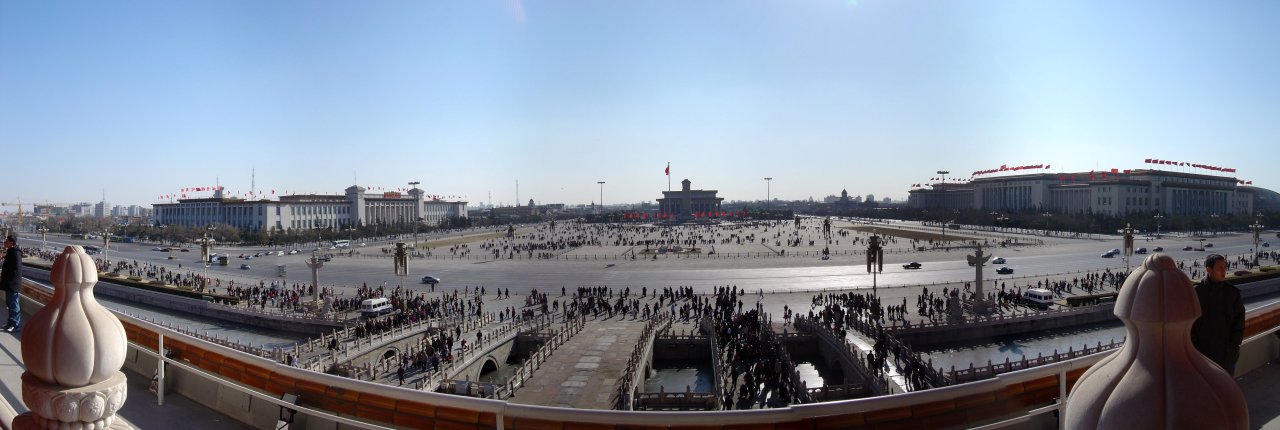
Tian'anmen Square is a large central plaza in Beijing often cited as one of the world's largest urban squares. Its English name references the adjacent gate, the Tian'anmen (Gate of Heavenly Peace), which faces the square on its northern edge. The site lies on Beijing's historic central axis and is closely associated with national ceremonies and civic life in Beijing. Coordinates commonly given for the site are linked as 39.90333°N 116.39167°E.
Image gallery
10 Images


Location and dimensions
The open area measures roughly 880 metres from south to north and 500 metres from east to west, for an overall area widely reported as approximately 440,000 square metres; these basic measurements are summarized in many reference descriptions (dimensions and area). The square is an intentionally open and formal space that connects several official buildings and cultural institutions.
Surrounding landmarks
Tian'anmen Square is framed by several prominent structures: to the north stands the gate with a large portrait of Mao Zedong; to the west is the Great Hall of the People, used for legislative and diplomatic functions; to the east sits the National Museum of China; and the Forbidden City lies immediately beyond the gate. Visitors and readers can find general descriptions of the plaza as a public plaza and civic forecourt in many guide resources.
Historical development
The area now forming the square evolved from imperial forecourts associated with the nearby ceremonial axis into a modern civic space during the 20th century. After major changes in layout and use during the Republican and early People's Republic periods, the plaza took on its current role as a site for national ceremonies and large public gatherings. The proclamation of the People's Republic of China in 1949 was announced from the gate to the north, an event frequently mentioned in historical summaries of the site.
Events, ceremonies and public use
The square is a focal point for official national events, including flag-raising ceremonies every day at dawn, ribbon-cutting and parade assemblies on National Day, and state visits that use the Great Hall and surrounding spaces. It is both an institutional setting for managed ceremonies and, at times, a gathering place for citizens and visitors. General visitor information and access notes are available from municipal and cultural sources (Tian'anmen Square).
1989 protests and subsequent significance
Outside China the square is widely known for the large-scale demonstrations of the spring of 1989. Those events drew international attention and remain a significant reference point in discussions of contemporary Chinese history. Descriptions of those events appear in many histories and analyses of late 20th-century China; writers often treat the subject with care given its historical sensitivity and differing perspectives.
Monuments and architecture
Prominent monuments within the square include the Monument to the People's Heroes, a tall cenotaph commemorating revolutionary struggles, and the mausoleum of Mao Zedong located near the center. The design of the plaza emphasizes broad open sightlines and axial relationships with the surrounding buildings used for state and cultural functions.
Visiting and conservation
Tian'anmen Square remains a major destination for domestic and international visitors. Access rules, security procedures, opening hours for museums and adjacent facilities, and guided-tour options are provided by official sources and visitor centers. Conservation and maintenance of monuments and paved surfaces are ongoing municipal responsibilities, reflecting the square's role as both a historic site and an active element of the city's public realm (China).
Cultural and civic importance
- The square functions as a ceremonial heart for state events and public rituals.
- It connects imperial, republican and modern layers of Beijing's urban history and planning.
- It remains a symbolically powerful public space in discussions of national identity, memory, and civic life (coordinates).
For readers seeking overviews, reference works and museum publications provide accessible introductions; academic studies explore the square's role in urban design, political symbolism and modern Chinese history. General guides and official descriptions give practical visitor information and summaries of the site's principal monuments and institutions (Beijing, Forbidden City, Tian'anmen, plaza, dimensions, Tian'anmen Square overview, national context).
Related articles
Author
AlegsaOnline.com Tiananmen Square, Beijing: overview, history, and significance Leandro Alegsa
URL: https://en.alegsaonline.com/art/99755