
The General Theory of Employment, Interest, and Money (Keynes, 1936)
John Maynard Keynes's 1936 work reshaped macroeconomics by arguing that aggregate demand determines output and employment, introducing the multiplier, liquidity preference and the principle of effective demand.
The General Theory of Employment, Interest, and Money is the landmark book by John Maynard Keynes first published in 1936. Written during the upheaval of the Great Depression, the work challenged prevailing economic thought and laid the foundations of what later became modern macroeconomics. Rather than assuming markets automatically restore full employment, Keynes argued that aggregate demand — total spending in an economy — can remain insufficient and leave unemployment persistent.
Image gallery
1 Image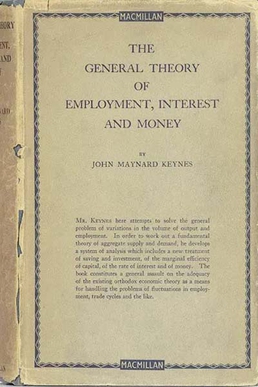
Key concepts introduced
- Consumption function — a concept describing how household consumption depends on income; Keynes used it to explain why increases in income do not translate one-for-one into spending. See consumption function for the idea.
- Multiplier — the notion that a change in investment or government spending produces a larger change in total income and output because initial spending induces additional rounds of consumption.
- Marginal efficiency of capital — a measure of expected returns on investment that helps determine whether firms will invest given the prevailing interest rate.
- Principle of effective demand — the claim that employment and output are set by the demand for goods and services, not by supply-side wage and price adjustments alone.
- Liquidity preference — Keynes's theory that the interest rate is determined by the supply and demand for money, reflecting people's preference to hold liquid assets; introduced as liquidity preference.
Historical context and reception
Published as a single volume intended to overturn classical approaches, the book triggered the so-called "Keynesian Revolution" by questioning the classical idea that economies naturally converge to full employment. Keynes wrote at a time when many countries were struggling with mass unemployment, and his prescriptions gave intellectual support to more active government involvement in stabilizing the economy. He directly critiqued key tenets of classical economics, especially the belief in self-correcting markets.
Applications, influence and debates
Keynes's ideas influenced policy in the mid-20th century, underpinning fiscal stimulus, deficit spending during downturns, and the expansion of public works as tools to boost demand. His work also inspired formal models (for example, the IS-LM framework) that translated his verbal arguments into schematic analysis. Over time Keynesian prescriptions met challenges — notably the 1970s stagflation that combined high unemployment with inflation — which led to refinements, criticisms from monetarists, and later synthesis efforts such as New Keynesian economics.
Notable facts and legacy
The book is notable for mixing theoretical innovation with policy urgency; it is less a mathematical treatise than a program for rethinking macroeconomic questions. While some technical aspects were later formalized and altered, the core insight — that insufficient aggregate demand can cause prolonged unemployment and that government policy can help — remains central to economic debate. For an introduction and further reading, consult standard histories of twentieth-century economic thought and modern treatments of macroeconomics.
Keynes's General Theory continues to be studied both for its historical importance and for the practical policy questions it raised: when should governments intervene, how large should fiscal responses be, and how do expectations and liquidity preferences shape interest rates and investment? These questions make the book enduringly relevant to students, policymakers, and scholars of economic policy.
For editions, scholarly commentary, and archival material related to the book and its author, see dedicated collections and bibliographies that compile Keynes's works and contemporary responses (book entry, author page).
Related articles
Author
AlegsaOnline.com The General Theory of Employment, Interest, and Money (Keynes, 1936) Leandro Alegsa
URL: https://en.alegsaonline.com/art/98043