
Three‑sector hypothesis: primary, secondary and tertiary sectors
Economic theory that divides activity into primary (extraction), secondary (manufacture) and tertiary (services), describing structural change as economies develop; introduced by Fisher, Clark and Fourastié.
Overview
The Three-sector hypothesis is a framework used to describe broad categories of economic activity and how their relative importance changes over time. It distinguishes among activities that extract or harvest natural resources, activities that transform those resources into goods, and activities that provide services. The model is often applied to long-run economic development, employment patterns and shifts in national income composition.
Image gallery
4 Images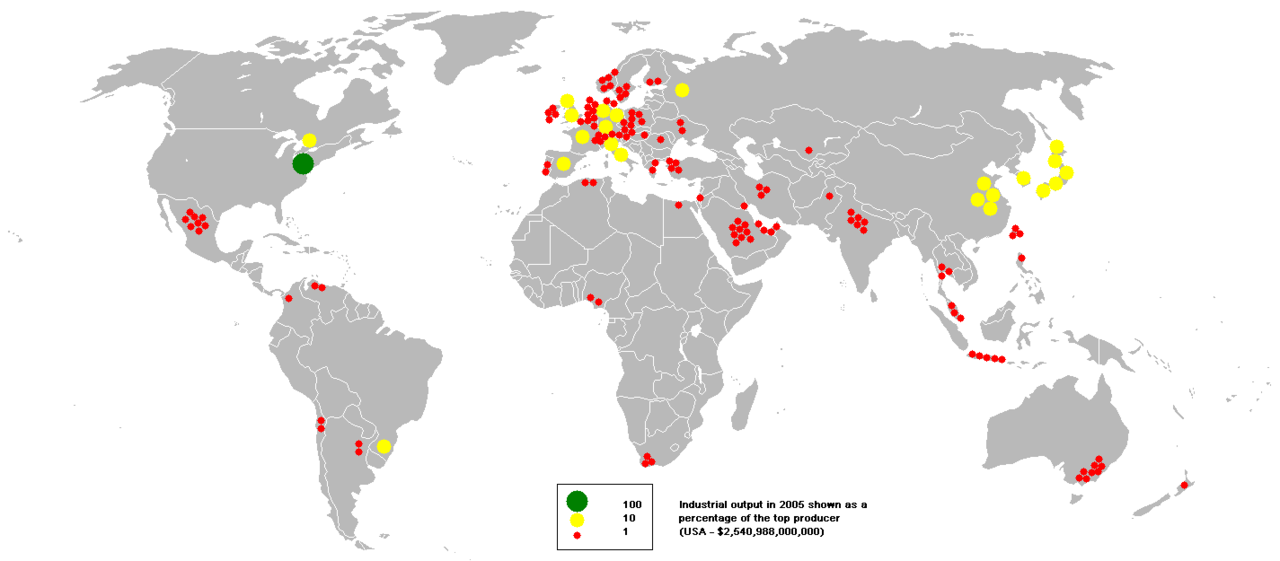


Components of the model
The hypothesis separates the economy into three principal sectors. Each has different technologies, skill mixes and economic roles:
- Primary sector: extraction and harvesting of natural resources such as agriculture, fishing, mining and forestry.
- Secondary sector: processing and manufacturing that convert raw materials into finished or semi-finished products. See examples under manufacturing goods.
- Tertiary sector: provision of services, including retail, transport, education, health and finance; often referred to as the service sector, discussed at providing services.
The three types are commonly grouped under the general term economic sector to distinguish them in statistics and policy discussions.
History and authorship
The concept emerged in the early 20th century and is associated with economists Alan Fisher, Colin Clark and Jean Fourastié. Colin Clark notably traced the idea back to earlier observations such as those attributed to Sir William Petty, a lineage that has sometimes led to the label "Petty's Law." For further reading on Clark's contribution see Colin Clark.
Economic implications and uses
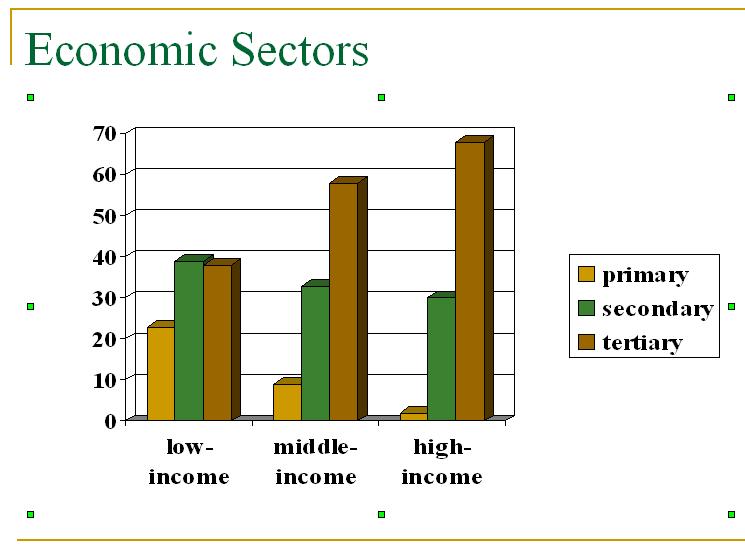
The model is used to describe "structural change": as societies industrialize, labor and output typically move from the primary to the secondary sector, and with further maturation toward the tertiary sector. This transition has practical implications for policy, education and investment decisions.
- It helps explain shifts in employment composition and wage structures.
- It frames industrial policy and the prioritization of infrastructure or social services.
- It provides a simple taxonomy for analyzing national accounts and comparative development.
Variations, limitations and criticism
Economists have extended the three-sector view to include a fourth (information and knowledge-based activities) and a fifth (high-level services such as government and top management), but such extensions are not universally adopted. Critics point out that the three-sector hypothesis simplifies complex economic relationships: modern services often embed manufacturing-like technologies, globalization fragments production across borders, and productivity dynamics vary by subsector. The model is best seen as a heuristic for structural patterns rather than a precise predictive law.
Notable facts and further context
Despite limitations, the three-sector hypothesis remains influential in economic history and development studies as a starting point for understanding how an economy evolves with technological change and changing consumer demand. It also guides comparative analysis of countries at different stages of development. For applied work, researchers combine this classification with detailed sectoral data to inform policy decisions and to interpret long-term employment and output trends.
Related articles
Author
AlegsaOnline.com Three‑sector hypothesis: primary, secondary and tertiary sectors Leandro Alegsa
URL: https://en.alegsaonline.com/art/99652