
The Emperor's New Clothes
A neutral overview of Hans Christian Andersen's tale: its plot, origins, themes of vanity and conformity, publication history, and cultural legacy including adaptations and idiomatic use.
"The Emperor's New Clothes" is a short literary fairy tale by the Danish writer Hans Christian Andersen. First published in 1837 as part of the same collection that included The Little Mermaid, the story has become one of Andersen's best known works. Its simple narrative — an emperor obsessed with fine clothing is tricked by two swindlers who claim to make a magnificent suit visible only to the competent and worthy — conceals several deeper themes: the dangers of pride, the fragility of authority, and the social pressure to conform.
Image gallery
5 Images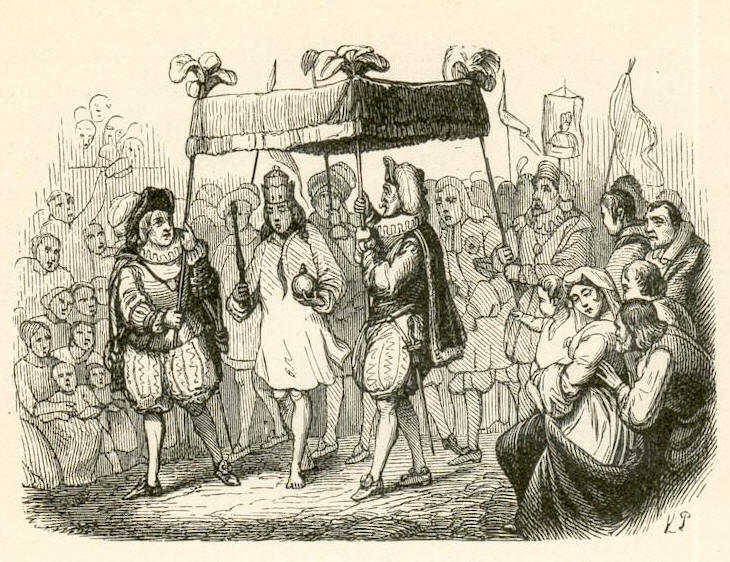


Story and themes
The tale follows an emperor who cares about little but his wardrobe. Two con artists promise a cloth that will be invisible to anyone who is unfit for their office or "hopelessly stupid." Officials and courtiers, fearful of appearing incompetent, pretend to see the non-existent fabric. The emperor, unwilling to admit he cannot see it, also plays along. When the swindlers mime dressing him, he parades through the streets in his imaginary garments. Only a child, unburdened by social pretense, blurts out that the emperor is naked. The crowd then admits the truth, yet the emperor continues the procession.
The story works on several levels. On the surface it is a moral fable about vanity and gullibility. More broadly it exposes how authority can be sustained by mutual deception: people uphold ostensible power rather than risk being judged inadequate. The child's cry functions as a metaphor for candid honesty and the possibility of social correction that comes from those not invested in maintaining appearances.
Origins and publication history
Andersen adapted the plot from older sources. A notable antecedent appears in the medieval Spanish book El Conde Lucanor (Book of Examples) by Juan Manuel, and other similar folk tales exist in various traditions. Andersen appears to have known the story through a German translation called "So ist der Lauf der Welt." He published his version on 7 April 1837 in Copenhagen, and while preparing the printed text he altered the ending: originally the court and populace were to continue admiring the non-existent clothes, but Andersen changed the climax to the spontaneous outcry of a child. He later explained that the change increased the tale's satirical force, emphasizing the power of an innocent voice to dispel collective self-deception.
Structure and notable elements
- Characters: the vain emperor, the persuasive swindlers, the anxious ministers, townspeople, and the forthright child.
- Motifs: invisible cloth as a test of worth, pretense maintained by fear of embarrassment, the child as truth-teller.
- Setting: an unspecified courtly realm, which helps make the satire general and portable across cultures.
Reception, adaptations, and cultural legacy
The tale has been widely adapted for stage, film, radio, and television and retold in children's collections and anthologies. Its central image — an authority figure parading naked while everyone pretends otherwise — has entered common discourse as an idiom used to point out hypocrisy, self-deception, or fashionable but empty ideas. Writers, cartoonists, politicians, and commentators frequently allude to the story when criticizing leaders, policies, or cultural fads.
In education and child development contexts the tale is often used to discuss critical thinking, courage, and peer pressure. It also serves as an introduction to satire and social commentary for younger readers, who can readily grasp its moral while older readers may appreciate its subtle critique of institutions and intellect.
Notable distinctions and facts
Unlike the earlier variants that focus on questions of lineage or legitimacy, Andersen shifted emphasis to courtly vanity and intellectual pretension, making the story a sharper satire of social manners and the fear of being judged incompetent. Today the title and image of "The Emperor's New Clothes" survive as a shorthand for any situation in which obvious truth is suppressed by collective delusion.
For further reading on Andersen's life and works see biographies and critical studies of Hans Christian Andersen. Collections that include the tale often pair it with other 19th-century fairy stories such as The Little Mermaid. The tale also belongs to a wider family of folk narratives that share motifs with fables traced to authors such as Aesop and medieval exempla; its central royal figure is sometimes generically referred to as the Emperor in discussions of the story's symbolism and adaptations.
Related articles
Author
AlegsaOnline.com The Emperor's New Clothes Leandro Alegsa
URL: https://en.alegsaonline.com/art/97915