
Aesop: Legendary Fabulist of Ancient Greece and the Tradition of Fables
Aesop is the traditional name attached to a corpus of moral tales known as Aesop's Fables. His life is uncertain, but the short animal stories attributed to him have shaped literature, education, and popular culture.
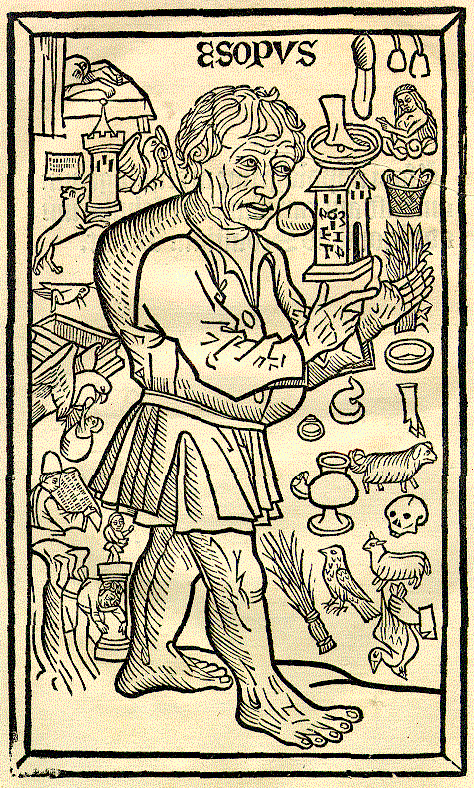
Aesop (Greek: Αἴσωπος) is the conventional name given to the figure associated with a large body of short moral tales known as Aesop's Fables. Traditionally described as a slave of possible African origin who lived in Ancient Greece during the early first millennium BCE, Aesop's historicity remains debated. No writings by him survive and the stories attributed to him were transmitted orally and later collected in many languages and forms.
Image gallery
10 Images




Overview and characteristics
The works linked to Aesop are typically short narratives that use animals, plants, objects or forces of nature endowed with human traits to dramatize ethical or practical lessons. These tales are concise, often ending with an explicit moral or an implied lesson, and they employ irony, reversal and concrete situations to make general points about conduct, prudence, justice, and folly. Typical features include anthropomorphism, a memorable opening or setup, a single striking conflict, and a pithy conclusion that lends itself to teaching and memorization.
Life, historical claims and authorship
Accounts of Aesop's life come from later ancient biographers and are inconsistent. Tradition places him roughly in the 6th–7th centuries BCE and describes a rise from slavery to freedom and an eventual violent death at the hands of the Delphians in some versions. Modern scholars treat these narratives cautiously: while a single historical person may have inspired the tales, many fables derive from widespread oral traditions and have been reshaped by successive storytellers and collectors. Major collections were later associated with authors and compilers such as Phaedrus and Babrius, and various medieval and modern anthologies helped fix particular versions.
Well-known fables and examples
- The Tortoise and the Hare (tortoise and hare): a parable about steady effort outrunning overconfidence and distraction.
- The Lion and the Mouse: a small animal repays a larger one’s mercy, illustrating reciprocity and humility.
- The Fox and the Grapes: a rationalization story that gave rise to the phrase "sour grapes."
These and other short fables are notable for packing a clear situation and ethical observation into a few lines, making them especially suited for oral delivery, schooling, and adaptation.
Transmission, adaptation and cultural impact
Aesop's tales have been translated, adapted, and illustrated across millennia. From classical Greek and Latin versifiers to medieval florilegia, Renaissance collections, and modern retellings, the fables have circulated in prose and verse. They have influenced literature, theater, political satire, and visual arts, and continue to appear in children's books, school curricula, cartoons and popular media (children's plays and cartoons). Collections were compiled and standardized at various times, but regional and cultural variants preserve many different versions.
Uses, legacy and notable distinctions
Educators use Aesop's Fables to teach language, moral reasoning and rhetorical forms. Because the tales are concise and memorable, they serve as parables for ethical discussion and as tools for developing reading comprehension and critical thinking. The label "Aesopic" has also been used more broadly to describe fable-like aphorisms or allegories.
Important distinctions to keep in mind: the name "Aesop" functions both as a traditional authorial attribution and as a convenient label for a body of anonymous folk material. While some individual fables may preserve ancient kernels, many evolved in transmission and were reshaped by collectors, translators and performers. For those seeking primary texts or scholarly discussion, annotated collections and academic studies trace the manuscripts, variants and reception history across cultures.
For further reading and to explore texts and commentaries, consult modern collections and critical introductions that assemble variant versions and discuss the problems of authorship and transmission in depth. Aesop's legacy endures not only in particular stories but in the wider practice of using compact, illustrative tales to convey moral and practical wisdom.
Greek name • Fables overview • Background on origins • Ancient Greek context • Modern adaptations • Accounts of death • Tortoise and Hare • Hare in tradition
Questions and answers
Q: Who was Aesop?
A: Aesop was a slave of African descent who lived in Ancient Greece from about 620 BC to 560 BC, known for his fables.
Q: What are Aesop's Fables?
A: Aesop's Fables are stories that use animals and inanimate objects with human characteristics to teach moral lessons.
Q: Were all of Aesop's fables written by him?
A: No, none of Aesop's fables have been verified as written by him. It is unclear whether he wrote any or simply collected them.
Q: What is Aesop's most famous fable?
A: Aesop's most famous fable is The Tortoise and the Hare, a parable about perseverance and determination.
Q: How have Aesop's Fables been used throughout history?
A: Aesop's Fables have been used as moral lessons and as subjects for entertainment, especially in children's plays and cartoons.
Q: Did Aesop's writings survive to present day?
A: No, none of Aesop's writings have survived to present day.
Q: What is the tradition surrounding Aesop's life and death?
A: The tradition is that Aesop was a slave who was eventually freed, but that he died at the hands of Delphians. However, there is doubt about his life and some have even denied his existence altogether.
Related articles
Author
AlegsaOnline.com Aesop: Legendary Fabulist of Ancient Greece and the Tradition of Fables Leandro Alegsa
URL: https://en.alegsaonline.com/art/1193
Sources
- bartleby.com : Caxton's famous Epilogue
- etext.library.adelaide.edu.au : i. A short history of the Aesopic fable
- ccat.sas.upenn.edu : Bryn Mawr Classical Review, with Aesop bibliography