
The Facts in the Case of M. Valdemar — Edgar Allan Poe's mesmeric tale
A concise encyclopedia article on Edgar Allan Poe's 1845 short story 'The Facts in the Case of M. Valdemar': plot, themes, publication context, and later influence in horror and media.
Overview
"The Facts in the Case of M. Valdemar" is a short story by Edgar Allan Poe first published in 1845. Presented as a clinical report, the tale recounts an experiment in mesmerism performed on a man at the point of death. Poe frames the narrative with a detached, ostensibly factual tone that heightens the story's unsettling atmosphere. For a reading of the text, see the story, and for context on its author, see Edgar Allan Poe.
Image gallery
3 Images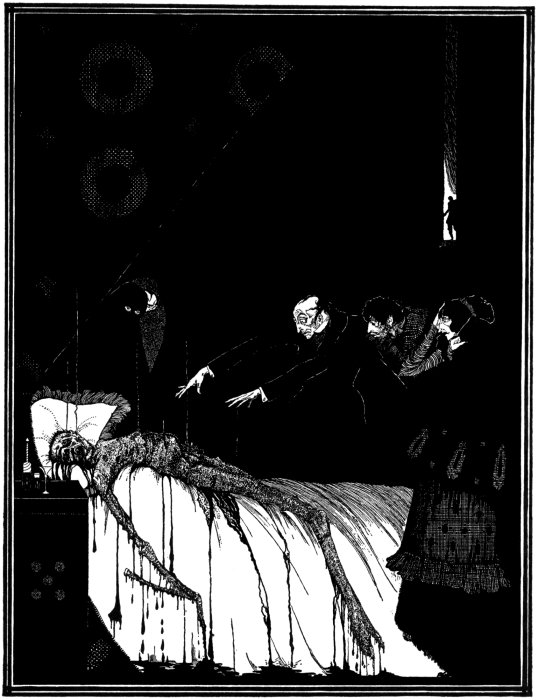


Plot and narrative style
The narrator describes placing M. Valdemar into a mesmeric trance as he lies dying. While under mesmerism Valdemar appears suspended between life and death: he speaks and responds to questions despite having no pulse or other signs of vital activity. When the narrator finally interrupts the trance, Valdemar's body rapidly collapses into a horrifying, liquefied state. Poe's use of a first-person, quasi-scientific voice turns a supernatural event into something presented as empirical observation, leaving readers to weigh whether the account is literal, exaggerated, or allegorical.
Characteristics and themes
- Mesmerism and pseudo-science: The story engages with contemporary interest in mesmerism and medical spectacle, reflecting 19th-century debates about the boundaries of science.
- Death and decay: Poe emphasizes the physical disintegration of the body, using graphic detail to provoke horror and philosophical unease.
- Unreliable framing: By adopting the language of clinical observation, the tale plays with credibility and the reader's trust.
Inspiration and publication
Poe reportedly drew inspiration from accounts of mesmerized patients and from a description of an operation performed upon a mesmerized subject; one such account is mentioned in discussions of the story and appears in contemporaneous sources describing mesmerism. The combination of medical rhetoric and gothic sensationalism fits within Poe's broader interest in physiology, psychology, and the macabre.
Reception, adaptations, and legacy
At the time of publication and afterward the tale attracted attention for its shocking imagery and apparent clinical precision. Critics and readers debated how realistic the account seemed and whether Poe had drawn on medical texts to achieve his effects. The story has influenced later horror writers and has been adapted for radio and film, often emphasizing its dramatic climax and grotesque detail. Its fusion of scientific framing with supernatural suggestion remains a notable example of Poe's ability to unsettle by blurring the limits of reason and terror.
Questions and answers
Q: What is "The Facts in the Case of M. Valdemar"?
A: "The Facts in the Case of M. Valdemar" is a short story written by Edgar Allan Poe and first published in 1845.
Q: What happens to the main character in the story?
A: The main character, M. Valdemar, is a dying, mesmerized man whose body disintegrates once the trance is lifted.
Q: What inspired Edgar Allan Poe to write the tale?
A: Poe was inspired to write the tale after reading a description of an operation performed upon a mesmerized patient.
Q: What is the tone of the story?
A: The story has a great deal of gore and is quite dark and eerie.
Q: What is the significance of the medical aspect of the story?
A: The speculation is that Poe had studied medical texts, which adds to the authenticity of the medical aspects of the story.
Q: Has "Valdemar" been adapted into other forms of media?
A: Yes, "Valdemar" has been adapted into movies and radio drama.
Q: When was "The Facts in the Case of M. Valdemar" first published?
A: "The Facts in the Case of M. Valdemar" was first published in 1845.
Related articles
Author
AlegsaOnline.com The Facts in the Case of M. Valdemar — Edgar Allan Poe's mesmeric tale Leandro Alegsa
URL: https://en.alegsaonline.com/art/97944