
Beethoven: Symphony No. 3 in E-flat major, Op. 55 (Eroica)
Symphony No. 3 in E-flat major, Op. 55, Beethoven's 'Eroica' (completed 1804) enlarged the symphony's length, form and emotional range; originally inscribed for Napoleon and premiered in 1805.
Overview
The Symphony No. 3 in E-flat major, Op. 55, commonly called the Eroica ("Heroic"), is one of Ludwig van Beethoven's best-known orchestral works. Composed in the early 1800s and completed in 1804, it marks a decisive expansion of the symphony's expressive and structural possibilities. Scored for a Classical orchestra enlarged in scope and used with new dramatic intensity, the work stands at the beginning of Beethoven's so-called middle period and is frequently cited as a turning point in Western art music. For a general reference to the orchestral forces used, see orchestral score and instrumentation.
Image gallery
4 Images


Structure and notable features
The symphony has four movements and is notable for its length, formal innovations, and emotional contrasts. The first movement opens with a bold theme and expansive development; the second movement is a solemn funeral march; the third is a lively scherzo; and the finale consists of a set of energetic variations on a principal theme. Critics and musicians point to the work's extended development sections, unexpected harmonic turns, and the prominence given to motifs that unify the work as features that influenced later composers. A concise listing of the movements is below; further analysis and scores are available at movement references.
- Allegro con brio — sonata form, E-flat major
- Marcia funebre: Adagio assai — funeral march, C minor
- Scherzo: Allegro vivace — with trio, E-flat major
- Finale: Allegro molto — theme and variations, E-flat major
History and dedication
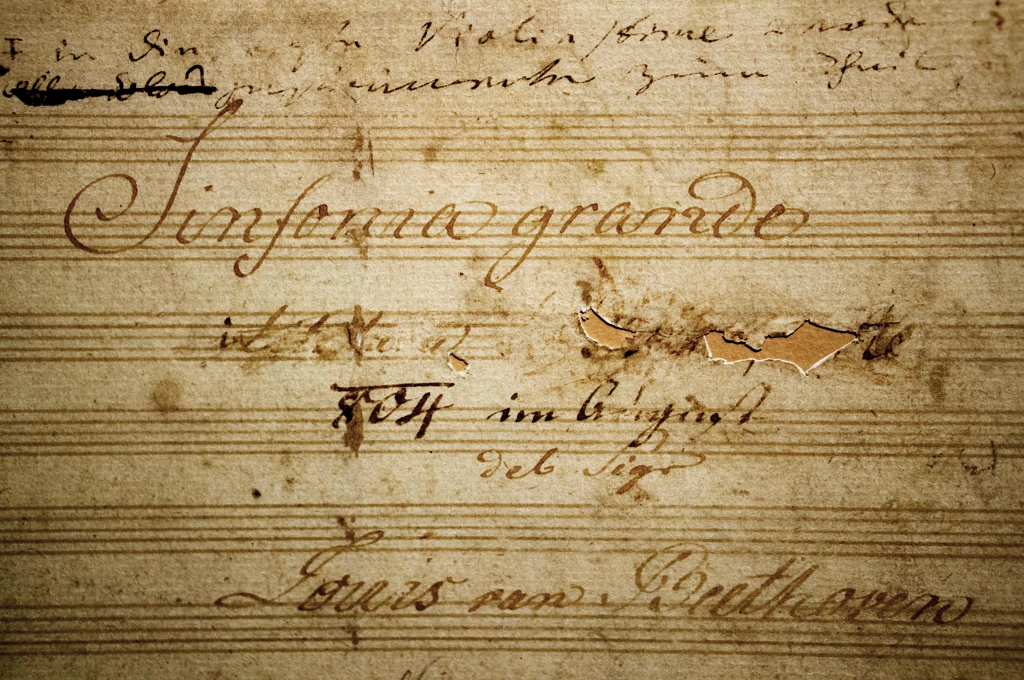
Beethoven began sketching ideas around 1803 and completed the symphony in 1804; it was first performed on 7 April 1805 at the Theater an der Wien. He initially intended to dedicate the work to Napoleon Bonaparte, whom he admired for revolutionary ideals, and at one point inscribed a dedication. When Napoleon declared himself emperor, Beethoven famously removed the dedication in anger and the composer later allowed the work to be published with the subtitle Eroica in 1806. The episode is part of the work's dramatic backstory and is discussed in many biographies and studies of Beethoven — see a general biography entry at Ludwig van Beethoven and a note on Napoleon at Napoleon Bonaparte. The question of the dedication and its removal is also discussed in sources on the topic of musical patronage and dedication practice (on dedications).
Reception and legacy
The Eroica initially surprised audiences and provoked mixed reactions because of its size and intensity, but it quickly became one of Beethoven's most influential works. Its experiments with form, motivic development, and emotional range helped set the course for the romantic symphonic tradition. Today it remains a central work in concert repertoires and a frequent subject of study for musicians, historians and listeners interested in the evolution of the symphony.
Related articles
Author
AlegsaOnline.com Beethoven: Symphony No. 3 in E-flat major, Op. 55 (Eroica) Leandro Alegsa
URL: https://en.alegsaonline.com/art/95638