
Sword Art Online — Japanese light novel and multimedia franchise
Sword Art Online is a Japanese light novel series by Reki Kawahara that spawned anime, manga, games and global popularity through stories about virtual-reality worlds and their social implications.
Sword Art Online is a Japanese light novel and multimedia franchise created by writer Reki Kawahara and illustrated by abec. The story began as an online serial before being professionally published in 2009 and has since expanded into animated television series, printed manga, video games and other licensed media. The original Japanese title is ソードアート・オンライン and the standard romanization is given as Sōdo Āto Onrain.
The central premise examines players who enter fully immersive virtual reality massively multiplayer online games. The earliest and best-known arc places characters in the titular Sword Art Online (SAO) game, where a malfunctioning interface traps thousands of participants and links in-game death to real-world mortality. The narrative focuses on Kazuto Kirigaya (commonly called Kirito), a skilled solo player, and his developing relationship with Asuna Yuuki, alongside a rotating cast of allies and antagonists across multiple virtual environments and time periods.
Image gallery
1 Image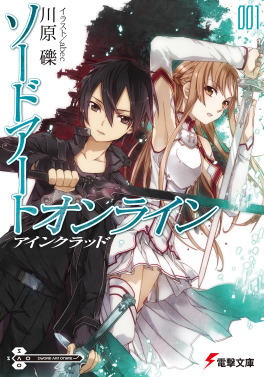
Format and publication
Sword Art Online originated as a web novel written and circulated by Kawahara. Following online popularity, the story was acquired and published by ASCII Media Works under the Dengeki Bunko imprint beginning in 2009 as a series of light novels illustrated by abec. The printed novels cover several distinct story arcs, often named after the game or setting they center on, and have been translated into multiple languages. The series achieved strong commercial success—Oricon reported it as a top-selling light novel series in 2012, and the novels have sold millions of copies in aggregate.
The success of the novels led to an animated adaptation produced by A-1 Pictures. The first televised season aired in Japan between July and December 2012; a second season titled Sword Art Online II followed in 2014; and the Alicization arc began airing in October 2018, later continuing with additional installments. The franchise's expansion includes manga adaptations, several console and mobile games, audio dramas, and stage events that reached international audiences. For details on the anime production and broadcast, see the televised anime series and related Japanese anime releases.
Themes, structure and reception
SAO combines action, romance and science-fiction themes to explore questions about identity, ethics in immersive technology, online social dynamics and the psychological effects of living within simulated realities. Its episodic structure moves characters between distinct virtual settings—each with their own rules and aesthetics—allowing the franchise to blend sword-and-sorcery motifs with modern military and legal dilemmas in later arcs.
Critical response has been mixed: many reviewers and fans praise the series for its imaginative concept, fast-paced action and emotional relationship arcs, while others have criticized aspects such as uneven pacing, treatment of secondary characters, and how certain sensitive subjects are handled. Regardless, SAO broadened mainstream awareness of light novels and helped popularize virtual-reality themes in 2010s anime and related media.
Adaptations and cultural impact
The franchise's media adaptations and commercial products are broad. Notable formats include:
- Anime: Multiple television seasons, compilation films and special episodes that adapt major novel arcs.
- Manga: Serialized comic adaptations that retell or expand particular storylines and character perspectives.
- Video games: Console and mobile titles that recreate virtual environments from the novels with original scenarios.
- Merchandise and events: Official soundtracks, collectibles, live concerts and stage productions.
As a cultural phenomenon, Sword Art Online influenced later stories about virtual reality and contributed to global interest in light novels as a transmedia source for animation and games. For readers and viewers new to the franchise, the original light novel volumes provide the canonical narrative sequence and are recommended for context before exploring adaptations and spin-offs.
While the franchise continues to release new material and inspire discussion about the future of immersive technology, its enduring presence in popular culture reflects both the appeal of high-concept speculative fiction and the commercial reach of serialized light novels adapted across multiple entertainment industries.
Related articles
Author
AlegsaOnline.com Sword Art Online — Japanese light novel and multimedia franchise Leandro Alegsa
URL: https://en.alegsaonline.com/art/95562
Sources
- animenewsnetwork.com : "Top-Selling Light Novels in Japan by Series: 2012"
- animenewsnetwork.com : "Sword Art Online Light Novels Have More Than 16.7 Million Copies in Print Worldwide"