
Swat (princely state): history, government and cultural legacy
Former princely state in what is now northern Pakistan. Overview of its origins, rulers, territory, Buddhist heritage, accession to Pakistan and eventual merger into Khyber Pakhtunkhwa.
Overview
Swat was a princely state in the northwestern Indian subcontinent that later became part of Pakistan. It occupied the Swat Valley and adjacent highlands and existed as a semi-autonomous polity under indirect British influence from the early 20th century until its formal dissolution in 1969. The state formally acceded to Pakistan at independence in 1947 and its territory now lies within the modern province of Khyber Pakhtunkhwa.
Image gallery
1 Image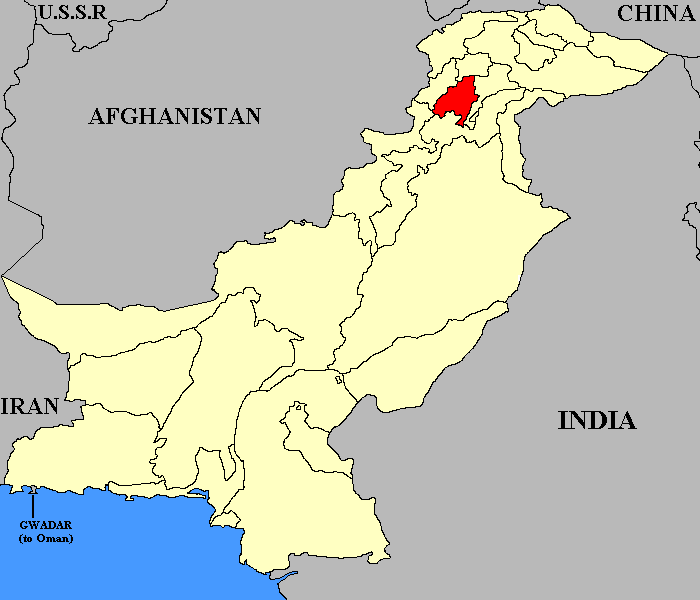
Origins and early history
The Swat Valley has a long history as a cultural crossroads. In pre-Islamic times it was an important centre of Buddhist Gandharan art and learning. In later centuries local chiefs and religious leaders administered the area under successive empires, including periods of Mughal suzerainty; historical accounts note influential local figures sometimes referred to by the honorific "Akhund" or similar titles. During the 19th and early 20th centuries regional consolidation and British frontier policies set the stage for a more formalized state structure.
Formation, rulers and governance
The modern princely state of Swat was organized in the 1920s and ruled by a line of hereditary leaders known as the Walis. Under this arrangement the Wali exercised internal authority while acknowledging external suzerainty of the British and later the Dominion of Pakistan. Notable leaders of the 20th century include Miangul Abdul Wadud, who helped establish centralized rule, and his successor Miangul Jahanzeb. The state's administration combined tribal customs with more formal institutions introduced in the 20th century.
Territory and administration
At the time of its abolition the state included the Swat Valley and surrounding areas that correspond to parts of present-day Swat, Buner and Shangla districts. It was administered from the valley towns and linked by routes over mountain passes to neighboring regions. The rulers maintained local law and order, tax collection and limited development projects while cooperating with British and later Pakistani authorities on external and defence matters.
Culture, archaeology and importance
Swat is noted for its archaeological remains from the Gandhara period, including stupas, monasteries and sculptural remains that attest to a flourishing Buddhist past. These sites contributed to the valley's reputation among scholars and visitors. The region’s Pashtun cultural traditions, tribal structures and Sufi-influenced religious life combined with the ancient heritage to form a distinctive regional identity.
Accession, dissolution and legacy
When British rule ended in 1947 the Wali of Swat chose to accede to the new state of Pakistan. Swat retained a degree of autonomy for two decades thereafter until the Pakistani government integrated the princely state into the provincial administrative framework in 1969. Today the former state's territory is fully part of Pakistan, and its historical sites, administrative records and local memory continue to shape regional politics and cultural preservation efforts.
For further reading on the political context and the colonial-era status of princely polities see general accounts of princely states in South Asia (princely state, British Raj) and regional histories of the Mughal period and frontier provinces (Mughal Empire, Khyber Pakhtunkhwa).
Related articles
Author
AlegsaOnline.com Swat (princely state): history, government and cultural legacy Leandro Alegsa
URL: https://en.alegsaonline.com/art/95439