
Surtur (Saturn XLVIII) — moon S/2006 S 7
Surtur (Saturn XLVIII, S/2006 S 7) is a small, irregular and likely captured retrograde moon of Saturn, discovered in 2006 and named after the fire giant Surtr of Norse mythology.
Overview
Surtur, designated Saturn XLVIII and provisionally S/2006 S 7, is one of Saturn's many small outer satellites. It was announced in 2006 and is classified among the irregular, retrograde moons that orbit far from the planet. With an estimated diameter of about six kilometres, Surtur is far too small to be spherical and is studied primarily through telescopic astrometry rather than direct imaging.
Image gallery
3 Images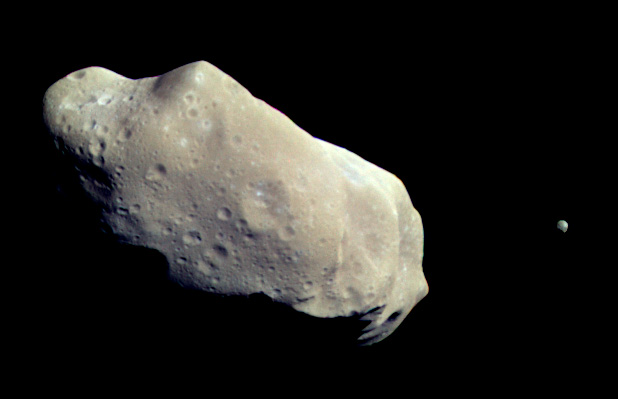


Discovery
The object was identified in observations made in 2006 and credited to a team that included Scott S. Sheppard, David C. Jewitt, Jan Kleyna and Brian G. Marsden. Detection of such faint, distant moons typically involves repeated imaging over weeks to months to confirm motion around Saturn and to derive orbital elements.
Orbital and physical characteristics
Surtur follows a distant, elongated and retrograde path around Saturn. Key orbital parameters include:
- Mean orbital distance: about 22,243,600 km from Saturn
- Orbital period: approximately 1,238.575 days
- Inclination: roughly 166.9° to the ecliptic (about 148.9° to Saturn's equator) — a strongly tilted, retrograde orientation (inclination)
- Eccentricity: about 0.3680 (eccentricity), indicating a noticeably elliptical orbit
- Estimated diameter: near 6 km, based on brightness and assumed surface reflectivity
Because of its size and distance, Surtur is expected to be a dark body composed of a mixture of rock and ice, similar to other irregular satellites, though direct compositional measurements are not available.
Origin, group and significance
Like many small, distant satellites of the giant planets, Surtur is considered an irregular satellite and is likely a captured object rather than having formed in place in Saturn's original circumplanetary disk. Its retrograde motion and orbital elements associate it with the so-called Norse group of Saturnian moons — a dynamical grouping of outer moons with similar inclinations and eccentricities. These bodies are of interest because they offer clues about the early dynamical history of the Saturn system and about capture and collisional processes in the outer Solar System.
Name and cultural reference
In April 2007 the moon received the official name Surtur, derived from Surtr (also spelled Surt), a leader of the fire giants in Norse mythology. The name reflects the convention of naming Saturn's retrograde irregular moons after figures from Norse myth; the formal naming and citation are recorded by astronomical naming authorities (Surtr naming).
Although small and faint, objects like Surtur contribute to the population statistics used to study satellite capture, fragmentation, and evolution. Continued observation refines their orbits and helps identify associations or collisional families among Saturn's many irregular satellites.
Related articles
Author
AlegsaOnline.com Surtur (Saturn XLVIII) — moon S/2006 S 7 Leandro Alegsa
URL: https://en.alegsaonline.com/art/95209
Sources
- ifa.hawaii.edu : Institute for Astronomy Saturn Satellite Data
- cfa-www.harvard.edu : IAUC 8727: Satellites of Saturn
- cfa-www.harvard.edu : MPEC 2006-M45: Eight New Satellites of Saturn
- cfa-www.harvard.edu : IAUC 8826: Satellites of Jupiter and Saturn